

Intro
Core Question of the sugya
What kinds of meal offerings (menachot) require hagashah (bringing near the altar), and how do we know?1
The sugya starts from Leviticus 2:8 and then builds outward by:
ribbuy2 from extra words in the verse
attempted kal va-homer3 / analogy
rebuttal by pircha4
rebuilt inference via tzad ha-shaveh5
final rescue by verse when the tzad ha-shaveh also gets attacked
Structure and Formula of the Sugya
Recurring formula:
The baraita uses a highly repetitive and formulaic dialectical template.6
It proceeds in recurring units:
Verse citation plus lemma. A word or phrase from the verse is isolated and assigned an inclusion: “X — to include Y.”
Challenge to the derivation. The text asks why a verse is needed at all: logically this should be derivable (ודין הוא)
Initial analogy or kal va-ḥomer. One offering is compared to another: “Just as A has hagashah, so too B.”
Pircha and counterproof chain. Each proposed proof is challenged by a distinguishing feature: “What is notable about A…? B can prove otherwise. What is notable about B…? A can prove otherwise.”
Formula of reset ( חזר הדין, לא ראי זה כראי זה, ולא ראי זה כראי זה): This marks the collapse of the simple comparison and transition to a common-denominator argument.
Tzad ha-shaveh construction: The baraita identifies a shared trait in two cases (הצד השוה שבהן), then extends it to the target case (אף אני אביא)
Final pircha on the tzad ha-shaveh. A further distinguishing trait blocks the inference.
Scriptural fallback: A verse is then needed after logic has failed (תלמוד לומר)
This whole sequence is repeated three times, with different offerings as the target case: minḥat ḥotei, minḥat sotah, and minḥat ha-omer.
So the recurring literary structure is (these are the step numbers that I use in the section headers in the main piece):
Verse-based derivation →
Attempt to replace it with logic, from single example →
Attempt to replace it with logic, from two separate examples, with pircha of each →
Tzad ha-shaveh →
Pircha of Tzad ha-shaveh →
Conclude: need verse-based derivation
What Counts as the Relevant Shared Feature?
The sugya keeps proposing:
if two offerings share kemitzah
and we know they share hagashah
then maybe any offering with kemitzah should get hagashah
But every time, the Talmud asks: Maybe the real cause is not kemitzah, but some more hidden cluster of traits:
oil/frankincense
tenufah
wheat vs barley
rich/poor eligibility
fine flour vs coarse flour
sin-clarification function
So the sugya is probing: What is the true legal driver of hagashah?
And its answer is: Pure logic (sevara) is unstable; textual inclusion is needed for some cases.
The overall Tannaitic dispute
R’ Shimon: verse needed for omer and sotah, each from a different word.
R’ Yehuda: verse needed for sotah; omer can be derived logically.
So both assume that these offerings need hagashah; they simply dispute the derivation: which extension can be sustained by logic and which requires explicit ribbuy.
Schema
Base verse teaches hagashah
extra words include more offerings
minchat chotei:
try derive from nedavah / sotah
fail
need verse
minchat sotah:
according to R’ Shimon, try derive from chotei / omer
fail
need verse
omer:
according to R’ Yehuda, derive from chotei / sotah
succeeds
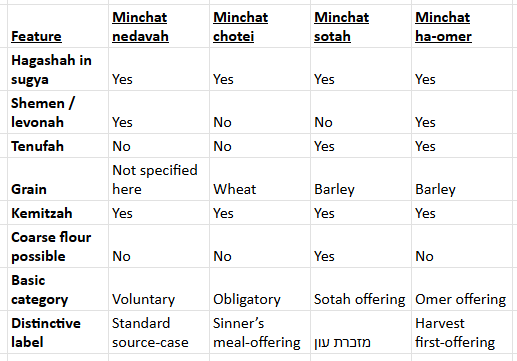
Table summarizing major features of meal offerings assumed in the sugya
Outline
Intro
Core Question of the sugya
Structure and Formula of the Sugya
What Counts as the Relevant Shared Feature?
The overall Tannaitic dispute
Schema
Table summarizing major features of meal offerings assumed in the sugya
The Passage
Which meal offerings require hagashah, and how do we know?- Leviticus 2:8
1 - Verse-based derivation - ‘מנחה’: the whole meal offering requires hagashah; ‘את המנחה’: includes sinner’s meal offering
2 - Attempt to replace it with logic, from single example: Can sinner’s meal offering be derived logically instead of from a verse? logically derive from a voluntary meal offering
3 - Attempt to replace it with logic, from two separate examples, with pircha of each: voluntary meal offering requires oil and frankincense; Counterproof: sotah’s meal offering doesn’t require oil and frankincense, yet has hagasha; Rebuttal: sotah’s meal offering requires waving; Counterproof: voluntary meal offering doesn’t require waving, yet has hagasha
4 - Tzad ha-shaveh: nedavah + sotah both have kemitzah and hagashah, So: minchat chotei, which has kemitzah, should also require hagashah
5 - Pircha of Tzad ha-shaveh: those cases are fit for rich/poor contexts; minchat chotei is not; Conclusion: logic fails; need verse ‘את המנחה’to include minchat chotei
6 - Conclude: need verse-based derivation
R’ Shimon
1 - Verse-based derivation: reassigns verse-words as inclusions; ‘והבאת’ includes minchat ha-omer; ‘והקריבה’ includes minchat sotah
2 - Attempt to replace it with logic, from single example - kal ve-chomer: Can minchat sotah be derived logically instead of from a verse?; Attempt B: kal va-homer from minchat chotei - chotei lacks tenufah yet has hagashah; sotah has tenufah, so all the more so
3 - Attempt to replace it with logic, from two separate examples, with pircha of each: chotei is wheat; sotah is barley; Counterproof: omer is also barley, yet has hagashah; Pircha: omer has oil and frankincense; Counterproof back: chotei lacks shemen u-levonah, yet has hagashah
4 - Tzad ha-shaveh: omer + chotei - both have kemitzah and hagashah; So: sotah, which has kemitzah,should also require hagashah
5 - Pircha on tzad ha-shaveh: those cases are not coarse flour; sotah can be coarse flour; Conclusion: logic fails, need verse ‘והקריבה’ to include minchat sotah
6 - Conclude: need verse-based derivation
R’ Yehuda
1 - Verse-based derivation: different verse assignment; ‘והבאת’ includes minchat sotah
2 - Attempt to replace it with logic - kal ve-chomer, from single example: Omer does not need a verse, can be derived logically - Attempt C: kal va-homer from minchat chotei - chotei lacks tenufah, yet has hagashah; omer has tenufah, so all the more so
3 - Attempt to replace it with logic, from two separate examples, with pircha of each: chotei is wheat; Counterproof: sotah is barley, yet has hagashah; Pircha: sotah is unique, it clarifies sin: ‘מזכרת עון’; Counterproof back: chotei does not clarify sin, yet has hagashah
4 - Tzad ha-shaveh: sotah + chotei both have kemitzah and hagashah; So: omer, which has kemitzah, also requires hagashah
The Passage
(In ChavrutAI, starts at Menachot 60a#11)
Which meal offerings require hagashah, and how do we know?- Leviticus 2:8
[...]
תנו רבנן:
אילו נאמר
״והבאת אשר יעשה מאלה לה׳
והקריבה אל הכהן
והגישה״,
הייתי אומר:
אין לי שטעון הגשה אלא קומץ בלבד.
[...]
A baraita states: A verse discussing the meal offering prepared in the pan states: “And you shall bring the meal offering that is made of these to YHWH, and it shall be drawn near to the priest, and he shall bring it near to the altar” (Leviticus 2:8).
If the verse had stated only:
“And you shall bring (הבאת) that which is made of these to YHWH
and it shall be drawn near (הקריבה) to the priest
and he shall bring it near (הגישה) to the altar”, omitting the words: “The meal offering”,
I would say:
I have derived only that the handful (קומץ) that is sacrificed on the altar alone requires bringing near (הגשה).
1 - Verse-based derivation - ‘מנחה’: the whole meal offering requires hagashah; ‘את המנחה’: includes sinner’s meal offering
מנחה, מנין?
תלמוד לומר:
״מנחה״.
From where is it derived that this halakha applies to the entire meal offering?
The verse states the superfluous term:
“The meal offering,”
which indicates that one must bring the entire meal offering to the altar prior to the removal of the handful.
מנחת חוטא מנין?
תלמוד לומר:
״את המנחה״.
The baraita further asks: From where is it derived that this halakha applies to the meal offering of a sinner?
The verse states:
“The meal offering.”
The addition of the definite article serves to include the meal offering of a sinner.
2 - Attempt to replace it with logic, from single example: Can sinner’s meal offering be derived logically instead of from a verse? logically derive from a voluntary meal offering
ודין הוא:
נאמר הבא
מנחת חובה,
ונאמר הבא
מנחת נדבה.
מה מנחת נדבה
טעונה הגשה –
אף מנחת חובה
טעונה הגשה!
The baraita raises a difficulty: Why is a verse necessary to teach that the requirement of bringing near applies to the meal offering of a sinner?
But this halakha is capable of being derived by logical inference.
The baraita elaborates:
The procedure of bringing a meal offering is stated here, in the context of the meal offering of a sinner,
which is an obligatory meal offering;
and it is stated there, with regard to the deep-pan meal offering,
which is a voluntary meal offering.
Just as a voluntary meal offering
requires bringing near,
so too an obligatory meal offering, such as the meal offering of a sinner,
requires bringing near.
3 - Attempt to replace it with logic, from two separate examples, with pircha of each: voluntary meal offering requires oil and frankincense; Counterproof: sotah’s meal offering doesn’t require oil and frankincense, yet has hagasha; Rebuttal: sotah’s meal offering requires waving; Counterproof: voluntary meal offering doesn’t require waving, yet has hagasha
מה למנחת נדבה,
שכן טעונה שמן ולבונה?
מנחת סוטה תוכיח
מה למנחת סוטה --
שכן טעונה תנופה?
מנחת נדבה תוכיח
וחזר הדין,
לא ראי זה כראי זה,
ולא ראי זה כראי זה.
The baraita rejects this inference:
What is notable about a voluntary meal offering?
It is notable in that it requires oil and frankincense upon it, rendering its halakha more stringent than that of the meal offering of a sinner, which does not include oil and frankincense. Therefore, it would be logical to suggest that a voluntary meal offering requires bringing near but the meal offering of a sinner does not.
The baraita responds: The meal offering brought by a sota, i.e., the meal offering of jealousy, can prove that this factor is not decisive, as it does not include oil and frankincense either, and yet it requires bringing near.
The baraita rejects this claim: One cannot derive the halakha of the meal offering of a sinner from the meal offering brought by a sota, as there is another requirement that applies to the meal offering brought by a sota but not to the meal offering of a sinner: What is notable about the meal offering brought by a sota?
It is notable in that it requires waving, whereas the meal offering of a sinner does not.
The baraita responds: The voluntary meal offering can prove that waving is not the decisive factor, as a voluntary meal offering does not require waving and yet it requires bringing near.
Therefore, the inference has reverted to its starting point,
as the aspect of this case is not like the aspect of that case
and the aspect of that case is not like the aspect of this case;
4 - Tzad ha-shaveh: nedavah + sotah both have kemitzah and hagashah, So: minchat chotei, which has kemitzah, should also require hagashah
הצד השוה שבהן
ששוו לקמיצה,
ושוו להגשה.
אף אני אביא מנחת חוטא
ששוה להן לקמיצה,
תשוה להן להגשה!
their common element is that
the voluntary meal offering and the meal offering brought by a sota are equal with regard to the requirement of the removal of a handful (קמיצה),
and similarly they are equal with regard to the requirement of bringing near.
I will also bring the additional case of the meal offering of a sinner,
which is equal to them with regard to the requirement of the removal of a handful,
and conclude that it should likewise be equal to them with regard to the requirement of bringing near.
5 - Pircha of Tzad ha-shaveh: those cases are fit for rich/poor contexts; minchat chotei is not; Conclusion: logic fails; need verse ‘את המנחה’to include minchat chotei
מה להצד השוה שבהן,
שכן הוכשרו לבא בעשיר כבעני,
תאמר במנחת חוטא
שלא הוכשרה לבא בעשיר כבעני?
The baraita rejects this suggestion:
What is notable about the common element of the voluntary meal offering and the meal offering brought by a sota?
It is notable in that they are suited to come as the meal offering of a wealthy person just as they are suited to come as the meal offering of a poor person.
Shall you say the same with regard to the meal offering of a sinner,
which is not suitable to come either as the meal offering of a wealthy person or as the meal offering of a poor person, since a sinner who is not poor does not bring a meal offering but a different offering (see Leviticus 5:6–11)?
6 - Conclude: need verse-based derivation
תלמוד לומר:
״את המנחה״.
Therefore, the verse states:
“The meal offering” (Leviticus 2:8),
with the addition of the definite article, to include the meal offering of a sinner in the requirement of bringing near.
R’ Shimon
1 - Verse-based derivation: reassigns verse-words as inclusions; ‘והבאת’ includes minchat ha-omer; ‘והקריבה’ includes minchat sotah
רבי שמעון אומר:
״והבאת״ –
לרבות מנחת העומר להגשה,
R’ Shimon adds to the logical inference and says that
other cases are included in the derivation from the verse, as the term “and you shall bring”
serves to include the omer meal offering in the requirement of bringing near to the altar;
וכן הוא אומר:
״והבאתם את עמר
ראשית קצירכם אל הכהן״,
and so the verse states with regard to the omer meal offering:
“Then you shall bring the omer,
the first of your harvest to the priest” (Leviticus 23:10).
״והקריבה״ –
לרבות מנחת סוטה להגשה,
וכן הוא אומר:
״והקריב אתה אל המזבח״.
Furthermore, “and it shall be drawn near”
serves to include the meal offering brought by a sota in the requirement of bringing near;
and so the verse states with regard to the meal offering brought by a sota:
“And draw it near to the altar” (Numbers 5:25).
2 - Attempt to replace it with logic, from single example - kal ve-chomer: Can minchat sotah be derived logically instead of from a verse?; Attempt B: kal va-homer from minchat chotei - chotei lacks tenufah yet has hagashah; sotah has tenufah, so all the more so
ודין הוא:
ומה מנחת חוטא,
שאינה טעונה תנופה –
טעונה הגשה,
מנחת סוטה,
שטעונה תנופה –
אינו דין שטעונה הגשה!
The baraita challenges:
But this halakha is capable of being derived a fortiori by logical inference:
And if the meal offering of a sinner,
which includes a lenient aspect, as it does not require waving,
nevertheless requires bringing near,
then with regard to the meal offering brought by a sota,
which does require waving,
is it not logical to conclude that it should require bringing near?
3 - Attempt to replace it with logic, from two separate examples, with pircha of each: chotei is wheat; sotah is barley; Counterproof: omer is also barley, yet has hagashah; Pircha: omer has oil and frankincense; Counterproof back: chotei lacks shemen u-levonah, yet has hagashah
מה למנחת חוטא,
שכן באה חיטין!
מנחת העומר תוכיח.
מה למנחת העומר,
שכן טעונה שמן ולבונה?
מנחת חוטא תוכיח.
וחזר הדין,
לא ראי זה כראי זה,
ולא ראי זה כראי זה.
The baraita rejects this logical inference, as there is a stringency that applies to the meal offering of a sinner which does not apply to the meal offering brought by a sota: What is notable about the meal offering of a sinner?
It is notable in that it comes from wheat, whereas the meal offering brought by a sota comes from barley, an inferior product.
The baraita responds: The omer meal offering can prove that this factor is not decisive, as it also comes from barley, and yet it requires bringing near. Therefore, the same should apply to the meal offering brought by a sota.
The baraita rejects this claim: What is notable about the omer meal offering?
It is notable in that it requires oil and frankincense, whereas the meal offering brought by a sota does not.
The baraita answers: The meal offering of a sinner can prove that the requirement of oil and frankincense is not a decisive factor, as the meal offering of a sinner does not require oil and frankincense and yet it requires bringing near.
Consequently, the inference has reverted to its starting point,
as the aspect of this case is not like the aspect of that case
and the aspect of that case is not like the aspect of this case;
4 - Tzad ha-shaveh: omer + chotei - both have kemitzah and hagashah; So: sotah, which has kemitzah,should also require hagashah
הצד השוה שבהן,
ששוו לקמיצה
ושוו להגשה,
אף אני אביא מנחת סוטה
ששוותה להן לקמיצה –
תשוה להן להגשה!
their common element is that
both the omer meal offering and the meal offering of a sinner are equal with regard to the requirement of the removal of a handful,
and they are equal with regard to the requirement of bringing near.
I will also bring the additional case of the meal offering brought by a sota,
which is equal to them with regard to the requirement of the removal of a handful,
and conclude that it should likewise be equal to them with regard to the requirement of bringing near.
5 - Pircha on tzad ha-shaveh: those cases are not coarse flour; sotah can be coarse flour; Conclusion: logic fails, need verse ‘והקריבה’ to include minchat sotah
מה להצד השוה שבהן,
שכן לא הוכשרו לבא קמח,
תאמר מנחת סוטה
שהוכשרה לבא קמח?
The baraita rejects this suggestion:
What is notable about the common element of the omer meal offering and the meal offering of a sinner?
It is notable in that they are both not suited to come as coarse flour, but only as fine flour.
Shall you say the same with regard to the meal offering brought by a sota,
which is suited to come as coarse flour?
6 - Conclude: need verse-based derivation
תלמוד לומר:
״והקריבה״.
Therefore, the verse states:
“And draw it near,”
which serves to include the meal offering brought by a sota in the requirement of bringing near.
R’ Yehuda
1 - Verse-based derivation: different verse assignment; ‘והבאת’ includes minchat sotah
רבי יהודה אומר:
״והבאת״ –
לרבות מנחת סוטה להגשה,
It was stated that R’ Shimon derives from the term “and you shall bring” (Leviticus 2:8), written in the context of the deep-pan meal offering, that the omer meal offering is included in the requirement of bringing near.
Conversely, R’ Yehuda says:
The term “and you shall bring”
serves to include the meal offering brought by a sota in the requirement of bringing near;
וכן הוא אומר:
״והביא את קרבנה עליה״.
and so the verse states with regard to the meal offering brought by a sota:
“Then the man shall bring his wife to the priest, and shall bring her offering for her, a 1/10th of an ephah of barley flour; he shall pour no oil upon it, nor give frankincense upon it, for it is a meal offering of jealousy, a meal offering of memorial, bringing iniquity to remembrance” (Numbers 5:15).
2 - Attempt to replace it with logic - kal ve-chomer, from single example: Omer does not need a verse, can be derived logically - Attempt C: kal va-homer from minchat chotei - chotei lacks tenufah, yet has hagashah; omer has tenufah, so all the more so
אבל מנחת העומר לא צריכא קרא,
מאי טעמא?
מדינא קא אתיא:
ומה מנחת חוטא
שאינה טעונה תנופה –
טעונה הגשה,
מנחת העומר
שטעונה תנופה –
אינו דין שטעונה הגשה!
But with regard to the omer meal offering, a verse is not needed to teach that it requires bringing near.
The baraita asks: What is the reason that no verse is needed for the omer meal offering?
It is because this halakha is derived a fortiori by logical inference:
And if the meal offering of a sinner,
which includes a lenient aspect, as it does not require waving,
nevertheless requires bringing near,
then with regard to the omer meal offering,
which includes a stringent aspect, as it does require waving,
is it not logical to conclude that it should require bringing near?
3 - Attempt to replace it with logic, from two separate examples, with pircha of each: chotei is wheat; Counterproof: sotah is barley, yet has hagashah; Pircha: sotah is unique, it clarifies sin: ‘מזכרת עון’; Counterproof back: chotei does not clarify sin, yet has hagashah
מה למנחת חוטא
שכן באה חיטין?
מנחת סוטה תוכיח.
מה למנחת סוטה
שכן באה לברר עון, ד״מזכרת עון״ היא!
מנחת חוטא תוכיח.
וחזר הדין,
לא ראי זה כראי זה,
ולא ראי זה כראי זה,
The baraita rejects this inference:
What is notable about the meal offering of a sinner?
It is notable in that it comes from wheat, whereas the omer meal offering comes from barley.
The baraita responds: The meal offering brought by a sota can prove that this factor is not decisive, as it comes from barley and yet it requires bringing near. The same should apply to the omer meal offering.
The baraita rejects this claim: What is notable about the meal offering brought by a sota?
It is notable in that it comes to clarify whether or not the wife committed the transgression of adultery, as it is described with the phrase: “Bringing iniquity to remembrance,” whereas the omer meal offering does not come to clarify whether or not one transgressed.
The baraita answers: The meal offering of a sinner can prove otherwise, as it does not come to clarify transgression and yet it requires bringing near.
Therefore, the inference has reverted to its starting point,
as the aspect of this case is not like the aspect of that case
and the aspect of that case is not like the aspect of this case;
4 - Tzad ha-shaveh: sotah + chotei both have kemitzah and hagashah; So: omer, which has kemitzah, also requires hagashah
הצד השוה שבהן,
שכן שוו לקמיצה,
ושוו להגשה,
אף אני אביא מנחת העומר
ששוותה להן לקמיצה,
תשוה להן להגשה.
their common element is that
both the meal offering brought by a sota and the meal offering of a sinner are equal with regard to the requirement of the removal of a handful,
and they are equal with regard to the requirement of bringing near.
I will also bring the additional case of the omer meal offering,
which is equal to them with regard to the requirement of the removal of a handful,
and conclude that it should likewise be equal to them with regard to the requirement of bringing near.
In this manner the requirement of bringing the omer meal offering near to the altar is derived jointly from the meal offering brought by a sota and the meal offering of a sinner.
This specific sugya was studied yesterday in the Daf Yomi schedule.
See also my piece yesterday, on the previous page: “A Sugya of Systematic Feature-Matching Between the ‘Omer’ Temple offering and Four Other Meal Offerings: A Case Study in Structuring Talmudic Lists (Menachot 59a-b)”, and see there for hyperlinks for technical terms, such as hagasha (“bringing near”).
As well previous case studies of literary structure in halachic sugyot, especially in tannaitic texts. This is a topic I plan to return to.
On Talmuidic hermeneutical methods in general, see these pieces of mine:
“Superfluity”, see Wikipedia, “Talmudical hermeneutics“, section “Superfluity in the text“.
On the next few hermeneutical (derash) methods here, see ibid., section “Binyan ab mi-katuv echad (בנין אב מכתוב אחד)” and on (I slightly modernized some transliteration):
Binyan av mi-katuv echad (בנין אב מכתוב אחד):
In “binyan av mi-katuv echad” (”A standard from a passage of Scripture”) a certain passage serves as a basis for the interpretation of many others, so that the decision given in the case of one is valid for all the rest.
Binyan av mi-shenei ketuvim (בנין אב משני כתובים):
By this rule of “binyan av mi-shene ketuvim” (”A standard from two passages of Scripture”) a decision in two laws having a characteristic in common (הצד השוה - ha-tzad ha-shaveh) is applied to many other laws which have this same characteristic.
For more on the Talmudic hermeneutical method of kal ve-homer (a fortiori), see my “ ‘Is it not all the more so?!’: The Kal Va-ḥomer (A Fortiori Argument) as a Literary and Rhetorical Pattern in the Talmud“.
“Refutation”.
On this, see Hebrew Wikipedia, “בניין אב“, section “הפרכות“, my translation:
Often, the Talmud tries to refute a claim based on the principle of ‘ha-tzad ha-shaveh’ (“the common denominator”).
Naturally, if one can identify a […] characteristic of the source case […] that is not shared by the case being derived, that constitutes a refutation (הפרכה) of the inference.
This formula is very common throughout the Talmud.
Compare also the discussion of this formula in Hebrew Wikipedia, “בניין אב“, section “יישום של בניין אב משני כתובים“.