

See my piece on sugyot (=from Mishnah section to Mishnah section) in Talmud Bavli: “A Quantitative Analysis of the Talmudic ‘Sugya’: Identifying the Upper Bound of Sugya Length, and Lower Bound of Number of Sugyot”. I note there:
For the purposes of this piece, we’ll be defining ‘sugya’ as the Talmudic text that occurs between consecutive mishnah sections. This is the upper bound of a sugya.
Interestingly, this is essentially what a “halacha” is in Yerushalmi.1 See Wikipedia, “Jerusalem Talmud“, section “Contents and pagination“:
[E]ach chapter of the Jerusalem Talmud (paralleling a chapter of Mishnah) is divided into “halachot”; each “halacha” is the commentary on a single short passage of Mishnah.
The Yerushalmi, as we have it, contains 2,162 “halakhot” totaling roughly 809,000 Hebrew words.2
The average halakha runs about 374 words; the median is just 260. Note that those averages hide an enormous range: the longest halakha is 201 times the length of the shortest.
What’s missing entirely
Note that the following Mishnah sections lack Yerushalmi commentary, despite appearing in tractates that otherwise have it:
Shabbat, chapters 21–24
Makkot, chapter 3
Niddah, from 4:2 onward
Ketubot 4:5 — a single isolated gap.
Yevamot — ten scattered halakhot lack Yerushalmi: 2:5, 4:5, 4:6, 4:14, 5:5, 5:7, 7:2, 8:4, 9:6, and 9:7.
See also Wikipedia ibid., section “Missing sections“:
The last four chapters of Shabbat (=chapters 21–24), and the last chapter of Makkot (=chapter 3), are missing [from the Jerusalem Talmud]. Niddah ends abruptly after the first lines of chapter 4.
The longest halachot
Halacha - Number of Hebrew words
Shabbat 7:2 - 4,816
Peah 1:1 - 4,503
Sanhedrin 10:2 - 3,881
Moed Katan 3:5 - 3,390
Taanit 4:5 - 3,118
Sanhedrin 1:2 - 3,046
Kiddushin 1:2 - 2,858
Berakhot 1:1 - 2,806
Yoma 1:1 - 2,790
Chagigah 2:1 - 2,729
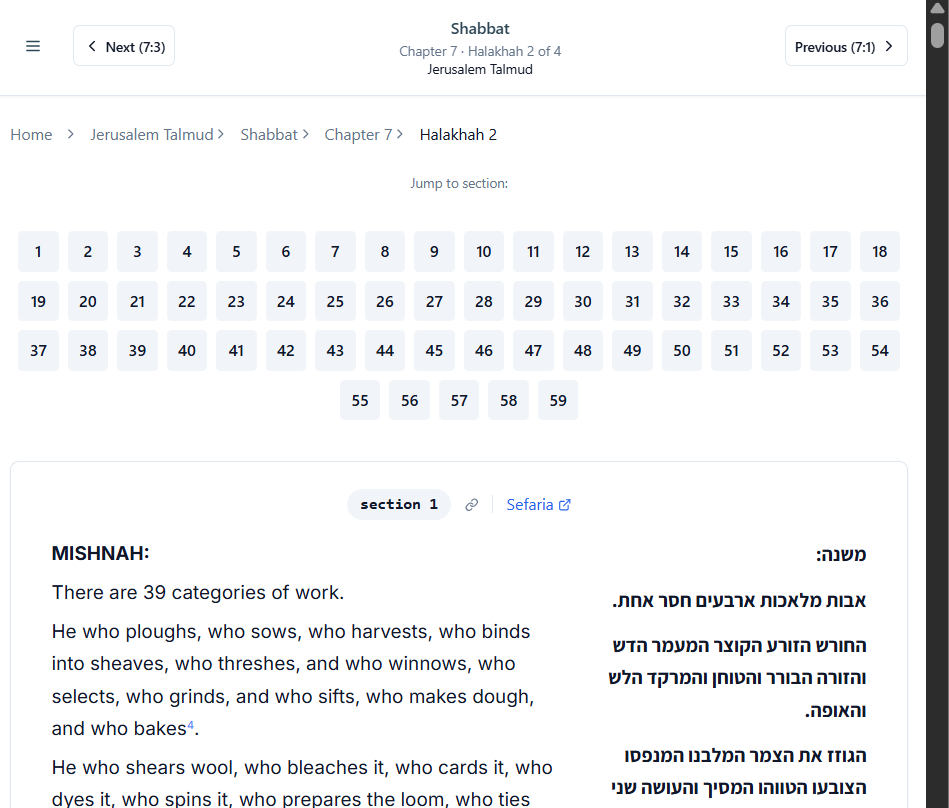
The reigning champion is Shabbat 7:2, the discussion of the 39 avot melachot (categories of forbidden Sabbath labor), at nearly 5,000 Hebrew words.
Screenshot at ChavrutAI (https://chavrutai.com/yerushalmi/Shabbat/7.2, in tablet view):
Peah 1:1 is the discussion of mitzvot whose fruits are eaten in this world while the principal is preserved for the next. Taanit 4:5 contains the Yerushalmi narratives of the destruction of Beitar and the death of Bar Kokhba. Sanhedrin 10:2 discusses who has and doesn’t have a share in the World-to-Come. Chagigah 2:1 discusses Ma’aseh Bereishit, and Ma’aseh Merkava, and the story of the tanna Aher/Elisha ben Avuyah. Several of the openings of tractates also make the list (Berakhot 1:1, Yoma 1:1, Kiddushin 1:2, Sanhedrin 1:2. A similar pattern exists for the Bavli, on these same chapters, see my previous discussion).
The shortest halachot
The shortest is Sotah 9.8, which weighs in at a grand total of 24 Hebrew words; and that’s counting both the Mishnah and the Talmud Yerushalmi. The full Talmudic discussion is just two words: bera ketola (”a son of murderers”), a brief gloss on the mishnah’s report that Elazar ben Dinai was nicknamed “the murderer’s son.”
Here are the ten shortest “halachot” in the Yerushalmi:3
Sugya - Hebrew words
Sotah 9:8 - 24
Beitzah 2:9 - 28
Nedarim 7:4 - 29
Rosh Hashanah 4:5 - 32
Eruvin 7:7 - 33
Nedarim 6:10 - 34
Avodah Zarah 5:2 - 34
Yevamot 13:9 - 35
Yevamot 13:10 - 35
Nedarim 7:9 - 35
[Edit: After the initial publication of this piece, Prof. Menachem Katz provided a number of detailed comments (private communication). Here are some notes and qualifications taking those into account (the wording of these notes are fully mine):
The term “sugya”, used in the intial version of this piece’s title, has been dropped to avoid confusion. “Sugya” typically refers to a finer-grained editorial unit within the span between consecutive Mishnah sections, not to that span itself. The unit used here (Mishnah section to Mishnah section) is thus better understood as an upper bound for sugya length (as I note in the piece), or at the very least, the word count of the halacha length of printed editions.
Katz further noted that the subdivision of a Mishnah chapter into individual numbered mishnayot (Mishnah 1, Mishnah 2, etc.) is not original to the Mishnah’s own structure. The Mishnah was organized into six Orders, tractates, and chapters; the further division into individual mishnayot within each chapter was introduced by later transmitters and copyists, and varies across manuscripts and printed editions, including within the Talmud Bavli. (Maimonides’ Mishnah commentary, for instance, uses a different division than the standard printed editions.)
For a scholarly treatment of sugya division, see Katz’s introduction (Hebrew) to his scholarly edition of Yerushalmi Kiddushin (2015), pp. 25–27.
Katz, who has edited several Bavli tractates and produced structural maps of their sugyot (including Yevamot, Kiddushin, and Ketubot, available on his Academia.edu profile), argues that the longest sugya in the Bavli is found in chapter 1 of tractate Yevamot.
And see also his “A Unit of Sugyot in the Yerushalmi – Aims of Redactions and Their Meaning (Hebrew)” (2011).]
The full count of all halachot is in a CSV at the Github repo here (the original count was done a few months ago). And see my word counts by Yerushalmi tractate, in “Words of Wisdom: Word Counts of Classical Jewish Works”, pp. 7-9, and my note there. In general, this is part of my ongoing work on improving ChavrutAI’s Talmud Yerushalmi reader, which recently went live.
And see also my “Talmud Yerushalmi in the Digital Age: New Frontiers in the Overlooked Talmud”, also uploaded to Academia here.
Note how Nedarim shows up three times in the top ten.