

The Talmud is full of numbers.1 Measurements in cubits (amah) and handbreadths (tefah).2 Fractions of agricultural offerings. Counts of Israelites leaving Egypt. Precise legal quantities down to one-sixtieth of a prohibited substance. When English translations spell out these numbers as words, the text can become dense and hard to scan.
ChavrutAI automatically converts spelled-out numbers and fractions into numerals. This makes the text easier to read while preserving its meaning.
Outline
Intro
The Problem with Spelled-Out Numbers
What Gets Converted
Cardinal Numbers
Ordinal Numbers, including calendar dates and chronologies
Fractions, including measurements
Mixed Numbers with Measurements
Why This Matters for Talmud Study
What Stays the Same
Summary
Appendix 1 - Technical
Architecture Overview
Data Structure
Unicode Fractions
Limitations
Appendix 2 - Competing Bids to the Temple Treasury for Redeeming a Consecrated Field (Mishnah Arakhin 8:2-3)
Escalating Bids and the Penalty for Reneging
A field is auctioned for redemption with ascending bids: 10, 20, 30, 40, 50 sela
Owner Priority at Equal Bids
How the 1/5 (=20%) surcharge Works When Others Outbid the Owner
When the Outsider’s Bid Exceeds What the Owner Can Be Compelled to Pay
Appendix 3 - Shmuel’s fixed calendar-astronomy scheme of the Solar Year: Seasons, Equinoxes, and Solstices (Eruvin 56a)
Appendix 4 - Talmudic diagrams: diagrams in manuscripts and printed editions of the Talmud, and in particular in Rashi’s commentary to the Talmud
Diagrams in Rashi’s commentary on Talmud, Listed by Talmud page (not exhaustive): Eruvin; Sukkah; Beitzah; Gittin; Bava Kamma; Yevamot; Zevachim; Niddah
The Problem with Spelled-Out Numbers
Consider this passage from Sotah 8b:
אין לי אלא סאה,
מנין לרבות
תרקב וחצי תרקב,
קב וחצי קב,
רובע וחצי רובע,
תומן ועוכלא,
מנין?
The baraita continues: I have derived only the relatively large measurement of a se’a, which alludes to a significant sin.
From where do I know to include even lesser sins that are comparable to smaller measurements, e.g.,
a half-se’a [tarkav] and a half-tarkav;
a kav and a half-kav;
a quarter-kav and half of a quarter-kav;
an eighth-kav [toman] and an ukla, which is one-thirty-second of a kav.
From where is it derived that all these lesser sins are also dealt with in accordance with the measure of the sin?
The phrase “one-thirty-second of a kav“ takes a moment to parse. The numeral “1/32 of a kav“ is immediately clear.
Or take a typical measurement passage:3
Up to thirteen and a third cubits from the entrance.
Compared to:
Up to 13⅓ cubits from the entrance.
The second version is faster to read. Your eye catches the number instantly.
What Gets Converted
ChavrutAI handles four categories of number-related text:
1. Cardinal Numbers
Spelled-out numbers from three to forty million become numerals:4

Large numbers use comma separators for readability. “Six hundred thousand” becomes “600,000” rather than “600000”.
The system handles common Talmudic numbers like 613 (the count of commandments), 600,000 (the traditional count of Israelites at Sinai), and 248 (the number of positive commandments, said to correspond to the limbs of the body).
2. Ordinal Numbers, including calendar dates and chronologies
Words like “third” and “twenty-first” become their numeral equivalents:5

This includes Hebrew calendar dates. “The first of Shevat” becomes “the 1st of Shevat.”6
3. Fractions, including measurements
The Talmud discusses fractions constantly—in the context of tithes, inheritance divisions, purity ratios, and measurements. ChavrutAI converts these to a compact format:7

4. Mixed Numbers with Measurements
For mixed numbers (i.e. a whole number plus a fraction), ChavrutAI uses Unicode fraction symbols. Mixed numbers are especially common in the case of measurements, for example:

The Unicode symbols ½, ⅓, and ⅔ render as single characters, improving readability. These render as single glyphs in modern browsers and fonts, producing clear and unambiguous output like “1½” rather than “1 1/2”.8
Why This Matters for Talmud Study
The Talmud’s legal discussions often hinge on precise quantities. A difference of one-sixtieth can determine whether a mixture is permitted or forbidden. The dimensions of a sukkah are specified in exact measurements. Inheritance laws divide property into specific fractions.
When these numbers are spelled out in words, two things happen:
Reading slows down. Your brain has to translate “one hundred and twenty” into a quantity before you can think about what it means.
Comparisons and calculations become harder. If one passage says “three hundred and sixty-five” and another says “two hundred and forty-eight,” comparing them requires mental conversion. But “365” and “248” are immediately comparable.
By converting to numerals, the text becomes more scannable. You can quickly identify the numbers in a passage and focus your attention on understanding the legal or narrative context.
What Stays the Same
Not every number gets converted. The system is conservative:
“One” and “two” remain as words when they appear in ordinary prose. These are common enough in standard prose (“one opinion”, “second statement”, etc) that converting them wouldn’t improve readability.
Context is preserved. The conversion only affects the number itself. “A cubit and a half” becomes “1½ cubits”—the unit stays attached and readable.
Summary
ChavrutAI converts spelled-out numbers and fractions into numerals to make Talmud text easier to read. The system handles:
Cardinal numbers from 3 to 40,000,000
Ordinal numbers (3rd, 21st, 480th)
Fractions (1/3rd, 1/60th, 1/500th)
Mixed numbers with measurements (1½ cubits, 4½ handbreadths)
This is one of many text processing features that make ChavrutAI’s Talmud display cleaner and more accessible.
Appendix 1 - Technical
Architecture Overview
ChavrutAI’s number processing is part of a larger text processing pipeline that runs on all English Talmud text fetched from the Sefaria API.9
Data Structure
All number and fraction conversions are stored in a JSON configuration file (term-replacements.json). The file organizes terms into categories:
ordinals_basic- Simple ordinals: “third” → “3rd”ordinals_compound- Compound ordinals: “twenty-first” → “21st”ordinals_fractional- Fractions and mixed numbers: “one-third” → “1/3rd”numerals- Cardinal numbers: “forty-two” → “42”
As of January 2026, the configuration contains:
27 basic ordinals (3rd through 600th)
39 compound ordinals (21st through 39th, plus special cases)
80+ fractional terms (simple fractions, measurement phrases, mixed numbers)
170+ cardinal number conversions (3 through 40,000,000)
Unicode Fractions
Mixed numbers use Unicode vulgar fraction characters:
½ (U+00BD) - one-half
⅓ (U+2153) - one-third
⅔ (U+2154) - two-thirds
These render as single glyphs in modern browsers and fonts, producing compact output like “1½” rather than “1 1/2”.
Limitations
The system uses explicit hardcoded mappings, not algorithmic number parsing.10
Numbers below 3 are not converted (to avoid cluttering prose with numerals).
The system cannot handle numbers that span multiple sentences or are interrupted by parenthetical phrases.
Certain terms are inherently ambiguous, and require parsing in context.11
Appendix 2 - Competing Bids to the Temple Treasury for Redeeming a Consecrated Field (Mishnah Arakhin 8:2-3)
Mishnah_Arakhin.8.2-3 (=Arakhin.27a.15-27b.3)12
Escalating Bids and the Penalty for Reneging
A field is auctioned for redemption with ascending bids: 10, 20, 30, 40, 50 sela
אמר אחד: ״הרי היא שלי בעשר סלעים״,
ואחד אומר: ״בעשרים״,
ואחד אומר: ״בשלשים״,
ואחד אומר: ״בארבעים״,
ואחד אומר: ״בחמשים״.
If one said: The field is hereby mine for 10 sela,
and one other person said: It is mine for 20,
and one said for 30,
and one said for 40,
and one said for 50;
If the highest bidder reneges (חזר בו), the treasurer seizes from that bidder’s assets (נכסיו) up to 10 sela, and the field passes to the next-highest bidder. This repeats down the chain: each reneging bidder is charged up to 10.
If even the 10-sela bidder reneges, the field is sold at its market value, and the treasurer collects from the 10-bidder whatever amount is needed to reach 10.
חזר בו של חמשים —
ממשכנין מנכסיו עד עשר.
חזר בו של ארבעים —
ממשכנין מנכסיו עד עשר.
חזר בו של שלשים —
ממשכנין מנכסיו עד עשר,
חזר בו של עשרים —
ממשכנין מנכסיו עד עשר,
חזר בו של עשר —
מוכרין אותו בשוויו, ונפרעין משל עשר את המותר.
and then
the one who bid 50 reneged on his offer,
the treasurer repossesses from his property up to 10 sela and the field is redeemed by the one who bid 40. This ensures that the Temple treasury does not lose.
If the one who bid 40 sela subsequently reneged on his offer,
the treasurer repossesses from his property up to 10 sela and the field is redeemed by the one who bid 30.
If the one who bid 30 subsequently reneged on his offer,
the treasurer repossesses from his property up to 10 sela and the field is redeemed by the one who bid 20.
If the one who bid 20 reneged on his offer,
the treasurer repossesses from his property up to 10 sela and it is redeemed by the one who bid 10.
If the one who bid 10 reneged on his offer,
the treasurer sells the field at its value and collects the remainder from the property of the one who bid 10, to complete the sum of 10 sela.
Owner Priority at Equal Bids
If the owner bids 20 and someone else also bids 20, the owner takes precedence, because the owner must add a 1/5 (=20%) surcharge (ḥomesh - thus increasing the Temple treasury’s intake).
הבעלים אומרים בעשרים,
וכל אדם אומרים בעשרים —
הבעלים קודמין,
מפני שהם מוסיפין חומש.
If the owner says he will pay 20 sela
and any other person says he will pay 20 sela --
the offer of the owner takes precedence,
due to the fact that he adds 1/5th (חומש)
How the 1/5 (=20%) surcharge Works When Others Outbid the Owner
If the owner bid 20 and someone else bids 21–25, the owner can still redeem by paying:
(1) the owner’s 20 plus its 1/5 surcharge, and (2) the increment needed to match the outsider’s higher bid.
The Mishnah’s examples yield owner payments of 26–30 respectively, with the principle that the 1/5 is applied only to the owner’s base bid, not to the outsider’s added increment.
אמר אחד: ״הרי היא שלי בעשרים ואחת״ —
הבעלים נותנין עשרים ושש,
״בעשרים ושתים״ —
הבעלים נותנין עשרים ושבע,
״בעשרים ושלש״ —
הבעלים נותנין עשרים ושמונה,
״בעשרים וארבע״ —
הבעלים נותנין עשרים ותשע,
״בעשרים וחמש״ —
הבעלים נותנין שלשים,
שאין מוסיפין חומש על עלויו של זה.
If the owner says he will pay 20 sela and one other person said: The field is hereby mine for a payment of 21 sela --
the owner gives 26 sela and takes the field.
He pays the 20 that he initially offered; plus 5 sela, which is 1/5th of the total future sum, i.e., 1/4th of his initial offer. In addition, he adds one sela, the difference between his initial offer and that of the other person, so that the Temple treasury will not receive less than the 21 sela offer proposed by the other person.
If the owner says he will pay 20 sela and another person said: The field is hereby mine for a payment of 22 sela --
the owner gives 27 sela and takes the field.
If the owner says he will pay 20 sela and another said: The field is hereby mine for a payment of 23 sela,
the owner gives 28 sela and takes the field.
If the owner says he will pay 20 sela and another said: The field is hereby mine for a payment of 24 sela,
the owner gives 29 sela and takes the field.
If the owner says he will pay 20 sela and another said: The field is hereby mine for a payment of 25 sela,
the owner gives 30 sela,
as the owner adds 1/5th only to the amount that he bid, and does not add 1/5th to the addition of that other person.
When the Outsider’s Bid Exceeds What the Owner Can Be Compelled to Pay
If someone bids 26 (above the owner’s reachable amount under this structure), the owner has priority only if he is willing to pay 31 and a dinar. Otherwise, the treasurer tells the outsider: “You have acquired it”.13
אמר אחד: ״הרי שלי בעשרים ושש״,
אם רצו הבעלים ליתן שלשים ואחד ודינר —
הבעלים קודמין,
ואם לאו —
אומר לו: ״הגעתיך״.
If the owner said he will pay 20 sela and one other person said: The field is hereby mine for a payment of 26 sela,
if the owner wished to pay 31 sela and a dinar --
the owner takes precedence;
and if not,
the treasurer says to the other person: The field has come into your possession based on your bid, as it is more than the Temple treasury can compel the owner to pay.
Appendix 3 - Shmuel’s fixed calendar-astronomy scheme of the Solar Year: Seasons, Equinoxes, and Solstices (Eruvin 56a)
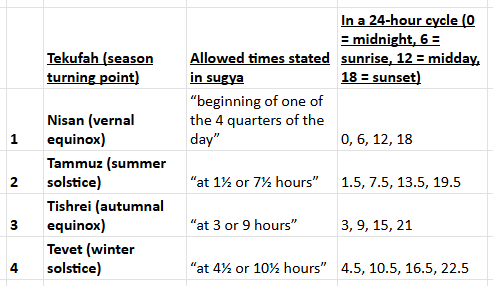
Shmuel posits a fixed calendar-astronomy scheme: each season’s turning point (tekufah) can occur only at one of 4 specific, discrete times within the day/night cycle.
He then anchors this in a constant interval between seasons—91 days plus 7.5 hours—so each tekufah begins 0.5 “planetary hour” later in the rotating sequence of 7 heavenly bodies.14
אמר שמואל:
אין תקופת ניסן נופלת אלא בארבעה רבעי היום:
או בתחלת היום
או בתחלת הלילה,
או בחצי היום
או בחצי הלילה.
ואין תקופת תמוז נופלת אלא
או באחת ומחצה,
או בשבע ומחצה,
בין ביום ובין בלילה.
ואין תקופת תשרי נופלת אלא
או בשלש שעות
או בתשע שעות,
בין ביום ובין בלילה.
ואין תקופת טבת נופלת אלא
או בארבע ומחצה או בעשר ומחצה,
בין ביום ובין בלילה.
On the topic of the previous discussion with regard to calculating the directions of the world based upon the seasons, Shmuel said:
The vernal equinox (תקופת ניסן) occurs only at the beginning of one of the 4 quarters (רבעי) of a day:
Either precisely at the beginning of the day,
or precisely at the beginning of the night,
or at midday,
or at midnight.
Similarly, the summer solstice (תקופת תמוז) occurs only at certain times of the day:
Either at the conclusion of 1½ hours
or 7½ hours
of the day or night.
And the autumnal equinox (תקופת תשרי) occurs only at certain times:
Either at the conclusion of 3 hours
or 9 hours
of the day or night.
And the winter solstice (תקופת טבת) occurs only at certain times:
Either at the conclusion of 4½ hours
or 10½ hours
of the day or night.
ואין בין תקופה לתקופה אלא תשעים ואחד יום ושבע שעות ומחצה.
And all this is based on the principle that there are only 91 days and 7½ hours between the beginning of one season and the next,
as he assumed that a year is exactly 365¼ days.
ואין תקופה מושכת מחברתה אלא חצי שעה.
And similarly, each season begins precisely one-half planetary hour past (מושכת) the beginning of the previous season.
Appendix 4 - Talmudic diagrams: diagrams in manuscripts and printed editions of the Talmud, and in particular in Rashi’s commentary to the Talmud
On the topic of diagrams in the traditional 19th century Romm-Vilna edition of the Talmud, see Eli Genauer, “Did Rashi Draw the Diagrams in his Commentary to Eruvin?” at TheLehrhaus.com (August 10, 2020):
In this tractate, Rashi’s commentary contains not only words, but many diagrams [...]
In fact, there are 54 such diagrams in Rashi’s commentary to Eruvin, and they represent about half of the total of diagrams found in Rashi’s commentary to the Talmud.
I have been studying these diagrams for the past 10 years, and when I speak to people about it, the first thing they want to know is, “Did Rashi really draw the diagrams that we see today in the Vilna Shas?” The answer I give them is yes, but there are some qualifications. Rashi drew the original diagrams, but they have changed over time [...]
Although we do not have an autograph ketav yad (meaning a manuscript written by Rashi himself) of his commentary to Talmud Bavli, we have many manuscripts of his commentary which were created not too long after Rashi lived. It is from manuscripts such as these that we derive the proper wording of Rashi, and we can also use them to get an idea of the pictures that Rashi drew. The diagrams are not always exactly the same as in the Vilna Shas, but they are oftentimes close [...]
[P]ublishers of new editions of the Talmud—such as Oz ve-Hadar, Vilna ha-Hadash, and Vagshal—have modified the diagrams in the Vilna Shas to reflect even more accurately the situations being described.
And see Genauer, “An “Artscroll”™ Illustration in the Vilna Shas-Masechet Shabbat 98b” at SeforimBlog.com (June 5, 2020), section “Diagrams in Printed Editions of the Talmud”:
The use of diagrams is attested to in numerous manuscripts. These diagrams appear in Rashi, Tosefot and even were used by the Geonim.
When manuscripts gave way to printing in the late 1400’s and early 1500’s, those diagrams were excluded in the early printed editions of the Shas. When Daniel Bomberg published the first complete edition of the Shas in the early 1500s, he did not include the actual diagrams, but instead left a space for the book’s owner to pencil in the relevant diagrams (how they would know what the diagram looked like is left unanswered).
Finally starting with 1697, (the Berman Shas of Frankfurt on der Oder) did diagrams start to reappear in the empty spaces (mostly in Eruvin and Sukkah).
And see Genauer, “Diagrams in Rashi’s Commentary: A Case Study of Eruvin 56b”, Ḥakirah 16 (2013).
And see the summary of Ezra Chwat (of the National Library of Israel) summary at his blog (in Hebrew) of his large cataloging project of diagrams in manuscripts of Rashi’s commentary on the Talmud, which found 129 distinct diagrams across 15 tractates, with Eruvin dominating (77 of the 129):
“ציורי רש”י“, גילוי מילתא בעלמא (1/15/2017)
And Chwat here:
עזרא שבט, “ציורי רש”י בכתב יד בפירושו לתלמוד“
Diagrams in Rashi’s commentary on Talmud, Listed by Talmud page (not exhaustive)
I asked ChatGPT to research, and it was able to find many pages at the Daf-Yomi.com website with Chwat’s discussions of Diagrams in Rashi’s commentary on Talmud. Each page is titled (in Hebrew): “Rashi’s diagrams in manuscript copies of his Talmud commentary” ( ציורי רש”י בכתב יד בפירושו לתלמוד).
From here and on is from ChatGPT:15
Below are dafim (across multiple tractates) where Rashi has a diagram locus, and where Vilna printings commonly include (or are expected to include) a diagram.
Eruvin
Eruvin 9b (Daf Yomi)
(And, per the catalog, Eruvin is by far the densest tractate for these. )
Sukkah
Also, in the Vilna/Romm printing tradition, diagrams are explicitly discussed as appearing at Sukkah 4a, 6b, 7a, 7b, 8a, 8b. (rabbimintz.com)
Beitzah
Beitzah 11a (Daf Yomi)
Gittin
Bava Kamma
Yevamot
Yevamot 43a (Daf Yomi)
Zevachim
Niddah
Niddah 17b (Daf Yomi)
For a basic overview of numbers in Hebrew, see Wikipedia, “Hebrew numerals“.
See also my previous piece on this topic: “Large Numbers (≥100) in the Talmud: A Data Analysis” (Aug 06, 2025), with attached files and the appendices there.
Compare also my edition of Mishnah tractate Middot, where lots of measurements are found; there too, I convert those spelled-out numbers to numerals (in my tables and summaries), for ease of reading and calculating.
And see my piece on the Talmudic sugya in tractate Megillah calculating the 70 years of the Babylonian exile, where I do the same as well: “Chronology, Calculations, and Royal Reigns: The 70 Years of Babylonian Exile Between the First and Second Temples (Esther 1:2, Jeremiah 29:10, Daniel 9:2; Megillah 11b-12a)” (Mar 18, 2025).
The relevant code for this mapping is here, from line 121 and on:
https://github.com/EzraBrand/replit-chavrutai-2/blob/main/shared/data/term-replacements.json
As an aside, I’ve continued doing lots of miscellaneous development on ChavrutAI, including on numbers, see the changelog page under section January 2026:
URL Structure Improvements
Changed Talmud page URLs from /
tractate/ to /talmud/ for consistency (e.g.,/talmud/berakhot/2a)Old bookmarked /
tractate/ URLs automatically redirect to new /talmud/ URLsUpdated all internal links, SEO metadata, and sitemaps to use the new URL structure
Sefaria Compatibility Fix
Fixed tractate name discrepancy with Sefaria: “Beitza” → “Beitzah” and “Arachin” → “Arakhin”
Restored broken Sefaria links on Mishnah Map page for these tractates
Added backwards compatibility for old URLs to prevent broken links
Jastrow Dictionary Improvements
Fixed sense numbering display (1, 2, 3...) that was being cut off from dictionary entries
Added origin metadata display showing language origins (Biblical Hebrew, Aramaic) and cross-references
Expanded abbreviation mappings with 10+ new terms (Assyr., frequ., opp., supra, etc.)
Blog Reader on About Page
Replaced “Latest Posts” widget with expandable blog post reader showing full content
Added Hebrew RTL text support with automatic detection
Footnotes display with hover tooltips and click-to-navigate functionality
Added post numbering (1, 2, 3...) for easier reference
Expanded posts now show first 3 paragraphs with “Load more of the post...” option
Shows 5 posts by default with “Load more posts...” to view up to 20 posts
Text Processing Improvements
Added animal term mappings: “domesticated animals” → “livestock”, “non-domesticated” → “wild”
Added 72 number text to numeral conversions (e.g., “forty million” → “40,000,000”)
Supports large numbers with comma-separated thousands for readability
Added fractional ordinal conversions (e.g., “one five-hundredth” → “1/500th”)
Added Hebrew month date conversions (e.g., “the first of Shevat” → “the 1st of Shevat”)
Added measurement fractions with Unicode symbols (e.g., “a finger and a third” → “1⅓ fingers”, “seven and a half” → “7½”)
Unrelated, see my new merged table at my academia page, mapping corresponding Mishnah and Talmud chapter word counts, based on my separate previous word counts of each: “Merged Mishnah and Bavli Chapter Wordcounts“.
This merging allowed me to conclude that there’s only weak relative correlation between Mishnah chapter word count and Talmud chapter word count; see my abstract there.
On Talmudic measurements, see Wikipedia, ‘“Biblical and Talmudic units of measurement“.
See the search results at Sefaria here.
For example, Eruvin.10a.12:
סבר רב אחי קמיה דרב יוסף למימר:
עד שלש עשרה אמה ושליש
Initially, Rav Aḥai thought to say before Rav Yosef:
Up to thirteen and a third cubits.
For a basic overview of cardinal numbers in Hebrew, see Wikipedia, “Hebrew numerals“ (cited earlier), section “Cardinal values“.
And see more at my piece on large numbers in the Talmud, cited in the beginning of the previous footnote.
For a basic overview of cardinal numbers in Hebrew, see Wikipedia, “Hebrew numerals“ (cited earlier), section “Ordinal values“.
For example, in the famous first Mishnah of tractate Rosh Hashanah (cited, for example, in Wikipedia, “Hebrew calendar“, section “Years“).
And compare also these pieces of mine, where I do the same for dates:
“The Origins of Tisha B’Av and the Chronology of Numbers 10-14: the Date of the Destructions of the Both Temples and the Biblical Spies Episode (Taanit 29a)”, final part: Pt2
Note also that in Talmudic Hebrew, the days of the week are referred to by ordinals: Sunday is “Day 1” (יום ראשון / חד בשבא); Monday is “Day 2” (יום שני / תרי בשבא), etc. (On this, see Wikipedia, “Hebrew calendar“, section “Weeks“.) See these pieces of mine, where this is especially relevant:
Similarly, months in the Hebrew Bible are typically referred to simply as “the 1st month” (=Nissan), “the 2nd month”, etc. (On this, see Wikipedia, “Hebrew calendar“, section “Months“.) This caused some confusion in the Talmud itself, see especially in the extended sugya on Biblical chronology at the beginning of tractate Rosh HaShanah.
Note that some are ambiguous, and can only be disambiguated from context. For example “a third” can be “a 3rd” or “1/3rd”.
The original Hebrew or Aramaic is not always more clear: Hebrew shlishit (שלישית) can be the fraction “1/3rd”, or feminine ordinal “3rd”. The same ambiguity exists with Aramaic tilta (תילתא).
Other common terms with similar ambiguity: “sixth” (shishit) and “tenth” (עשירית ; though עשרון is unambiguously the fraction “1/10th”, referring to the measurement 1/10th of an eiphah)
And note also other technical words:
See more on this at the technical appendix at the end of this piece.
The relevant code for this mapping is here, from line 121 and on:
https://github.com/EzraBrand/replit-chavrutai-2/blob/main/shared/data/term-replacements.json
E.g. “Forty-three thousand, two hundred and seventeen” would require a specific entry.
To create this hardcoded mapping, I used the concordance of numbers in the file at my “Large Numbers’ piece.
I first tried an algorithmic solution, but this didn’t work well. But it’s likely that an algorithmic solution can be found.
See previous footnote on this (especially the ordinal “3rd” vs. the fraction “1/3rd”). I’m still trying to figure out solutions for this.
Compare my previous series about literary structure in the Mishnah. Much of the analysis there is relevant here; here, the additional interest is on the numbers series, fractions, and calculations.
הגעתיך - i.e., the field goes to the outsider at that higher bid.
Cited in Wikipedia, “Birkat Hachama“, section “Source of the practice“, see the overall discussion there in that entry, on the broader calendrical context.
Note that the next part of the sugya--immediately subsequent--is very dense in numbers and calculations. It discusses squaring space for shabbat limit (‘tehum’), and the city’s “extra” area (Eruvin 56b-57a). Indeed multiple diagrams (which are typically quite unusual) appear in the traditional 19th century Romm-Vilna edition of the Talmud for these pages. I was considering analyzing it in an appendix, but I decided not to due to its complexity. I hope to return to it.
On diagrams in the Talmud in general, see the following appendix.
You can the see convo shared at the following link:
https://chatgpt.com/share/696ba1b0-7364-8012-a525-ea3dc939ddce
As an aside, ChatGPT5 “thinking” model is excellent for finding links to research, as I recently discussed as well.