

I built this project because I wanted a way to visualize at a high level how legal topics move across four core layers of Jewish texts:
Pentateuch (Torah law passages)
Mishnah
Mishneh Torah
Shulchan Aruch
I wanted a usable map: one place where I can take a topic (for example Shabbat, Niddah, damages, or Shemitah) and see where it sits in each corpus.
The final pages are here and here.1
Outline
Intro
The core problem
What I built
Citation-granular topic tree
High-level relationship chart
Why I used both views
What this project is
Why this matters for learners
Screenshots
Topic mapping
Topics index
First entries
High-Level Relationship Chart
Top
Bottom
The core problem
Most people who learn these texts know the basic story: Torah (=Pentateuch) is foundational, Mishnah organizes Oral Law, Rambam codifies, and Shulchan Aruch becomes a practical code.2
But when you actually try to compare them directly, even at a high level, it gets messy:
The Torah (=Pentateuch) is not arranged as a legal code in the same way later works are.
Mishnah organizes by sedarim and masekhtot.
Mishneh Torah organizes by 14 books and then halakhot.
Shulchan Aruch organizes by 4 main sections and simanim.
So even simple questions are hard to visualize and answer quickly:
“Where is this topic mainly located in each layer?”
“Is this topic practical in Shulchan Aruch, or mostly theoretical at that stage?”
“How do the major buckets line up between systems that were not written with identical structure?”
I wanted a visual way to answer those questions.
What I built
I built two complementary outputs from the same mapping data.
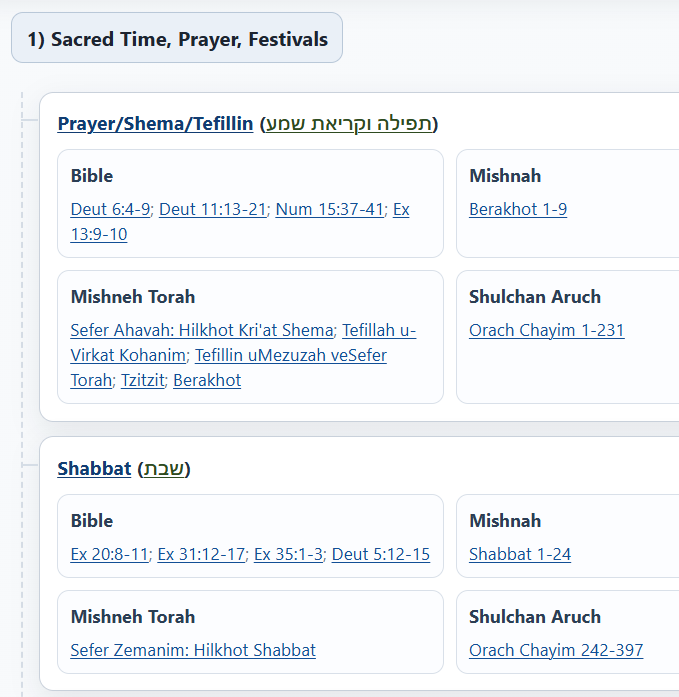
1) Citation-granular topic tree
This is the detailed view. Each subtopic has four columns:
Bible citation ranges
Mishnah tractate/chapter ranges
Mishneh Torah units
Shulchan Aruch simanim
Each citation is clickable to Sefaria.
Each subtopic label also links to English and Hebrew Wikipedia entries to make quick background lookup easier.
This page provides actual references and links.
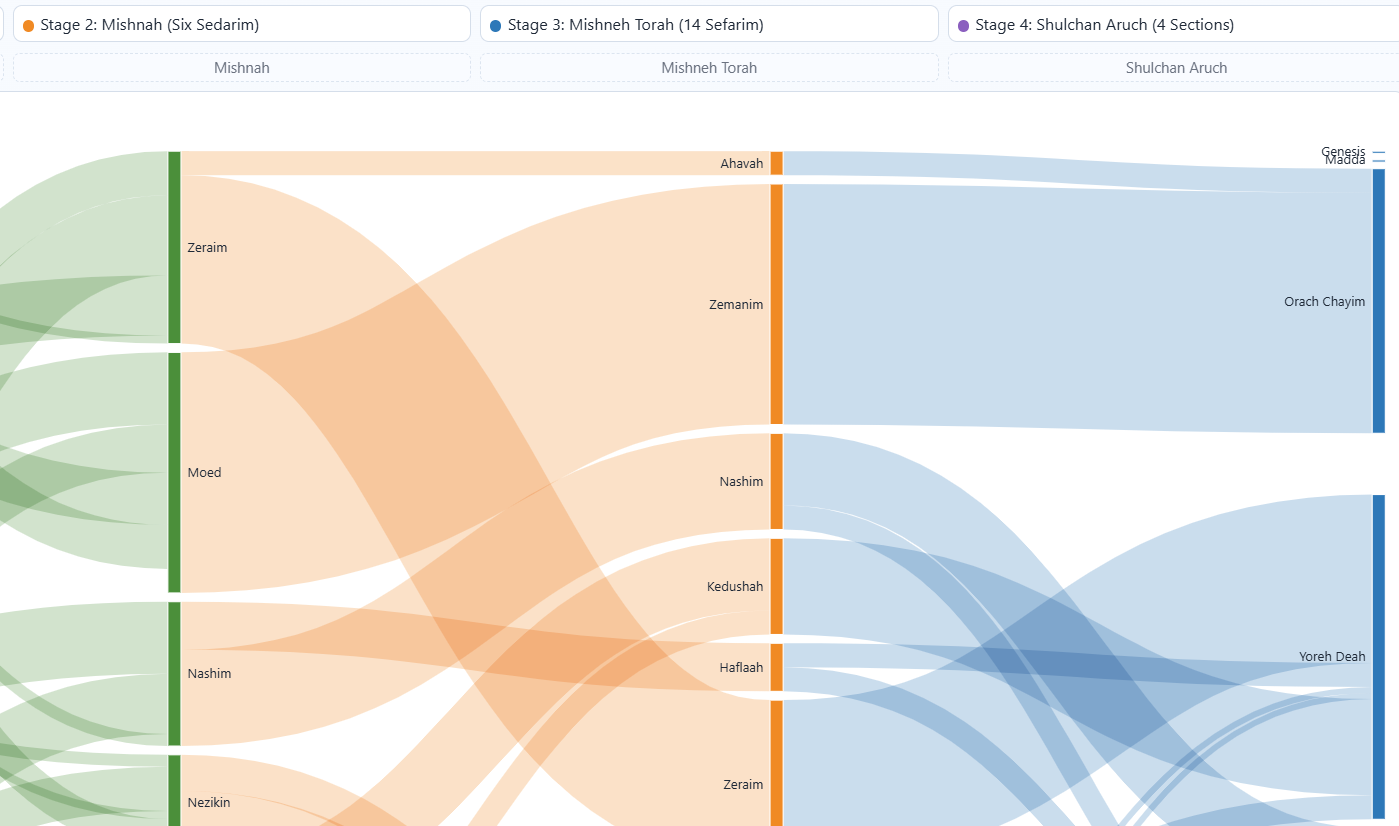
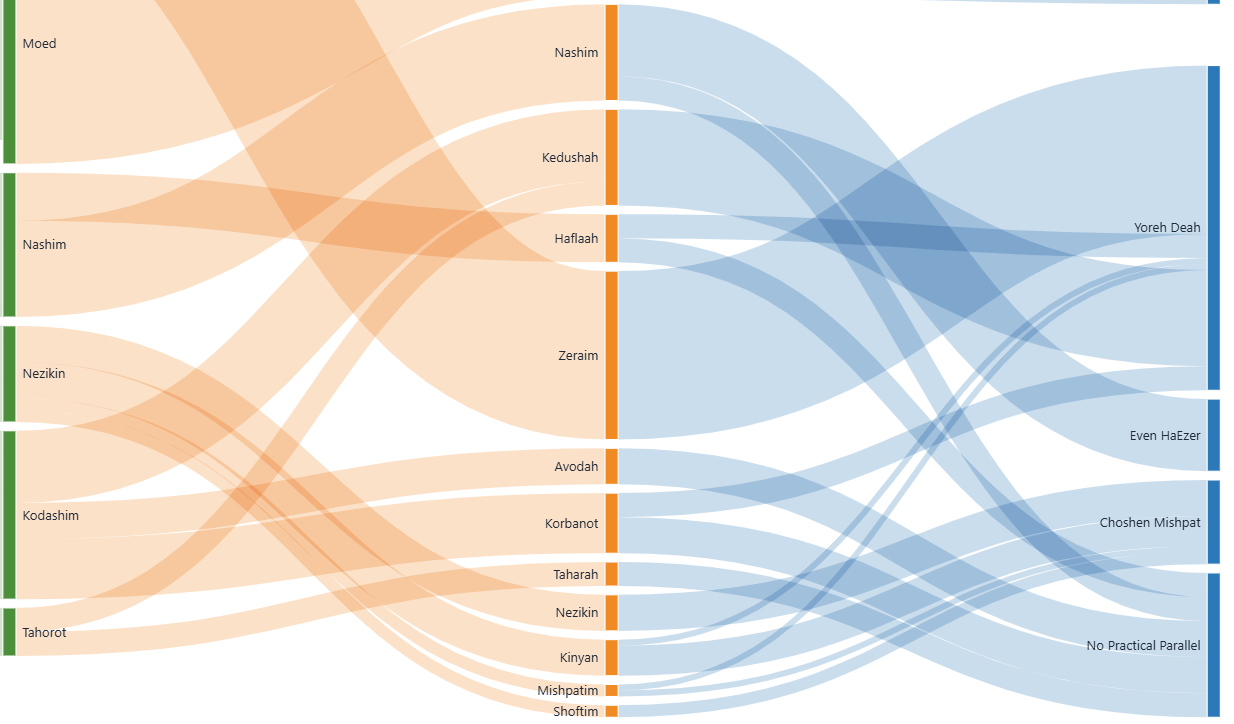
2) High-level relationship chart
This is the “lines and flow” view. It is intentionally more abstract than the citation tree.
It maps:
Pentateuch books
Mishnah sedarim
Mishneh Torah sefarim
Shulchan Aruch sections
I built it as a weighted Sankey-style chart so I can see where flow is concentrated and where it thins out.
This chart includes descriptive hover content: sampled subtopics and citation snippets that explain why a given connection exists.
Why I used both views
I found that one format alone is not enough:
The granular tree is precise but visually heavy.
The high-level flow chart is intuitive but is too abstract without evidence.
Together, they solve that:
The line chart gives structure and direction.
The citation tree gives traceability and source-level detail.
Also includes Wikipedia links in both languages (English and Hebrew) for subtopics.3
What this project is
This is:
a comparative map
a study/navigation tool
a transparent, inspectable data pipeline from CSV to visual output
Note that in several areas, especially Temple/purity domains, practical codification in Shulchan Aruch is limited compared to earlier corpora. The project makes those asymmetries especially visible.
Why this matters for learners
A big benefit is orientation.
One can now get a clear picture of:
where I am in the legal system
what kind of structure I’m reading (narrative law vs organized code)
what is broad principle vs practical codification
In other words: this is a map for the history of halacha at the level of structure.
Screenshots
Topic mapping
https://ezrabrand.github.io/jewish-law-tree/index.html
Topics index:

First entries:
High-Level Relationship Chart
https://ezrabrand.github.io/jewish-law-tree/high_level_relationship_chart.html
Top:
Bottom:
Image, based on this data, also uploaded to my Academia page, as a PDF: Comparative Hierarchical Topic Tree of Jewish Law: Bible, Mishnah, Mishneh Torah, Shulchan Aruch
Full code and repo here: https://github.com/EzraBrand/jewish-law-tree. I built this whole project using OpenAI’s excellent Codex agentic coding tool (via the VS Code plug-in).
Compare Sefaria’s Sankey charts. Their charts are much more granular; while mine are high-level. And see also my previous discussion of them, in “Mapping the High-Level Hierarchical Structure of Classical Hebrew Texts: A Case Study of Graphing Talmudic Chapters and Word Counts“, especially section “Contextualizing Within Digital Humanities: Sefaria’s Visualization Efforts“.
And see also my “Biblical Citations in the Talmud: A New Digital Index and Concordance“, where I discuss Sefaria’s visualizations as well.
Note that the Talmud follows the same structure as the Mishnah; and the Shulchan Aruch follows the same structure as the Tur.