

This the second and final part of a two-part series. Part 1 is here: the outline of the series can be found at Part 1.
Story about Abaye - Abaye follows a man and woman to prevent sin; they part innocently
אמר אביי: ובתלמידי חכמים יותר מכולם.
כי הא דאביי שמעיה לההוא גברא דקאמר לההיא אתתא: נקדים וניזיל באורחא.
אמר:
איזיל
אפרשינהו מאיסורא
Abaye said: And it1 provokes Torah scholars more than it provokes everyone else.
The Talmud illustrates that point.
It is like this incident, as Abaye once heard a certain man say to a certain woman: Let us rise early and go on the road.
Upon hearing this, Abaye said to himself:
I will go and accompany them
and prevent them from violating the prohibition2 that they certainly intend to violate.
אזל בתרייהו תלתא פרסי באגמא.
כי הוו פרשי מהדדי,
שמעינהו דקא אמרי:
אורחין רחיקא,
וצוותין בסימא.
He went after them for a distance of 3 parasangs in a marsh among the reeds, while they walked on the road, and they did not engage in any wrongful activity.
When they were taking leave of each other,
he heard that they were saying:
We traveled a long distance together,
and the company was pleasant.3
... Abaye concludes that in their place he would have sinned; “A certain elder” to Abaye - “Anyone who is greater than his fellow, his evil inclination is greater than his” (explaining Abaye’s intense struggle as a function of his stature)
אמר אביי:
אי מאן דסני לי הוה --
לא הוה מצי לאוקומי נפשיה.
אזל תלא נפשיה בעיבורא דדשא ומצטער.
אתא ההוא סבא, תנא ליה:
כל הגדול מחבירו —
יצרו גדול הימנו
Abaye said:
In that situation, if instead of that man it had been one whom I hate, a euphemism for himself --
he would not have been able to restrain himself from sinning.
After becoming aware of so great a shortcoming he went and leaned against the doorpost, thinking and feeling regret.
A certain Elder came and taught him:
Anyone who is greater than another --
his evil inclination is greater than his.4
R’ Yitzḥak - A person’s inclination overpowers him every day; “only evil all day” describes the constancy of this impulse - Genesis 6:5
אמר רבי יצחק:
יצרו של אדם מתגבר עליו בכל יום,
שנאמר: ״רק רע כל היום״.
R’ Yitzḥak said:
A person’s inclination overcomes him each day,
as it is stated: “Only evil all day” (Genesis 6:5).
All day long his thoughts and desires are for evil.
R’ Shimon ben Lakish - The evil inclination overcomes a person daily and seeks to kill him - Psalms 37:32
אמר רבי שמעון בן לקיש:
יצרו של אדם מתגבר עליו בכל יום
ומבקש להמיתו,
שנאמר:
״צופה רשע לצדיק
ומבקש להמיתו״,
R’ Shimon ben Lakish said:
A person’s evil inclination overcomes him each day
and seeks to kill him,5
as it stated:
“The wicked watches the righteous
and seeks to kill him” (Psalms 37:32);
the wicked here is referring to the wickedness inside one’s heart.
... only God’s help prevents total defeat - Psalms 37:33
ואלמלא הקדוש ברוך הוא שעוזר לו —
אינו יכול לו,
שנאמר:
״ה׳ לא יעזבנו בידו
ולא ירשיענו בהשפטו״.
And if not for God, Who assists him with the good inclination,
he would not overcome it,
as it is stated:
“YHWH will not leave him in his hand,
nor suffer him to be condemned when he is judged” (Psalms 37:33).
R’ Yishmael’s School - If the “disgusting one” (=yetzer) meets you, drag it to the study hall; Torah, compared to water and fire, can dissolve stone or shatter iron
תנא דבי רבי ישמעאל:
אם פגע בך מנוול זה —
משכהו לבית המדרש.
אם אבן הוא —
נימוח,
אם ברזל הוא
מתפוצץ
The school of R’ Yishmael taught:
If this scoundrel, the evil inclination, accosted you, seeking to tempt you to sin —
drag it to the study hall and study Torah.
If it is like a stone,
it will be dissolved by the Torah.
If it is like iron,
it will be shattered.
Prooftexts - Isaiah 55:1; Job 14:19; Jeremiah 23:29
אם אבן הוא — נימוח,
דכתיב: ״הוי כל צמא לכו למים״,
וכתיב: ״אבנים שחקו מים״.
אם ברזל הוא — מתפוצץ,
דכתיב: ״הלא כה דברי כאש נאם ה׳ וכפטיש יפוצץ סלע״.
The Talmud elaborates:
If it is like stone, it will be dissolved,
as it is written: “Ho, everyone who is thirsty, come you for the water” (Isaiah 55:1), water in this context meaning Torah;
and it is written: “Stones were worn by water” (Job 14:19).
If it is like iron, it will be shattered,
as it is written: “Is not My word like fire, says YHWH; and like a hammer that shatters rock” (Jeremiah 23:29).
R’ Shmuel bar Naḥmani citing R’ Yoḥanan - The evil inclination incites a person in this world and later testifies against him in the next
אמר רבי שמואל בר נחמני, אמר רבי יונתן:
יצר הרע
מסיתו לאדם
בעולם הזה,
ומעיד עליו
לעולם הבא
R’ Shmuel bar Naḥmani said that R’ Yoḥanan said:
The evil inclination
incites (מסיתו) a person to sin
in this world,
and then testifies against him
in the next world,
Prooftext - Proverbs 29:21
שנאמר:
״מפנק מנוער עבדו
ואחריתו יהיה מנון״
as it is stated:
“He that delicately brings up his servant from a child
shall have him become a master [manon] at the last” (Proverbs 29:21).
Initially, in one’s youth, the evil inclination, which should have been enslaved to him, takes control of him and causes him to sin. Then, ultimately, that same evil inclination becomes his manon.
שכן
באטבח
של רבי חייא —
קורין לסהדה מנון
Manon means “witness”, as in
coded alphabet in which alef and tet and beit and ḥet,6 etc., are interchanged
of R’ Ḥiyya
“Witness” [sahada] is called manon.7
Rav Huna - “The spirit of harlotry caused them to err” versus “is within them” describes a process: at first external temptation, later internalized nature - Hosea 4:12, 5:4
רב הונא רמי:
כתיב:
״כי רוח זנונים התעה״.
וכתיב:
״בקרבם״
בתחלה
התעם,
ולבסוף
בקרבם.
Rav Huna raised a contradiction between two verses:
It is written:
“For the spirit of harlotry caused them to err” (Hosea 4:12),
indicating that this spirit was a temporary phenomenon and not an integral part of their persona.
And it is also written:
“For the spirit of harlotry is within them” (Hosea 5:4),
indicating that it is an integral part of their persona.
The Talmud explains:
Initially,
it causes them to err from without,
and ultimately,
it is from within them.
Rava - The evil inclination is first a “traveler,” then a “guest,” and finally a “man” (permanent inhabitant; reading Nathan’s parable to David as a model of escalating intimacy with sin) - 2 Samuel 12:4
אמר רבא:
בתחלה
קראו ״הלך״,
ולבסוף
קראו ״אורח״,
ולבסוף
קראו ״איש״,
Rava said:
Initially,
the verse called the evil inclination a “traveler” coming from afar.
Subsequently,
the verse calls it a “guest”, as one welcomes it.
Ultimately,
the verse calls it “man”, indicating significance, as it became the homeowner.
שנאמר:
״ויבא הלך לאיש העשיר
ויחמול לקחת מצאנו ומבקרו
לעשות לאורח״,
וכתיב:
״ויקח את כבשת האיש הרש
ויעשה לאיש הבא אליו״.
As it is stated in the parable of the poor man’s lamb that Nathan the prophet said to David, in regards to the sin of Bathsheba:
“And there came a traveler to the rich man,
and he was reluctant to take of his own flock and of his own herd,
to prepare for the guest” (II Samuel 12:4).
And it is written in the same verse:
“And he took the poor man’s lamb,
and prepared it for the man that was come to him.”
In other words, the evil inclination that began as a traveler gradually rose in prominence.
R’ Yoḥanan - A man has a “small organ” (=penis): if he “starves” it (of sex), it is satisfied; if he “feeds” it (overindulges in sex), it is always hungry - Hosea 13:6
אמר רבי יוחנן:
אבר קטן יש לו לאדם,
מרעיבו —
שבע,
משביעו —
רעב,
שנאמר:
״כמרעיתם
וישבעו וגו׳״.
R’ Yoḥanan said:
A man has a small organ used in sexual relations.
If he starves the organ, and does not overindulge in sex --
it is satiated;
however, if he satiates the organ and overindulges in sex --
it is starving, and desires more,
as it is stated:
“When they were fed,
they became full, they were filled, and their heart was exalted; therefore have they forgotten Me” (Hosea 13:6).
Rav Ḥana bar Aḥa citing Rav’s School - God regrets 4 creations: exile, Chaldeans, Ishmaelites (=Arabs), and the evil inclination
אמר רב חנא בר אחא, אמרי בי רב:
ארבעה מתחרט עליהן הקדוש ברוך הוא שבראם,
ואלו הן:
גלות,
כשדים,
וישמעאלים,
ויצר הרע.
Rav Ḥana bar Aḥa said that the rabbis in the school of Rav say:
There are four creations that God created, yet He regrets (מתחרט) that He created them, as they do more harm than good.
And these are they:
Prooftexts (all portrayed as harmful forces) - Isaiah 52:5; Isaiah 23:13; Job 12:6; Micah 4:6
גלות,
דכתיב: ״ועתה מה לי פה נאם ה׳ כי לקח עמי חנם וגו׳״.
כשדים,
דכתיב: ״הן ארץ כשדים זה העם לא היה״.
ישמעאלים,
דכתיב: ״ישליו אהלים לשודדים ובטוחות למרגיזי אל לאשר הביא אלוה בידו״.
יצר הרע,
דכתיב: ״ואשר הרעתי״.
Exile,
as it is written: “Now therefore, for what am I here, says YHWH, seeing that My people is taken away for naught” (Isaiah 52:5).
God Himself is asking: For what am I here?
Chaldeans,
as it is written: “Behold the land of the Chaldeans, this is the people that was not” (Isaiah 23:13), meaning, if only they never were.
Ishmaelites,
as it is written: “The tents of robbers prosper, and they that provoke God are secure, in whatsoever God brings with His hand” (Job 12:6).
God brought upon Himself these Arabs that dwell in the deserts in tents.
The evil inclination,
as it is written: “On that day, says YHWH, will I assemble her that is lame, and I will gather her that is driven away, and her that I corrupted” (Micah 4:6).
God is saying that He created the evil inclination that led the people to sin and to be cast into exile.
R’ Yoḥanan - Were it not for 3 verses showing God’s role in corrupting and reshaping hearts, “the legs” of Israel would collapse under the weight of their sins
אמר רבי יוחנן:
אלמלא שלש מקראות הללו --
נתמוטטו רגליהם של שונאיהן של ישראל:
R’ Yoḥanan said:
Were it not for these three verses that follow that indicate that God controls people’s hearts --
the legs of the enemies of the Jewish people, a euphemism for the Jewish people themselves, would have collapsed, unable to withstand the repercussions of their sins.
The three verses - Micah 4:6; Jeremiah 18:6; Ezekiel 36:26
חד,
דכתיב: ״ואשר הרעתי״.
וחד,
דכתיב: ״הנה כחומר ביד היוצר, כן אתם וגו׳״.
ואידך:
״והסרתי את לב האבן מבשרכם, ונתתי לכם לב בשר״.
One,
as it is written: “And her that I corrupted,” indicating God’s regret for doing so.
And one,
as it is written: “Behold, as the clay in the potter’s hand, so are you in My hand, O house of Israel” (Jeremiah 18:6).
And the other verse:
“And I will take away the heart of stone out of your flesh, and I will give you a heart of flesh” (Ezekiel 36:26),
indicating that the matter is not solely in human hands, but in the hands of God as well.
Rav Pappa - Adds a 4th verse: God’s spirit placed within Israel causes them to walk in His statutes and perform His laws - Ezekiel 36:27
רב פפא אמר,
אף מהאי נמי: ״ואת רוחי אתן בקרבכם וגו׳״.
Rav Pappa said:
It is derived from this verse as well: “And I will put My spirit within you, and cause you to walk in My statutes, and you shall keep My ordinances, and do them” (Ezekiel 36:27).
The evil inclination.
This is direct continuation of the homiletic interpretation of the verse in Joel 2:20 as referring to the evil inclination, in the previous installment, section “Baraita - Homiletic interpretation of Joel 2:20“, list item #5:
“Because it has done greatly” (Joel 2:20):
איסורא - i.e. illicit sex.
אורחין רחיקא, וצוותין בסימא.
This Aramaic line is poetic; it’s a balanced couplet:
אורחין רחיקא - “[it is/was] a long road”
וצוותין בסימא - “and [the] company [is/was] sweet/pleasant”
It’s likely that this was a known stock-phrase, used here for saying goodbye.
Ed. Steinsaltz explains:
Therefore, Abaye should not feel regret, as his realization is a consequence of his greatness.
It’s important to note that this line is making a claim about pressure/temptation, not about rates of wrongdoing.
Meaning of the clause
כל הגדול מחבירו = “Whoever is greater than his fellow” (in stature: spiritual, intellectual, social, or moral seriousness).
יצרו גדול הימנו = “his yetzer is greater than him,” i.e., his inner drive/impulse (shorthand for yetzer hara) is correspondingly stronger.
So the straightforward sense is: greater people face a stronger yetzer, not necessarily that they sin more. It’s about the intensity of the struggle scaling with the person’s “greatness.”
So this doesn’t imply that “great” people sin more, since:
The statement is about the yetzer, not the outcome. Stronger temptation can produce either (a) greater risk, or (b) greater merit if resisted. The line itself doesn’t specify which happens more often.
Rabbinic discourse often separates “capacity/temptation” from “act.” The yetzer can be “greater” in volume, sophistication, or persistence without implying more actual transgression.
It can be read as an explanatory theodicy for elite failure cases (why impressive figures can still stumble), without claiming a general statistical pattern.
This resembles a widespread moral-psychological motif: the higher the level, the harder the test. Exemplary figures are often portrayed as facing heightened temptations precisely because they’re exemplary: temptation scales with vocation, authority, or sanctity. Compare discussion of tests/trials of Abraham, Noah, Job, David, etc. See especially my previous piece, where David is said to have explicitly requested a moral trial from God, so that he can be on par with the biblical Patriarchs.
Compare the famous Talmudic line in my “Pt2 Book of Job in Talmudic Interpretation: Job’s Contested Righteousness and Satan’s Character (Bava Batra 15b-16b)“, section “Reish Lakish - Satan = Evil Inclination = Angel of Death - Job 2:6; Genesis 6:5“.
אטבח.
For more on this letter-substitution cipher, see Hebrew Wikipedia, “צופן אטב”ח“.
For other Talmudic letter-substitution ciphers, see these pieces of mine:
“Pt2 Talmudic Homiletics on the Hebrew Alphabet: Homiletics on Letter Transformations (Shabbat 104a)“ (‘At Bash’ (א”ת ב”ש) ; ‘Akhas beta’ (אח״ס בט״ע גי״ף) ; ‘Al bam’ (א״ל ב״ם))
And see also my “Letter Permutations (Tzerufim) in Medieval Hebrew Literature: Origins and Development“.
Ed. Steinsaltz explains:
The letters
mem and samekh,
nun and heh,
and vav and dalet
are interchanged […]
Table visualizing:
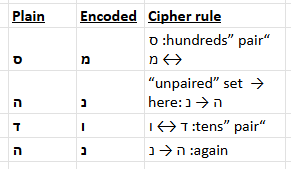
See Hebrew Wikipedia ibid. (previous note), that this cipher swaps letters in pairs whose gematria sums to a “round” number (10, 100, and—per the common version—1000).
Because they don’t have a partner that completes 10 / 100 / 1000, certain letters are treated as “singletons” and swap among themselves: heh (5) and nun (50).
גלות - galut.
On galut in the Talmud, see my discussions here:
“Chronology, Calculations, and Royal Reigns: The 70 Years of Babylonian Exile Between the First and Second Temples (Esther 1:2, Jeremiah 29:10, Daniel 9:2; Megillah 11b-12a)“, section “Note on the word “Exile” (Galut)”
“The Divine Providence of Galut: A Talmudic Perspective on the Jewish Diaspora As A Shield Against Genocide of the Jewish Nation (Pesachim 87b)“
I.e Arabs.
For other discussions of “Ishmaelites” in the Talmud, see these pieces of mine:
“Appendix #2a - Bear-Like Persians and Other Cultural Metaphors: Perspectives on Nations, Magi, and Babylonian Torah scholars (Kiddushin 72a, sections #9-10)“, list item #3, where I summarize: “Ishmaelites are described as resembling demons of an outhouse (בית הכסא).“
“ ‘The Land of Canaan is Ours’: Alexander the Great as Moderator of Territorial Claims on ‘Canaan’ by Africans and Arabs in the Talmud (Sanhedrin 91a)“, where Arabs are referred to as “B’nei Ishmael” (בני ישמעאל)