

This is the third and final part of a three-part series. Part 1 is here; Part 2 is here; the outline of the series can be found at Part 1.
R’ Elazar - Even in God’s anger, He remembers mercy
אמר רבי אלעזר:
אפילו בשעת כעסו של הקדוש ברוך הוא --
זוכר את הרחמים.
R’ Elazar said:
Even at God’s time of anger --
He remembers the attribute of compassion,
Prooftext - Hosea 1:6
שנאמר:
״כי לא אוסיף עוד ארחם את בית ישראל״.
as it is stated:
“For I will no more have compassion upon the house of Israel” (Hosea 1:6).
Even when implementing His attribute of justice, God still mentions His attribute of compassion.
R’ Yosei b. Ḥanina - God’s mercy is also implied by “I will surely bear them,” meaning eventual forgiveness - Hosea 1:6
רבי יוסי בר רבי חנינא אמר:
מהכא:
״כי נשא אשא להם״.
R’ Yosei bar R’ Ḥanina said that
this is also indicated from here, from the continuation of the verse, which states:
“That I should bear them,”
indicating that God promised to eventually bear Israel’s sins and pardon them.
R’ Elazar - Israel was exiled among the nations so converts would be added to them, like seed producing a larger harvest - Hosea 2:25
ואמר רבי אלעזר:
לא הגלה הקדוש ברוך הוא את ישראל לבין האומות אלא כדי שיתוספו עליהם גרים,
שנאמר:
״וזרעתיה לי בארץ״.
כלום אדם זורע סאה אלא להכניס כמה כורין?
And R’ Elazar said:
God exiled Israel among the nations only so that converts would join1 them,
as it is stated:
“And I will sow her to Me in the land” (Hosea 2:25).
Does a person sow a se’a of grain for any reason other than to bring in several kor of grain during the harvest?
So too, the exile is to enable converts from the nations to join the Jewish people.
R’ Yoḥanan - The same idea is derived from God having compassion on “not pitied” and calling “not My people” His people - Hosea 2:25
ורבי יוחנן אמר מהכא:
״ורחמתי את לא רחמה״.
And R’ Yoḥanan said that this idea may be derived from here:
“And I will have compassion upon her that had not received compassion;
and I will say to them that were not My people: You are My people” (Hosea 2:25).
Even those who were initially “not My people,” i.e., non-Jews, will convert and become part of the Jewish nation.
R’ Yoḥanan citing R’ Shimon ben Yoḥai - Even when a generation is wicked, one must not slander God’s servants (=Jews) to their Master (=God) - Proverbs 30:10–11
אמר רבי יוחנן, משום רבי שמעון בן יוחי,
מאי דכתיב:
״אל תלשן עבד אל אדוניו
פן יקללך
ואשמת״,
R’ Yoḥanan said in the name of R’ Shimon ben Yoḥai:
What is the meaning of that which is written:
“Slander not a servant to his master,
lest he curse you,
and you be found guilty” (Proverbs 30:10),
וכתיב:
״דור אביו יקלל
ואת אמו לא יברך״,
משום דאביו יקלל ואת אמו לא יברך —
אל תלשן?
and it is then written in the next verse:
“There is a generation that curses its father,
and does not bless its mother” (Proverbs 30:11).
Is it because they curse their father and do not bless their mother --
that you should not slander them?!
Clearly that is absurd.
אלא,
אפילו דור שאביו יקלל ואת אמו לא יברך —
אל תלשן עבד אל אדוניו.
Rather,
the juxtaposition serves to emphasize that even in a wicked generation (of Jews) that curses its father and does not bless its mother --
one should not slander a servant (=Jews) to his master (=God)
... and this is learned from Hosea
מנלן?
מהושע.
[...]
From where do we derive this?
From Hosea2
[...]
R’ Ḥiyya - God exiled Israel to Babylonia because He knew they could not endure Roman decrees - Job 28:23
תני רבי חייא,
מאי דכתיב:
״אלהים הבין דרכה
והוא ידע את מקומה״,
R’ Ḥiyya teaches:
What is the meaning of that which is written:
“God understands its ways
and He knows its place” (Job 28:23)?
יודע הקדוש ברוך הוא את ישראל שאינן יכולין לקבל גזירות של רומיים,
לפיכך הגלה אותם לבבל.
God knows that the Jewish people are unable to withstand the harsh decrees of the Romans.
Therefore, He exiled them to Babylonia3
R’ Elazar - Israel was exiled to Babylonia because it is deep like Sheol, fitting redemption from Sheol - Hosea 13:14
ואמר רבי אלעזר:
לא הגלה הקדוש ברוך הוא את ישראל לבבל אלא מפני שעמוקה כשאול,
שנאמר:
״מיד שאול אפדם
ממות אגאלם״.
And R’ Elazar said:
God exiled Israel to Babylonia only due to the fact it is a land as deep as the netherworld,4 i.e., it is a land of plains and valleys,
which alludes to that which is stated:
“I shall ransom them from the power of the netherworld,
I shall redeem them from death” (Hosea 13:14).
R’ Ḥanina - Israel was exiled to Babylonia because Aramaic is close to Hebrew (“the language of Torah”)
רבי חנינא אמר:
מפני שקרוב לשונם ללשון תורה.
R’ Ḥanina said:
It is due to the fact that their language, Aramaic, is similar to the language of the Torah (i.e. Hebrew),
which enables the Jews who live there to study Torah.
R’ Yoḥanan - Israel was exiled to Babylonia as to its mother’s house
רבי יוחנן אמר:
מפני ששיגרן לבית אמן.
R’ Yoḥanan said:
It is due to the fact that He sent them (שיגרן) to their mother’s house5
... like a wife sent back to her mother’s home
משל לאדם שכעס על אשתו,
להיכן משגרה?
לבית אמה.
This is comparable to a man who is angry at his wife;
to where does he send her?
He sends her to her mother’s house.
R’ Alexandri - Three things returned to their origin: Israel to Babylonia, Egyptian wealth to Egypt, and the writing of the Tablets upward
והיינו דרבי אלכסנדרי, דאמר:
שלשה חזרו למטעתן,
אלו הן:
ישראל,
כסף מצרים,
וכתב לוחות.
And this is expressed in the statement of R’ Alexandri, who said:
There are 3 that returned to their points of origin,
and these are they:
The Jewish people,
the money of Egypt,
and the writing on the Tablets of the Covenant.
Prooftexts - I Kings 14:25–26; Deuteronomy 9:17; Baraita - When the Tablets broke, the letters flew away
ישראל —
הא דאמרן.
כסף מצרים,
דכתיב: ״ויהי בשנה החמישית למלך רחבעם, עלה שישק מלך מצרים על ירושלים וגו׳״.
כתב הלוחות,
דכתיב: ״ואשברם לעיניכם״,
תנא:
לוחות נשברו
ואותיות פורחות.
The Jewish people;
that which we just said, they returned to Babylonia.
The money of Egypt;
as it is written: “And it came to pass in the 5th year of King Rehoboam, that Shishak, king of Egypt, came up against Jerusalem; and he took away the treasures of the house of YHWH and the treasures of the king’s house; he took everything” (I Kings 14:25–26).6
The writing on the Tablets of the Covenant;
as it is written: “And I took hold of the two tablets, and cast them out of my two hands, and broke them before your eyes” (Deuteronomy 9:17).
And it was taught in the Tosefta:
The tablets were broken
and the letters are flying and returning to their point of origin.
Ulla - Israel was exiled to Babylonia so they could eat dates and study Torah
עולא אמר:
כדי שיאכלו תמרים
ויעסקו בתורה.
Ulla said:
Israel was exiled to Babylonia in order to enable them to eat the dates that grow there plentifully,
which gave them strength and allowed them to engage in Torah study.
Anecdote about Ulla - he first criticized Babylonians for not learning more despite cheap dates
עולא איקלע לפומבדיתא,
קריבו ליה טירינא דתמרי.
אמר להו: כמה כי הני בזוזא?
אמרו ליה: תלת בזוזא.
אמר:
מלא צנא דדובשא בזוזא,
ובבלאי לא עסקי באורייתא?!
The Talmud records a related incident:
Ulla visited Pumbedita,
and his hosts brought him a basket [tirina] of dates.
He said to them: How many baskets of dates like these can one purchase for a zuz?
They said to him:
One can purchase 3 for a zuz.
He said:
How can it be that it is possible to purchase a basketful of date honey for just a single zuz,
and yet the Babylonians do not engage in Torah study more extensively?!
Since the cost of food is so low and they do not need to work hard to support themselves, the Babylonians should be more extensively engaged in Torah study.
... then after indigestion, praised them for learning despite the dates’ harmful effect
בליליא צערוהו.
אמר:
מלא צנא סמא דמותא בזוזא בבבל,
ובבלאי עסקי באורייתא!
That night, the dates he ate afflicted him and he suffered from indigestion.
In light of this, Ulla retracted his original assessment of the Babylonians and instead praised them and said:
A basketful of lethal poison, i.e., the dates that cause indigestion, sells for a zuz in Babylonia,
and despite the fact that they suffer its effects the Babylonians still engage in Torah study!
R’ Elazar - The future Temple is called specifically “God of Jacob,” because Abraham called it a mountain, Isaac a field, but Jacob called it a house - Isaiah 2:3; Genesis 22:14, 24:63, 28:19
ואמר רבי אלעזר:
מאי דכתיב:
״והלכו עמים רבים ואמרו:
לכו ונעלה אל הר ה׳
אל בית אלהי יעקב וגו׳״.
The Talmud returns to its discussion of prophecies of consolation that are related to those in the book of Hosea.
And R’ Elazar said:
What is the meaning of that which is written:
“And many peoples shall go and say:
Go and let us go up to the mountain of YHWH,
to the house of the God of Jacob;
and He will teach us of His ways, and we will walk in His paths” (Isaiah 2:3)?
אלהי יעקב,
ולא אלהי אברהם ויצחק?
The Talmud notes that Jacob is the only Patriarch mentioned and asks:
Is He the God of Jacob
and not the God of Abraham and Isaac?
אלא:
לא כאברהם
שכתוב בו ״הר״,
שנאמר: ״אשר יאמר היום: בהר ה׳ יראה״,
ולא כיצחק
שכתוב בו ״שדה״,
שנאמר: ״ויצא יצחק לשוח בשדה״,
אלא כיעקב
שקראו ״בית״,
שנאמר: ״ויקרא את שם המקום ההוא בית אל״.
Rather,
the verse specifically mentions Jacob to allude to the fact that the Temple will ultimately be described in the same way that Jacob referred to it:
It will not be referred to as it was referred to by Abraham.
It is written of him that when he prayed at the location of the Temple mountain, he called it “mountain”,
as it is stated: “As it is said on this day: On the mountain where YHWH is seen” (Genesis 22:14).
And it will not be referred to as it was referred to by Isaac.
It is written of him that he called the location of the Temple “field” when he prayed there,
as it is stated: “And Isaac went out to meditate in the field” (Genesis 24:63).
Rather, it will be described as it was referred to by Jacob,
who called it “house”,
as it is stated: “And he called the name of that place Beth-El” (Genesis 28:19), which means “house of God”.
R’ Yoḥanan - The ingathering of exiles is as great as the creation of heaven and earth
אמר רבי יוחנן:
גדול קבוץ גליות כיום שנבראו בו שמים וארץ,
R’ Yoḥanan said:
The day of the ingathering of exiles (קבוץ גליות) is as great as the day on which heaven and earth were created.
Prooftexts - based on “day” in both passages - Hosea 2:2; Genesis 1:5
שנאמר:
״ונקבצו בני יהודה ובני ישראל יחדו
ושמו להם ראש אחד
ועלו מן הארץ
כי גדול יום יזרעאל״,
This is derived by means of a verbal analogy between the word day in these two contexts,
as it is stated concerning the ingathering of exiles:
“And the children of Judea and the children of Israel shall be gathered together,
and they shall appoint themselves one head,
and shall go up out of the land;
for great shall be the day of Jezreel” (Hosea 2:2),
וכתיב:
״ויהי ערב
ויהי בקר
יום אחד״.
and it is written in the narrative of Creation:
“And there was evening
and there was morning,
one day” (Genesis 1:5).
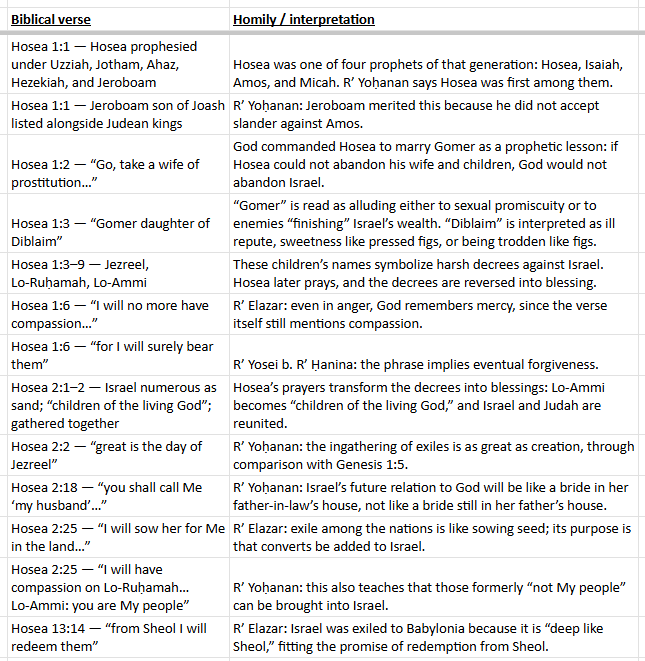
Appendix - the sugya’s homiletic material on Hosea, ordered by biblical verse sequence
יתוספו - literally: “be added”.
For a different Talmudic explanation of the divine logic behind Israel’s dispersion into the diaspora, see my “The Divine Providence of Galut: A Talmudic Perspective on the Jewish Diaspora As A Shield Against Genocide of the Jewish Nation (Pesachim 87b)”.
Steinsaltz explains:
[Hosea’s] criticism of the Jewish people (God’s servants) to God (their master) aroused [God’s] ire, despite the fact that it was a wicked generation.
Note that I discussed the Talmud’s subsequent few sections in my “The Divine Providence of Galut” (cited in previous footnote); therefore, I elide it here.
Steinsaltz explains:
[Babylonian] people are less cruel.
However, more likely, it’s referring to the fact that Babylonia was ruled by (Sasanid) Persia, which was perceived by the Talmud as more tolerant toward Jews.
Steinsaltz explains:
i.e., the birthplace of the forefathers of the Jewish people, who lived in Aram-Nahara’im, which is in Babylonia.
However, more precisely, see Genesis 11:28, 31, where it says that Abraham came from “Ur Kasdim”, which is traditionally identified with the city of Ur in Chaldea/Babylonia.
Compare elsewhere, in my “Appendix - Rav Yehuda citing Shmuel - “All the silver and gold in the world”: The Historical Chain of Global Wealth Transfers, from Joseph to Rome - over the course of 14 steps and 1500 years (Pesachim 119a)“, especially list items #1-3, which I summarize as follows:
The Talmud traces the treasure’s path from Joseph to Rome, listing each transfer:
“Joseph collected and brought to Egypt all the silver and gold in the world”
The Israelites took it with them during the Exodus; it stays in Judah until Rehoboam (1st king of Judah)
Shishak of Egypt (שישק מלך מצרים) takes it from Rehoboam - homiletically derived from I Kings 14:25-26