

This sugya sets out boundaries for what parts of Scripture are publicly read, what is publicly translated into the vernacular, and what is avoided altogether. Its working assumption is the standard synagogue practice of public Bible reading together with targum (oral translation into Aramaic), aimed at making the reading intelligible to the wider audience. The sugya treats translation as an intensifier: when a passage is translated, its plain sense and implications are made more immediate and widely grasped. The rules therefore manage two competing values: public instruction through accessible reading, and protection against predictable misunderstandings or social damage caused by broadcasting sensitive content.1
The opening rulings distinguish between “read and translated” and “read but not translated” for specific narratives. Reuben’s sin (Genesis 35:22)2 is read but not translated. The story of Tamar and Judah (Genesis 38) is read and translated. The sin of the Golden Calf is split: the primary narrative (Exodus 32:1–20) is read and translated, while Aaron’s later account to Moses (Exodus 32:21–24/25) is read but not translated. The sugya then extends the “read but not translated” category to the Priestly Blessing (Numbers 6:24–26) and the David–Amnon episode (II Samuel 13).
A related set of rules concerns the haftara (the prophetic reading used to conclude the Torah reading). The Mishnah prohibits concluding with the account of the Divine Chariot (Ma’aseh Merkava) in Ezekiel 1.3 R. Yehuda permits it. R. Eliezer adds a different restriction: one may not conclude with Ezekiel 16.4
The Talmud then anchors the discussion in a baraita that formalizes a three-way taxonomy: (1) passages read and translated, (2) passages read but not translated, and (3) passages neither read nor translated. The “read and translated” list is extensive and includes narratives of origins and moral failure (Creation; Lot and his daughters; Judah and Tamar; the Golden Calf), covenantal admonitions (blessings/curses; “warnings and punishments”), and national catastrophe or civil and sexual breakdown (Amnon and Tamar; Absalom;5 the concubine at Gibeah), as well as Ezekiel 16.
Two narrative interludes illustrate how these policies are applied. First, regarding Reuben, the baraita reports an episode in which R. Ḥanina b. Gamliel stops the translator and instructs him to render only the end of the verse (“and Israel heard”), effectively minimizing the broadcast of the explicit act while preserving the public reading. The Sages’ praise frames this as proper boundary-setting within the practice of translation itself. Second, regarding Ezekiel 16, a baraita recounts a reader who chose that haftara in R. Eliezer’s presence; R. Eliezer rebukes him sharply, and the narrative ends with an investigation that finds a flaw in the reader’s lineage.
The Golden Calf sub-case is then used to extract a general ethical rule about speech. R. Shimon b. Elazar reads Aaron’s explanation (“I cast it into the fire and this calf came out”) as a cautionary example: an attempted justification can be worse than the original deed because it invites skeptical or heretical reinterpretation.
The sugya then shifts from “what to translate” to “how to read aloud,” introducing a separate but adjacent norm: verses written with coarse language are publicly read with refined substitutes. A baraita lists examples in Deuteronomy and 2 Kings where the synagogue reading replaces an indelicate term with a euphemism.
That norm is immediately qualified: R. Yehoshua b. Korḥa objects to euphemizing one term for “latrines” in a verse about degrading idolatry, insisting it should be read as written because the coarseness functions as contempt for idol worship. Rav Naḥman generalizes the principle: mockery and obscenity are ordinarily prohibited, except mockery of idol worship, which is permitted. The sugya supplies prophetic prooftexts that portray idols as stooping or “bearing a burden,” read as scatological derision. It then extends this permissibility into speech-acts (permitted insults directed at idolatry) and finally into reputation discourse: Rav Ashi allows public derogation of someone with a notorious sexual reputation using an acronym insult, while also affirming that public praise is permitted and even meritorious.
Outline
Intro
The Passage - Public Bible Reading, Translation, and Decorum: Regulating Sensitive Scripture in the Synagogue (Mishnah Megillah 4:10; Megillah 25a-b)
Mishnah (Megillah 4:10)
Public reading/translation rules: Reuben (Genesis 35:22) is read not translated; Tamar (Genesis 38) is read and translated; 1st Golden Calf passage (Exodus 32:1–20) read+translated, 2nd Golden Calf passage (Exodus 32:21–24) read not translated; Priestly Benediction (Numbers 6:24–26) and David–Amnon (II Samuel 13) read not translated
Haftara rules: no Haftara with the Chariot (Ezekiel 1); R’ Yehuda permits; R’ Eliezer forbids “Make known Jerusalem her abominations” (Ezekiel 16:2)
Talmud
Baraita - Tripartite list: sections read+translated; read not translated; neither read nor translated
Biblical sections publicly read and translated - a list of 10: Creation (Genesis 1); Lot and his daughters (Genesis 19:30–38); Judah and Tamar (Genesis 38); Golden Calf (Exodus 32); Blessings and Curses (Leviticus 26; Deuteronomy 28); Amnon and Tamar (2 Samuel 13); Absalom’s rebellion (2 Samuel 15–18); the Concubine in Gibeah (Judges 19–21); “Make known to Jerusalem her abominations” (Ezekiel 16)
Baraita - Anecdote of R’ Eliezer: reader recited “Make known Jerusalem…” ; R’ Eliezer insulted him; they checked and found a lineage “stain” - Ezekiel 16:2
Baraita - Reuben (Genesis 35:22) is read not translated
Anecdote of R’ Ḥanina ben Gamliel in Kabul - instructs translator to translate only the verse’s end; sages praise him
The second narrative of the incident of the Golden Calf = Exodus 32:21-25
R’ Shimon ben Elazar - Moral of Aaron’s report: be careful how you explain yourself; sometimes the excuse is worse than the deed, causing skeptics to apostasize - Exodus 32:24 (context of Exodus 32:21–24)
Baraita - Vulgar scriptural terms are read with refined substitutes - A list of 5 instances (yishgalena→yishkavena; afolim→teḥorim; ḥiryonim→divyonim; etc) - Deuteronomy 28:30, 27; II Kings 6:25, 18:27, 10:27
R’ Yehoshua ben Korḥa - Disputes the final list item: “le-moḥra’ot” (latrines) is read as written, since it expresses contempt for idol worship - II Kings 10:27
Rav Naḥman - General rule: mockery/obscenity is forbidden except mockery of idol worship, which is permitted
Prooftext - Isaiah 46:1–2
R’ Yannai - Alternative prooftext (with wordplay): read “kevodo” as “keveido” (“its burden”), mocking idols as defecating - Hosea 10:5
Rav Huna bar Manoaḥ citing Rav Aḥa b. Ika - Permits telling a non-Jew: take your idol and put it in your “shin–tav” (ie, shet, buttocks)
Rav Ashi - Permits publicly humiliating someone with a bad (sexual) reputation using an acronym insult; permits praising someone with a good reputation; and blesses the praiser
Appendix - Table Summarizing by Biblical Passage / Topic
The Passage
Mishnah (Megillah 4:10)
Public reading/translation rules: Reuben (Genesis 35:22) is read not translated; Tamar (Genesis 38) is read and translated; 1st Golden Calf passage (Exodus 32:1–20) read+translated, 2nd Golden Calf passage (Exodus 32:21–24) read not translated; Priestly Benediction (Numbers 6:24–26) and David–Amnon (II Samuel 13) read not translated
מעשה ראובן —
נקרא ולא מתרגם.
מעשה תמר —
נקרא ומתרגם.
מעשה עגל הראשון —
נקרא ומתרגם,
והשני —
נקרא ולא מתרגם.
ברכת כהנים,
מעשה דוד ואמנון —
נקראין ולא מתרגמין.
The incident of Reuben, about which it says: “And Reuben went and lay with Bilhah, his father’s concubine” (Genesis 35:22),
is read from the Torah in public but not translated,
so that the uneducated not come to denigrate Reuben.
The incident of Tamar (Genesis, chapter 38)
is read in public and also translated.
The first report of the incident of the Golden Calf, i.e., the Torah’s account of the incident itself (Exodus 32:1–20),
is read and translated,
but the second narrative, i.e., Aaron’s report to Moses of what had taken place (Exodus 32:21–24)
is read but not translated.
The verses constituting the Priestly Benediction (Numbers 6:24–26)
and the incident of David and Amnon (II Samuel, chapter 13)
are read, but not translated.
Haftara rules: no Haftara with the Chariot (Ezekiel 1); R’ Yehuda permits; R’ Eliezer forbids “Make known Jerusalem her abominations” (Ezekiel 16:2)
אין מפטירין במרכבה,
ורבי יהודה מתיר.
רבי אליעזר אומר:
אין מפטירין ב״הודע את ירושלם״.
One may not conclude (מפטירין) the Torah reading with by reading from the Prophets the account of the Divine Chariot (Ezekiel, chapter 1), so as not to publicize that which was meant to remain hidden.
And R’ Yehuda permits it.
R’ Eliezer says:
One may not conclude with section from the Prophets beginning with: “Make known to Jerusalem her abominations” (Ezekiel 16:2),
because it speaks derogatively of the Jewish people.
Talmud
Baraita - Tripartite list: sections read+translated; read not translated; neither read nor translated
תנו רבנן:
יש נקרין ומתרגמין,
ויש נקרין ולא מתרגמין,
ויש לא נקרין ולא מתרגמין.
A baraita states in the Tosefta (3:31):
There are portions of the Bible that are read and translated;
there are portions that are read but not translated;
and there are portions that are neither read nor translated.
Biblical sections publicly read and translated - a list of 10: Creation (Genesis 1); Lot and his daughters (Genesis 19:30–38); Judah and Tamar (Genesis 38); Golden Calf (Exodus 32); Blessings and Curses (Leviticus 26; Deuteronomy 28); Amnon and Tamar (2 Samuel 13); Absalom’s rebellion (2 Samuel 15–18); the Concubine in Gibeah (Judges 19–21); “Make known to Jerusalem her abominations” (Ezekiel 16)
אלו נקרין ומתרגמין.
בל״ת עק״ן נשפ״ה
סימן.
The following are read and translated:
The Hebrew acronym
bet,
lamed,
tav;
ayin,
kuf,
nun;
nun,
shin,
peh,
heh
comprise a mnemonic6 for the sections included in this category, as the Talmud will explain.
The Biblical sections sections publicly read that are indicated by the letters of the mnemonic are listed:7
Creation (מעשה בראשית - Genesis 1 ; the Creation narrative).
Lot and his two daughters (Genesis 19:30–38)
Judah and Tamar (Genesis 38)
Golden Calf (עגל - Exodus 32 ; the narrative of the sin).
Blessings and curses (ברכות וקללות / תוכחה)8
“Warnings and punishments” (אזהרות ועונשין - a general label rather than a single story; in Torah-reading contexts it often points to a legal/covenantal “admonitions” section; frequently overlapping with the tochacha material above).
Amnon and Tamar (2 Samuel 13)
Absalom (2 Samuel 15–18 - rebellion and aftermath; with relevant lead-in in 2 Samuel 13–14).
The concubine in Gibeah (פילגש בגבעה - Judges 19 ; leading into the civil war narrative in Judges 20–21).
“Make known to Jerusalem her abominations” (הודע את־ירושלים את־תועבותיה - Ezekiel 16; prophetic allegory/indictment).
מעשה בראשית
נקרא ומתרגם [...]
מעשה לוט ושתי בנותיו
נקרא ומתרגם [...]
מעשה תמר ויהודה
נקרא ומתרגם [...]
מעשה עגל הראשון
נקרא ומתרגם [...]
קללות וברכות
נקרין ומתרגמין [...]
אזהרות ועונשין
נקרין ומתרגמין [...]
מעשה אמנון ותמר
נקרא ומתרגם
[מעשה אבשלום
נקרא ומתרגם] [...]
מעשה פילגש בגבעה
נקרא ומתרגם [...]
״הודע את ירושלם את תועבותיה״
נקרא ומתרגם [...]
The sections indicated by the letters of the mnemonic are listed:
The section of the act of Creation [bereshit],
is read and translated
alluded to by the letter bet [...]
The incident of Lot and his two daughters
is read and translated.
The name Lot begins with a lamed, the second letter of the mnemonic [...]
The incident of Tamar and Judah
is read and translated
beginning with a tav [...]
The first report of the incident of the Golden Calf [egel]
is read and translated.
Egel begins with the letter ayin, the next letter of the mnemonic [...]
The curses [kelalot] and blessings
are read and translated.
The warnings and punishments [onashin],
are read and translated
alluded to in the first nun of the mnemonic [...]
The incident of Amnon and Tamar,
is read and translated
alluded to in the second nun in the mnemonic
the incident of Absalom
is read and translated,
alluded to in the shin of the mnemonic, the 3rd letter of his name [...]
The incident of the concubine [pilegesh] in Gibeah
is read and translated [...]
The section of: “Make known [hoda] to Jerusalem her abominations” (Ezekiel 16:2)
is read and translated [...]
Baraita - Anecdote of R’ Eliezer: reader recited “Make known Jerusalem…” ; R’ Eliezer insulted him; they checked and found a lineage “stain” - Ezekiel 16:2
תניא:
מעשה באדם אחד
שהיה קורא למעלה מרבי אליעזר ״הודע את ירושלם את תועבותיה״.
אמר לו:
עד שאתה בודק בתועבות ירושלים
צא ובדוק בתועבות אמך
it is taught in a baraita:
There was an incident with regard to a certain man
who was reading the haftara in the presence of R’ Eliezer, and he read the section of: “Make known to Jerusalem her abominations.”
R’ Eliezer said to him:
Before you examine the abominations of Jerusalem,
go and examine the abominations of your own mother.
בדקו אחריו
ומצאו בו שמץ פסול.
they examined his lineage
and found him to have a stain (שמץ) of illegitimacy (פסול)
His mother had engaged in illicit sex, and therefore he was of questionable lineage.
Baraita - Reuben (Genesis 35:22) is read not translated
ואלו נקרין ולא מתרגמין,
(רעבד״ן
סימן)
The Tosefta also states: And these sections are read but are not translated.
The acrostic composed of the letters
reish,
ayin,
bet,
dalet,
nun
is a mnemonic for the sections included in this category, as the Talmud will explain.
מעשה ראובן נקרא ולא מתרגם.
The Tosefta states that the incident of Reuben is read but not translated.
The name Reuben begins with a reish, the first letter of the mnemonic.
Anecdote of R’ Ḥanina ben Gamliel in Kabul - instructs translator to translate only the verse’s end; sages praise him
ומעשה ברבי חנינא בן גמליאל
שהלך לכבול,
והיה קורא חזן הכנסת ״ויהי בשכון ישראל״,
ואמר לו למתורגמן:
(הפסק)
אל תתרגם אלא אחרון,
ושיבחוהו חכמים.
And there was an incident involving R’ Ḥanina ben Gamliel,
who went to the village of Kabul,
and the sexton (חזן) of the synagogue was reading: “And it came to pass, while Israel dwelt in that land, that Reuben went and lay with Bilhah, his father’s concubine; and Israel heard of it” (Genesis 35:22).
R’ Ḥanina said to the translator:
Stop!
translate only the end of the verse.
And the Sages praised him for this.
The second narrative of the incident of the Golden Calf = Exodus 32:21-25
מעשה עגל השני נקרא ולא מתרגם.
איזה מעשה עגל השני?
מן ״ויאמר משה״
עד ״וירא משה״.
The Tosefta continues: The second narrative of the incident of the Golden Calf is read but not translated.
Egel, the Hebrew word for calf, begins with an ayin, the second letter in the mnemonic.
The Talmud explains: What is the second narrative of the incident of the Golden Calf?
Aaron’s account of what had taken place, from “And Moses said to Aaron” (Exodus 32:21)
until “And Moses saw” (Exodus 32:25).
R’ Shimon ben Elazar - Moral of Aaron’s report: be careful how you explain yourself; sometimes the excuse is worse than the deed, causing skeptics to apostasize - Exodus 32:24 (context of Exodus 32:21–24)
תניא,
רבי שמעון בן אלעזר אומר:
לעולם יהא אדם זהיר בתשובותיו,
שמתוך תשובה שהשיבו אהרן למשה --
פקרו המערערים,
שנאמר:
״ואשליכהו באש ויצא העגל הזה״
[...]
With regard to Aaron’s account, the Talmud cites that which is taught in a baraita:
R’ Shimon ben Elazar says:
A person should always be careful in the way he formulates his responses,9 as sometimes the explanation that a person provides for his actions is worse than the original action itself,
As, for example, based on Aaron’s response to Moses --
the skeptics (מערערים) renounced (פקרו) their religious beliefs.
It is stated in Aaron’s response: “And I cast it into the fire and this calf came forth” (Exodus 32:24).
This formulation implies that the calf came from the fire by itself, suggesting that it had divine power and substance.
[...]
Baraita - Vulgar scriptural terms are read with refined substitutes - A list of 5 instances (yishgalena→yishkavena; afolim→teḥorim; ḥiryonim→divyonim; etc) - Deuteronomy 28:30, 27; II Kings 6:25, 18:27, 10:27
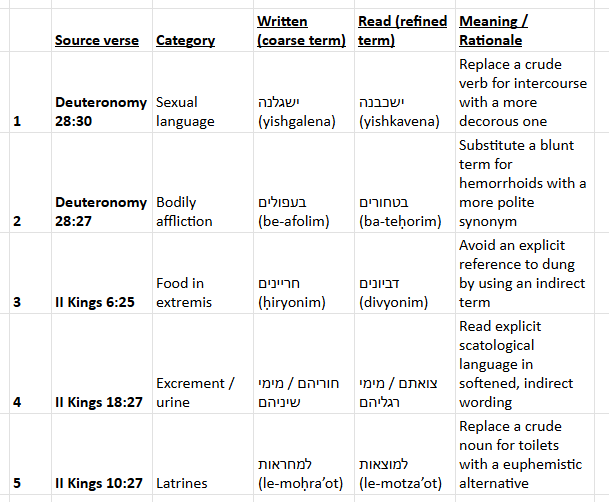
(See footnote).10
תנו רבנן:
כל המקראות הכתובין בתורה לגנאי —
קורין אותן לשבח,
§ A baraita states:
All of the verses that are written in the Torah in a coarse manner --
are read in a refined manner.
כגון:
״ישגלנה״ —
ישכבנה,
״בעפולים״ —
בטחורים,
״חריונים״ —
דביונים,
״לאכול את חוריהם ולשתות את מימי שיניהם״ —
לאכול את צואתם ולשתות את מימי רגליהם.
״למחראות״ —
למוצאות
For example,
the term “shall lie with her [yishgalena]” (Deuteronomy 28:30)
is read as though it said yishkavena, which is a more refined term.
The term “with hemorrhoids [be-afolim]” (Deuteronomy 28:27)
is read ba-teḥorim.
The term “doves’ dung [ḥiryonim]” (II Kings 6:25)
is read divyonim.
The phrase “to eat their own excrement [ḥoreihem] and drink their own urine [meimei shineihem]” (II Kings 18:27)
is read with more delicate terms: To eat their own excrement [tzo’atam] and drink their own urine [meimei ragleihem].
The term “into latrines [le-moḥra’ot]” (II Kings 10:27)
is read as the more refined le-motza’ot.
R’ Yehoshua ben Korḥa - Disputes the final list item: “le-moḥra’ot” (latrines) is read as written, since it expresses contempt for idol worship - II Kings 10:27
רבי יהושע בן קרחה אומר:
״למחראות״ כשמן,
מפני שהוא גנאי לעבודה זרה.
R’ Yehoshua ben Korḥa says:
Le-moḥara’ot is read as it is written
because it is used here as an expression of contempt for idol worship,
and it is therefore permissible to use an indelicate term.
Rav Naḥman - General rule: mockery/obscenity is forbidden except mockery of idol worship, which is permitted
אמר רב נחמן:
כל ליצנותא אסירא,
בר מליצנותא דעבודה זרה —
דשריא.
Similarly, Rav Naḥman said:
All mockery and obscenity is forbidden
except for mockery of idol worship --
which is permitted,
Prooftext - Isaiah 46:1–2
דכתיב:
״כרע בל
קרס נבו״,
וכתיב:
״קרסו
כרעו יחדיו
לא יכלו מלט משא וגו׳״.
as it is written:
“Bel bows down,
Nabu stoops” (Isaiah 46:1).
The prophet mocks these idols by describing them as crouching in order to defecate.
Additionally, it is written:
“They stoop,
they bow down together;
they could not deliver the burden” (Isaiah 46:2).
R’ Yannai - Alternative prooftext (with wordplay): read “kevodo” as “keveido” (“its burden”), mocking idols as defecating - Hosea 10:5
רבי ינאי אמר,
מהכא:
״לעגלות בית און יגורו שכן שומרון
כי אבל עליו עמו
וכמריו עליו יגילו
על כבודו
כי גלה ממנו״.
R’ Yannai said:
This principle that one is permitted to mock idol worship is derived from here:
“The inhabitants of Samaria shall be in dread for the calves of Beth-aven;
for its people shall mourn over it,
and its priests shall tremble for it,
for its glory,
because it is departed from it” (Hosea 10:5).
אל תקרי ״כבודו״,
אלא ״כבידו״.
Do not read it is as “its glory [kevodo],”
rather read it as its burden [keveido],
meaning that it is unable to restrain itself from defecating.
Rav Huna bar Manoaḥ citing Rav Aḥa b. Ika - Permits telling a non-Jew: take your idol and put it in your “shin–tav” (ie, shet, buttocks)
אמר רב הונא בר מנוח, משמיה דרב אחא בריה דרב איקא:
שרי ליה לבר ישראל למימר ליה לגוי:
שקליה לעבודה זרה
ואנחיה ב”שין תיו” שלו.
Rav Huna bar Manoaḥ said in the name of Rav Aḥa, son of Rav Ika:
It is permitted for a Jew to say to a non-Jew:
Take your idol
and put it in your shin tav,
i.e., shet, buttocks.
Rav Ashi - Permits publicly humiliating someone with a bad (sexual) reputation using an acronym insult; permits praising someone with a good reputation; and blesses the praiser
אמר רב אשי:
האי מאן דסני שומעניה —
שרי ליה לבזוייה בגימל ושין,
Rav Ashi said:
One whose reputation is tarnished,11 i.e., he is known as a philanderer --
it is permitted to humiliate him by calling him gimmel sin,
an acronym for girta sarya, son of a putrid prostitute.
האי מאן דשפיר שומעניה —
שרי לשבוחיה,
ומאן דשבחיה —
ינוחו לו ברכות על ראשו.
One whose reputation is commendable --
it is permitted to publicly praise him,
and one who praises him --
blessings will rest upon his head.
Appendix - Table Summarizing by Biblical Passage / Topic
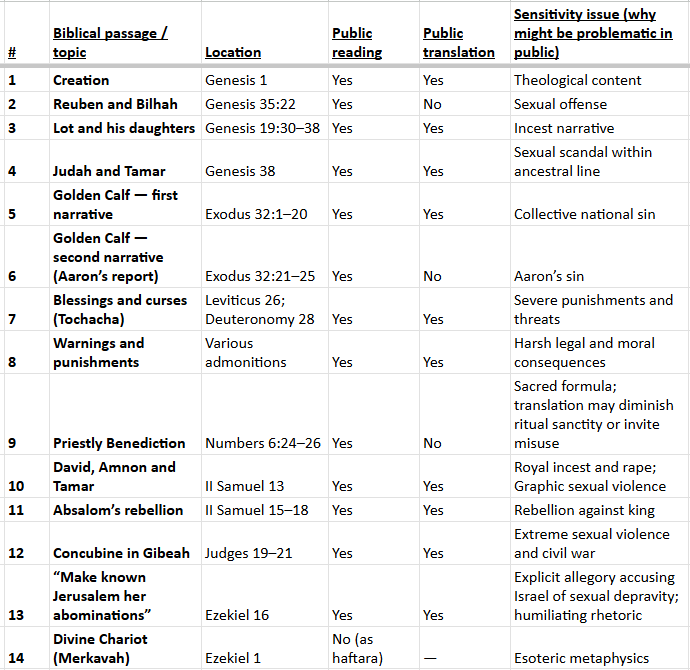
In general, note that narratives relating to sex (especially rape) is one of the main common denominators in the biblical sections discussed in this sugya:
Reuben and Bilhah (Genesis 35:22): incest / sexual transgression
Lot and his daughters (Genesis 19:30–38): incest
Judah and Tamar (Genesis 38): sexual deception
Amnon and Tamar (II Samuel 13): rape
Concubine in Gibeah (Judges 19–21): gang rape and death
“Make known Jerusalem her abominations” (Ezekiel 16): explicit sexualized allegory
And see also previous sugya (in my piece yesterday), which also has sexual themes.
For more on this story in the Talmud, see my “Pt1 ‘Whoever says that [X] sinned is mistaken’: Reinterpretations of Sins In Defense of the Biblical Righteous (Shabbat 55b-56a)“, section “Part 1: Reuben and Bilhah (Genesis 35, 49)“.
I.e., this material is not meant for publicization.
For more on this in the Talmud, see my series “ “Ma’aseh Merkava”: The Nature of God, Angels, and Heaven in Ezekiel 1 (Chagigah 13a-14a)”, final part: Pt3.
Referred to by its incipit (as is typical): “Make known Jerusalem her abominations…”.
See the overview of this chapter in Wikipedia, “Ezekiel 16“, section “Text“:
Ezekiel 16 describes an allegory in which Jerusalem is portrayed as an abandoned child who is rescued and nurtured by God, later becoming His wife. The narrative recounts Jerusalem’s humble beginnings, her growth and prosperity under divine care, and her subsequent unfaithfulness, represented through imagery of adultery and prostitution. The chapter concludes with a statement of judgment and a future promise of restoration within the framework of a renewed covenant.
The rabbis likely wished to prevent this chapter from being publicized due to its major theme of explicitly sexual content, with the extended metaphor of Israel as an adulteress and a prostitute. See the initial footnote, that sex is one of the main common denominators in the biblical sections discussed in this sugya.
And see also the discussion by Eli Duker, “The Haftarah of Parashat Shemot”, at SeforimBlog.com (2021), on the fact that “[t]he Babylonian haftarah for Parashat Shemot was from Ezekiel 16: ‘Hoda’ et yerushalayim’ “.
For more on the story of Absalom in the Talmud, see my “ ‘My Son Absalom!’: The Pride, Punishment, and Aftermath of Absalom in II Samuel 14-19 (Sotah 10b-11a)”.
סימן - from Greek, literally: “sign”.
Note that although this term is commonly rendered in this context as “mnemonic” (as is consistently done in the Steinsaltz edition), it more plausibly denotes a structural marker or schematic outline rather than a memory aid in the modern sense. Its usage aligns with repeated literary structures and list-form organization, as in this case.
Note that for each item in the list, the Talmud interjects with the question “isn’t this obvious?”—i.e., isn’t it self-evident that the passage may be read and translated, since that is the default. It then explains, in each case, why one might have thought the passage should be barred from public reading and translation. I omit those explanations here (indicated with ellipses in brackets, as usual).
Commonly identified with Leviticus 26 (=the Tochacha) and/or Deuteronomy 28 ; the two major Torah “covenant curses” passages; which one is meant can vary by context.
For more on these curses in the Talmud, see my series “ ‘Due to Sin [X], Occurs [Y]’: Divine Justice and Human Responsibility for Suffering and Death (Shabbat 32b-33a)”, final part: Pt3. and see my intro there in Pt1.
Likely referring primarily to responses to sensitive questions and critiques. Compare the Mishnah’s “know how to respond to an apikoros”, cited in my “Tannaitic Aphorisms (Avot 2:10-3:2)“, section “R’ Elazar - Be diligent in Torah; know how to respond to a heretic; remember before whom you labor and that the Employer will reward you (2:14)“.
And see also my “Refuting Heresy: Talmudic Responses to Heretical Claims of Divine Multiplicity in Scripture (Sanhedrin 38b)“, section “Responding to Heresy: R’ Eliezer and R’ Yoḥanan on Engaging with Non-Believers“, where I summarize:
In Avot 2:14, R’ Eliezer advises diligence (שקוד) in learning Torah to be able to respond to heretics.
R’ Yoḥanan qualifies that this applies only to non-Jewish heretics, not Jewish ones, as responding to a Jewish heretic would likely deepen their heresy. His reasoning is that Jewish heresy is intentional, and rebutting it may only strengthen their stance.
This baraita articulates a normative distinction between ketiv (written form) and qeri (public oral realization), motivated by register control. The Torah’s diction is acknowledged as containing lexemes marked as linguistically coarse (גנאי), yet the synagogue performance requires euphemistic substitution (שבח).
Several linguistic mechanisms are at work:
Register substitution: Each example preserves denotation while shifting socio-linguistic register:
ישגלנה → ישכבנה: replacement of a rare/archaic vulgar verb with a neutral, unmarked sexual verb (cf. Deuteronomy 28:30).
עפולים → טחורים: avoidance of an opaque or harsh term in favor of a transparent anatomical euphemism (ibid. 28:27). (See also the discussion by Zev Farber, “Unspoken Hemorrhoids: Making the Torah Reading Polite”, at
TheTorah.com (2016).
Phonetic and affective softening: Terms like חריונים (“dung”) are replaced with diminutive-sounding or less vivid forms (דביונים), reducing acoustic and affective offensiveness (II Kings 6:25).
Lexical taboo management via paraphrase: The long phrase “to eat their own excrement and drink their own urine” is re-lexicalized -
חוריהם / מימי שיניהם → צואתם / מימי רגליהם (ibid. 18:27).
Semantic bleaching through bureaucratic vocabulary
מחראות (“latrines”) → מוצאות (“places of exit”) exemplifies institutional euphemism, replacing bodily reference with spatial abstraction (ibid. 10:27).
The most offensive roots cluster around:
sexual acts, specifically the root SH-G-L (שגל)
On this last one, see Hebrew Wiktionary, “חרא“, section “גיזרון“, my translation:
The word appears in the Bible three times, and only in the written form (ketiv). In two cases it is replaced by the word tzoʾah (“excrement”), and in one case the phrase ḥarei yonim is replaced by divyonim.
Usage in Modern Hebrew is influenced by spoken Israeli Arabic: kharā (cf. Literary Arabic khurʾ “excrement,” khariʾa “to defecate”).
And see Wiktionary, “Reconstruction: Proto-West Semitic/ḫarʔ-“:
Noun
*ḫarʔ- m
shit, a dump (action and product)
Related terms
*ḫariʔ- (“to shit”)
It’s worth noting that the collocated terms genai and shevah more typically have the connotation of “blameworthy” vs. “praiseworthy”; see these pieces of mine:
“Ahasuerus and the Kingship of the World (Esther 1:1; Megillah 11a-b)“, section “Ahasuerus’ Rise to Power (Esther 1:1): Ahasuerus became king on his own, without inheritance; Some see this as a virtue, indicating his suitability, while others view it as proof that he bought his way to the throne“
סני שומעניה - literally: “what’s heard about him (שומעניה - i.e. rumors) is bad”, i.e. he has a bad reputation (most likely relating to illicit sex).
This idiom is used elsewhere in the Talmud, see my “The Laughing Sage and the Stung Scholar: The Story of the Osctracism of the Rabbi With the Bad Reputation (Moed Katan 17a)”.