

This sugya provides a set of allegories linking biblical figures to the value and pursuit of Torah study. The discussion centers on Achsah (Caleb ben Yefune‘s only daughter) and Jabez—figures who appear only briefly in the Bible but are richly reinterpreted in rabbinic tradition.
Through close readings of Joshua 15 and I Chronicles 4, the Talmud transforms their actions and prayers into metaphors for Torah study, pedagogical relationships, and spiritual sustenance.
Achsah’s plea for water becomes a symbol of the human need for Torah, while Jabez’s enigmatic prayer is decoded into a passionate appeal for intellectual growth, communal learning, and moral resilience.
Alongside these interpretations, the Sages introduce layered readings of Proverbs that frame the student-teacher relationship—and even economic interaction—as spiritually charged encounters in which divine justice can upend conventional hierarchies. The result is a dynamic vision of Torah not only as divine wisdom but as the animating force of human life, deserving of urgent and unrelenting pursuit.
Joshua 15:15-19
ויעל משם אל ישבי דבר
ושם דבר לפנים קרית ספר
From there he marched against the inhabitants of Debir—
the name of Debir was formerly Kiriath-sepher—
ויאמר כלב:
אשר יכה את קרית ספר ולכדה
ונתתי לו את עכסה בתי לאשה
וילכדה עתניאל בן קנז אחי כלב
ויתן לו את עכסה בתו לאשה
and Caleb announced:
“to the man who attacks and captures Kiriath-sepher--
I will give my daughter Achsah in marriage”
His kinsman Othniel the Kenizzite captured it;
and Caleb gave him his daughter Achsah in marriage.
ויהי בבואה
ותסיתהו לשאול מאת אביה שדה
ותצנח מעל החמור
ויאמר לה כלב:
מה לך?
When she came [to him],
she induced him to ask her father for some property.
She dismounted (תצנח) from her donkey,
and Caleb asked her:
“What is the matter?”
ותאמר:
תנה לי ברכה
כי ארץ הנגב נתתני
ונתתה לי גלת מים
ויתן לה
את גלת עליות
ואת גלת תחתיות
She replied:
“Give me a present (ברכה);
for you have given me away as Negeb-land;
so give me springs (גלת) of water.”
And he gave her
Upper Gulloth (גלת)
and Lower Gulloth.
I Chronicles 4:9-10
I Chronicles 4:9-10:2
ויהי יעבץ נכבד מאחיו
ואמו קראה שמו יעבץ לאמר:
כי ילדתי בעצב
Jabez was more esteemed than his brothers;
and his mother named him Jabez, saying:
“Because, I bore him in pain (עצב)”
ויקרא יעבץ לאלהי ישראל לאמר:
אם ברך תברכני
והרבית את גבולי
והיתה ידך עמי
ועשית מרעה לבלתי עצבי
ויבא אלהים את אשר שאל
Jabez invoked the God of Israel, saying:
“Oh, bless me,
enlarge my territory,
stand by me,
and make me not suffer pain from misfortune!”
And God granted what he asked.
Outline
Intro
Joshua 15:15-19
I Chronicles 4:9-10
The Passage - Achsah, Othniel, and Jabez, and Allegories for Torah Study in Joshua 15 and I Chronicles 4 (Temurah 16a)
Achsah’s Name and Beauty - Joshua 15:18
Rava citing R’ Yitzḥak - Achsah’s Outcry as a Metaphor for Female Need - Joshua 15:18
The Metaphorical Significance of Achsah’s Request for Water: Achsah’s Request as a Plea for Blessing; Water as a Metaphor for Torah; Sustenance Through Torah Merit - Joshua 15:19
Baraita - Jabez’s Identity and Prayer: Interpretations of a Biblical Figure and His Petition - I Chronicles 4:10
Jabez’s prayer in I Chronicles 4:10 as an allegory for Torah study
R’ Natan - Interpretation of the Teacher-Student Dynamic: Shared Enlightenment Through Teaching; Reversal of Roles When Teaching Is Refused - Proverbs 29:13; 22:2
R’ Yehuda HaNasi - interprets Jabez’s prayer more literally: children; business success; health; righteousness
Proverbs 29:13, 22:2 is interpreted economically—A poor person requests charity from a homeowner (בעל הבית)
The Passage
Achsah’s Name and Beauty - Joshua 15:18
A Talmud explains Achsah’s name as stemming from the Hebrew root “ko’es” (כועס - “angry”), because men who saw her beauty became resentful of their own wives.3
ולמה נקרא שמה ״עכסה״?
שכל הרואה אותה --
כועס על אשתו.
The baraita adds: And why is she called Achsah?
The reason is that anyone who sees her --
became angry [ko’es] about his own wife, who was not as beautiful as Achsah.
Rava citing R’ Yitzḥak - Achsah’s Outcry as a Metaphor for Female Need - Joshua 15:18
The Talmud comments on the verse where Achsah persuades her husband to ask her father, Caleb, for land, and then “alights” from her donkey (Joshua 15:18).
The word “titznaḥ” (תצנח - “she alighted”) can also mean “she cried out.” This prompts the Talmud to interpret the scene not merely as physical dismounting but as emotional or verbal protest.
Achsah uses the image of a hungry donkey to justify her cry: Just as a donkey with no food in its trough (אבוסו) brays (צועק - “screams”), a woman without produce (תבואה) in her home also raises her voice (צועקת - “screams”; suggesting a natural, justified response to lack).
“ויהי
בבואה
ותסיתהו לשאל מאת אביה שדה
ותצנח מעל החמור”
מאי ״ותצנח״?
The Talmud relates another incident involving Achsah. The verse states: “And it came to pass,
when she came to him,
that she persuaded him to ask of her father a field;
and she alighted from off her donkey; and Caleb said to her: What do you want?” (Joshua 15:18).
The Talmud asks: What is the meaning of: “And she alighted [va-titznaḥ],” which can also be understood as crying out?
אמר רבא, אמר רבי יצחק:
אמרה לו:
מה חמור זה,
כיון שאין לו מאכל באבוסו —
מיד צועק,
כך אשה,
כיון שאין לה תבואה בתוך ביתה —
מיד צועקת
Rava says that R’ Yitzḥak says:
Achsah said to Caleb:
Just as in the case of this donkey,
when it has no food in its trough
it immediately cries out,
so too in the case of a woman,
when she has no produce in her house
she immediately cries out.
The Metaphorical Significance of Achsah’s Request for Water: Achsah’s Request as a Plea for Blessing; Water as a Metaphor for Torah; Sustenance Through Torah Merit - Joshua 15:19
The Talmud cites Joshua 15:19, where Achsah asks her father Caleb for a blessing, requesting water in the arid southern (נגב - Negev) land she was given.
The Talmud interprets “springs of water” as a symbol for Torah. Achsah’s complaint about her inheritance is interpreted as being “dried (מנוגב) of all goodness”, which is read as a metaphor for lacking material support despite having Torah, which is called “water.”
The verse states that Caleb gave her the upper and lower springs (גולות). The Talmud interprets this homiletically: Caleb replies rhetorically that someone who has Torah—dwelling (דר) in both the “upper”4 and “lower” (worlds)—should not require earthly sustenance (מזונות).
“ותאמר:
תנה לי ברכה
כי ארץ הנגב נתתני”
בית שמנוגב מכל טובה,
The Talmud cites yet another verse involving Achsah: “And she said:
Give me a blessing;
for that you have set me in the land of the South [negev], and you have given me springs of water. And he gave her the upper springs and the lower springs” (Joshua 15:19).
She said to her father: You have given me a home dried [menugav] of all goodness.
“ונתתה לי גולות מים״ —
אדם שאין בו אלא תורה בלבד.
“And you have given me springs of water”;
this is referring to a man who has nothing other than Torah, which is metaphorically called water. But as he is unable to provide me with food, how can I live?
״ויתן לה כלב
את גולות עליות
ואת גולות תחתיות״ —
אמר לה:
מי שדר עליונים ותחתונים
יבקש ממנו מזונות?!
[...]
“And gave her
the upper springs (גולות)
and the lower springs.”
Caleb said to her:
Does someone learned in Torah, who dwells in the upper worlds and the lower worlds,
require that sustenance be requested for him?! He certainly does not need it, as God will provide for him in merit of his Torah studies.
[...]
Baraita - Jabez’s Identity and Prayer: Interpretations of a Biblical Figure and His Petition - I Chronicles 4:10
A baraita states that Othniel and Jabez (יעבץ) are the same person, whose actual name is “Judah, brother of Simeon” (יהודה אחי שמעון).
The name Othniel derives from “God answered him” (ענאו אל), and Jabez from “he advised (יעץ) and spread (ריבץ)” Torah to Israel.5
תנא:
הוא עתניאל,
הוא יעבץ,
ומה שמו?
יהודה אחי שמעון שמו.
״עתניאל״ —
שענאו אל,
״יעבץ״ —
שיעץ וריבץ תורה בישראל.
A tanna taught in a baraita:
The same person is known as Othniel
and he is also known as Jabez.
And what is his actual name?
Judah, brother of Simeon, is his name.
He was known as Othniel --
as God answered [ana’o El] his prayer.
He was also known as Jabez [yabetz] --
because he advised and spread [ya’atz ve-ribetz] Torah among the Jewish people.
Allegorical Interpretations of Jabez’s prayer in I Chronicles 4:10
Summary table, of the upcoming two interpretations, per clause:
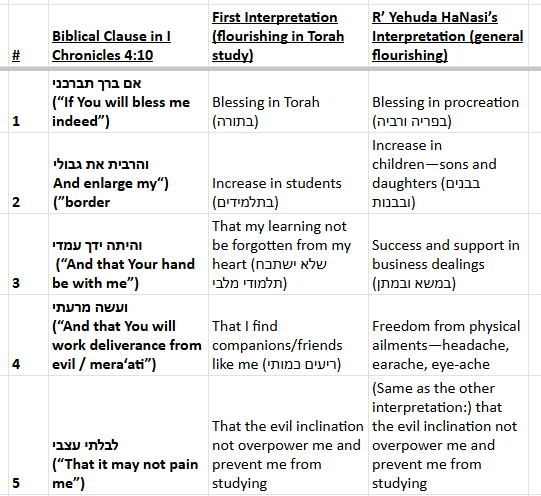
Jabez’s prayer in I Chronicles 4:10 as an allegory for Torah study
The Talmud reads Jabez’s prayer in I Chronicles 4:10 as an allegory for Torah study:
“Bless me” refers to Torah (knowledge)
“enlarge my border” to (gaining) students
“Your hand with me” to memory retention
“deliverance from evil (רעתי)” to finding good study companions6
“that it may not pain me (עצבי)” to resisting the evil inclination.7
Othniel concludes his prayer with a stark ultimatum: If God grants his requests, all is well—but if not, he will descend in “depression”8 to Sheol.9
God subsequently granted him what he requested.
ומנלן שענאו אל?
דכתיב:
״ויקרא יעבץ לאלהי ישראל לאמר:
אם ברך תברכני
והרבית את גבולי
והיתה ידך עמדי
ועשה מרעתי
לבלתי עצבי
ויבא אלהים את אשר שאל״.
The Talmud asks: And from where do we derive that God answered him?
As it is written:
“And Jabez called on the God of Israel, saying:
If You will bless me indeed,
and enlarge my border,
and that Your hand may be with me,
and that You will work deliverance from evil,
that it may not pain me
And God granted him that which he requested” (I Chronicles 4:10).
“אם ברך תברכני” —
בתורה,
״והרבית את גבולי״ —
בתלמידים,
״והיתה ידך עמדי״ —
שלא ישתכח תלמודי מלבי,
״ועשה מרעתי״ —
שיזדמנו לי ריעים כמותי,
״לבלתי עצבי״ —
שלא ישגבני יצר הרע מלשנות.
The Talmud interprets this verse:
The phrase: “If You will bless me indeed,”
means that he prayed for a blessing with regard to Torah.
“And enlarge my border,”
means that he prayed for a blessing with regard to students.
“And that Your hand be with me,”
that my studies not be forgotten from my heart.
“And that You will work deliverance from evil [mera’ati],”
that I will find friends [re’im] like me.
“That it may not pain me,”
that the evil inclination should not grow stronger10 and prevent me from studying (לשנות) Torah.
אם אתה עושה כן —
מוטב,
ואם לאו —
הריני הולך (לנסיסי) [בנסיסי] לשאול.
מיד,
״ויבא אלהים את אשר שאל״.
Othniel further prayed:
If You do so,
good;
and if not,
I will go depressed [li-n’sisi] to my grave and the netherworld
Immediately,11 God answered him, as the verse states:
“And God granted him that which he requested.”
R’ Natan - Interpretation of the Teacher-Student Dynamic: Shared Enlightenment Through Teaching; Reversal of Roles When Teaching Is Refused - Proverbs 29:13; 22:2
R’ Natan interprets the verse as referring to a Torah student and a teacher: The “poor man” (רש) represents the student lacking Torah knowledge, while the “oppressor” (תככים - tekhakhim) is the teacher.
If the teacher agrees to teach the student, God “gives light to the eyes of both” (i.e. Both grow in wisdom through their interaction).
But if the teacher refuses, Proverbs 22:2 applies: “the rich and the poor meet together; YHWH is the maker of them all.” R’ Natan interprets this to mean that God can reverse their roles—making the teacher foolish (טיפש) and the student wise.
כיוצא בדבר אתה אומר:
״רש ואיש תככים נפגשו
מאיר עיני שניהם ה׳״.
בשעה שהתלמיד הולך אצל רבו
ואומר לו: ״למדני תורה!״
On a similar note, you say likewise with regard to the following verse:
“The poor man and the oppressor [tekhakhim] meet together;
YHWH gives light to the eyes of both of them” (Proverbs 29:13).
When the student, who is poor in his knowledge, goes to his teacher, i.e., one who knows enough to teach but requires further enlightenment himself, as he is a man between [tokh] the levels of a Sage and a commoner,
and says to him: Teach me Torah!
אם מלמדו —
״מאיר עיני שניהם ה׳״,
ואם לאו —
״עשיר ורש נפגשו, עושה כלם ה׳״.
מי שעשאו חכם לזה —
עושה אותו טיפש,
טיפש לזה —
עושה אותו חכם.
זו משנת רבי נתן.
if the teacher agrees to teach him,
then “YHWH gives light to the eyes of both of them”, as they both become greater as a result.
But if the teacher will not teach the student,
then “the rich and the poor meet together; YHWH is the maker of them all” (Proverbs 22:2).
This verse teaches that
He Who made this one wise
now makes him foolish,
and He Who made that one foolish
now makes him wise.
This is the exposition (משנת) of R’ Natan.
R’ Yehuda HaNasi - interprets Jabez’s prayer more literally: children; business success; health; righteousness
R’ Yehuda HaNasi interprets the prayer more literally:
“Bless me” with fertility,12
“enlarge my border” with children,
“Your hand” with business success,
“deliverance from evil” with relief from physical ailments,
“that it not pain me” again as protection from the evil inclination.
As before, the request is granted.
רבי יהודה הנשיא אומר:
״אם ברך תברכני״ —
בפריה ורביה,
״והרבית את גבולי״ —
בבנים ובבנות,
״והיתה ידך עמדי״ —
במשא ובמתן,
״ועשית מרעתי״ —
שלא יהא בי
מיחוש ראש
ומיחוש אזנים
ומיחוש עינים,
״לבלתי עצבי״ —
שלא ישגבני יצר הרע מלשנות.
R’ Yehuda HaNasi says an alternative interpretation of the prayer of Jabez:
“If You will bless me indeed”
means with procreation (פריה ורביה)
“And enlarge my border”
refers to blessing with children (“sons and daughters”)
“And that Your hand may be with me,”
indicates in business (במשא ובמתן)
“And that You will work deliverance from evil,”
so that I will not have
a headache (מיחוש ראש)
or an earache
or an eye ache.
“That it may not pain me,”
that the evil inclination will not grow strong against me and prevent me from studying Torah.
אם אתה עושה כן —
מוטב,
ואם לאו —
הריני הולך בנסיסי לשאול,
״ויבא לו אלהים את אשר שאל״.
Jabez then said to God:
If you do so,
good;
and if not,
I will go depressed to my grave and the netherworld.
Immediately, God answered him: And God granted him that which he requested.
Proverbs 29:13, 22:2 is interpreted economically—A poor person requests charity from a homeowner (בעל הבית)
Proverbs 29:13 is interpreted economically: A poor person requests aid from a homeowner (בעל הבית).
Once again, as previously: if the request is fulfilled, God blesses both; if refused, Proverbs 22:2 applies—God reverses their economic status.
כיוצא בדבר אתה אומר:
״רש ואיש תככים נפגשו
מאיר עיני שניהם ה׳״,
בשעה שעני הולך אצל בעל הבית
ואמר: פרנסני!
On a similar note, you say an interpretation with regard to the verse:
“The poor man and the oppressor meet together;
YHWH gives light to the eyes of both of them” (Proverbs 29:13).
When a poor person goes to a homeowner
and says: Provide for me!
אם מפרנסו —
מוטב,
ואם לאו —
״עשיר ורש נפגשו, עושה כלם ה׳״,
מי שעשאו עשיר לזה —
עושה אותו עני,
עני לזה —
עושה אותו עשיר.
if he provides for him,
that is good.
But if not,
then it is stated: “The rich and the poor meet together; YHWH is the maker of them all” (Proverbs 22:2).
This verse indicates that
He Who made this one wealthy
now makes him poor,
and He Who made that one poor
now makes him wealthy.
See the summary in Wikipedia, “Joshua 15”, section “Achsah’s blessing (15:13–19)”:
Having been granted the city of Hebron by Joshua, Caleb has to fight to conquer it along with surrounding areas (could be a part of Joshua’s conquest in Joshua 10:36–37).
In turn, Caleb becomes a ‘distributor’ to grant a land to his son-in-law Othniel, because of his role in the conquest (Othniel later becomes the first ‘Judge’ of Israel; Judges 3:8–11), and his daughter Achsah, Othniel’s wife, whose request for water reflects the condition in the drier areas of Negeb, Judah’s southern desert.
See Wikipedia, “1 Chronicles 4”, section “Prayer of Jabez (4:9–10)”:
These two verses form a unique passage highlighting the Chronicler’s respect for wealth and the effectiveness of prayer.
It shows one example of the Chronicler’s frequent use of meaningful names: “Jabez” (יַעְבֵּץ֙, ya‘-bêz) was given that name because his mother bore him with sorrow (בְּעֹֽצֶב, bə-‘ō-zeḇ, meaning “in pain”; verse 9), while he himself prays that no sorrow’ (עָצְבִּ֑י, ‘ā-zə-bî; verse 10) would fall upon him.
Comparing their wives relative lack of beauty to Achsah’s great beauty.
Compare the Talmud’s somewhat similar etymology the name “Ethnan” in my “From Azubah to Zohar: Reading Miriam and Caleb in the Genealogies of the Book of Chronicles (Sotah 12a)“, section “Beauty Transformed: From Affliction to Desire (I Chronicles 4:5)“:
״אתנן״ —
שכל הרואה אותה מוליך אתנן לאשתו
She is called “Ethnan” —
as any man that saw her would be aroused so much that he would bring a gift [etnan] to his wife to entice her for conjugal sex.
In general, that sugya there in Sotah has a lot of similarities with ours, featuring homiletic readings of verses in Chronicles concerning Caleb and the women associated with him.
And see ibid. in general, “Appendix 3 – Women Identified in the Talmud for Their Provocative Sexual Allure“.
Regarding the the etymology of the name Achsah, compare a different etymology at the Wikipedia entry English and Hebrew, that connects it to the noun עכס (ekes), anklet or bangle, found in Isaiah.3.18: “העכסים”.
עליונים - literally: “upper ones”. In this context, this means “heavens, supernal world”, as opposed to the mundane physical “lower” (תחתונים) world.
Compare Jastrow (modernized):
עֶלְיוֹן
uppermost, highest; most high […]
Especially עליונים - heavenly creatures, angels.
Vayikra Rabbah 9:9 בראשון ברא מן העליונים וכ׳ “on the first he created heavenly and earthly things etc.”
בראו מן העליונים וכ׳ - “he created man so as to make him partake of the nature of the upper creatures and of that of the lower”
and frequently
And compare the usage of this word in Ketubot.104a.3, in the context of the final illness and death of R’ Yehuda HaNasi:
סליקא אמתיה דרבי לאיגרא,
אמרה:
עליונים מבקשין את רבי,
והתחתונים מבקשין את רבי.
יהי רצון שיכופו תחתונים את העליונים
The female slave of R’ Yehuda HaNasi ascended to the roof
and said:
The upper (עליונים) realms are requesting the presence of R’ Yehuda HaNasi,
and the lower realms are requesting the presence of R’ Yehuda HaNasi.
May it be the will of God that the lower worlds should impose their will upon the upper worlds.
כיון דחזאי כמה זימני דעייל לבית הכסא וחלץ תפילין ומנח להו וקמצטער,
אמרה:
יהי רצון שיכופו עליונים את התחתונים.
However, when she saw how many times he would enter the bathroom and remove his tefillin, and then exit and put them back on, and how he was suffering with his intestinal disease,
she said:
May it be the will of God that the upper worlds should impose their will upon the lower worlds.
Note that the Bible itself (in Chronicles) himself gives a different etymology of the name ‘Ya’avetz’, as cited in the intro.
רֵעִים - a wordplay on the root רע, which can mean both “evil” and “friend”. See Hebrew Wiktionary on this root, definition #1 (רֵעַ - ‘re’a’ - “friend”), and definition #2 (רַע - ‘ra’ - “bad, evil”)
Compare the similar prayers in my three-part series “Prayer, Poetry, and Ethics: A Journey Through Seventeen Talmudic Prayers and Ethical Teachings (Berakhot 16b-17a)“, final part here.
Re saving from the evil inclination, see especially ibid., Part 2, sections “R’ Yehuda HaNasi“ and “Mar son of Ravina“.
נסיסי - ‘nisisi’.
See Jastrow (modernized):
נָסִיס
(נסס) falling away, grief.
Temurah 16a (interpreting עצבי, I Chronicles 4:10) - הריני הולך בנְסִיסִי לשאול (not לנסיסי) - “I shall go with my grief to the grave” (compare Genesis 37:35; Genesis 44:31;
and elsewhere.
Mekhilta Yitro, Amalek, section 2 - יורד כבן סיסי (correct accordingly);
Yalkut Shimoni on Nach 27:1 (a. Arukh under the word בר) ברסיסי (correct accordingly).
נְסִיס
same, evil, trouble.
Targum Sheni Esther I, 3 - נסיס לנונין - “a trouble to the fish”
[Aramaic Targum to Ecclesiastes 5:16 בִּנְסִיס, ב radical, see בְּנַס; perh. to be read: בִּנְסָא.]
Plural: נְסִיסִין.
Kohelet Rabbah 2:17 - תלת נסיסין בישין - “three great evils”
adj. constr. suffering, weak.
Targum Jonathan on Leviticus 22:22 - נ׳ עיני Arukh (ed. עינוי לקיין).
שאול - the netherworld.
playing on the word שאל - “ask, request”.
ישגבני - literally: “he should raise me”, i.e. “secure me”.
A biblical word, unusual in the Talmud.
Likely alluding to Psalms.59.2:
הצילני מאיבי אלהי
ממתקוממי תשגבני
Save me from my enemies (איבי), O my God;
secure me (תשגבני) against my assailants (מתקוממי)
מיד - “immediately”.
Note that “immediately” in such context is better understood not as literaly temporal instantaneousness, but in the sense of “thereupon,” “consequently,” or “as a direct result.”
Compare also my discussion elsewhere regarding the common connector in Talmudic Aramaic אדהכי והכי, to mean “thereupon”.
פריה ורביה - “being fruitful and multiplying”.
See some of these common idioms paralleled in my “Prayer, Poetry, and Ethics” (cited in previous footnote), Part 3, section “Rav“.
And see also my “Appendix: The Six Orders of the Mishnah and the Six Questions Asked in Divine Judgment (Shabbat 31a)“ section “The Six Questions Asked in Divine Judgment: Honesty, Torah Study, Procreation, Anticipation of Salvation, Wisdom, and Understanding“.
What's the compiler for these alegories? So insightful.