

When I first built ChavrutAI, the homepage was simply a table of contents for the Babylonian Talmud. It listed all 37 tractates organized by Seder (the traditional ordering), and that was it. This made sense at the time: the site was primarily a Talmud reader, and getting users to the text quickly was the priority.
But ChavrutAI has grown. The platform now includes the complete Hebrew Bible (Tanakh), a full-text search feature, the Jastrow Dictionary, a Biblical Citations Index, a Mishnah Map, and more. The old homepage no longer reflected what the site had become.
So I redesigned it.1
Outline
Intro
What’s New
Primary Texts
Quick Access Row
Study Tools
About Link
Design Principles
Looking Ahead
What’s New
The new homepage is a directory: a single page that shows you everything ChavrutAI offers and helps you get where you want to go.
Nothing was removed. The new homepage simply provides a better entry point that acknowledges the full scope of what ChavrutAI offers.
See the breakdown at the changelog page, section “December 2025“, sub-section “New Homepage“:
Redesigned homepage as a minimalist directory showcasing all platform features
Primary sections for Talmud and Tanakh with equal prominence
Quick search bar for searching across all texts
Today’s Daf Yomi widget with direct study link
Famous Talmud Pages section linking to curated suggested readings
Study Tools grid: Sugya Viewer, Dictionary, Biblical Index, Mishnah Map
Talmud table of contents accessible at
/talmud
Primary Texts
At the top, you’ll find two cards side by side: one for the Babylonian Talmud, one for the Tanakh. Both receive equal visual weight. Each card briefly describes what’s available (5,400+ pages for the Talmud; Torah, Prophets, and Writings for the Bible) and has a button to browse the full collection.
Screenshot:
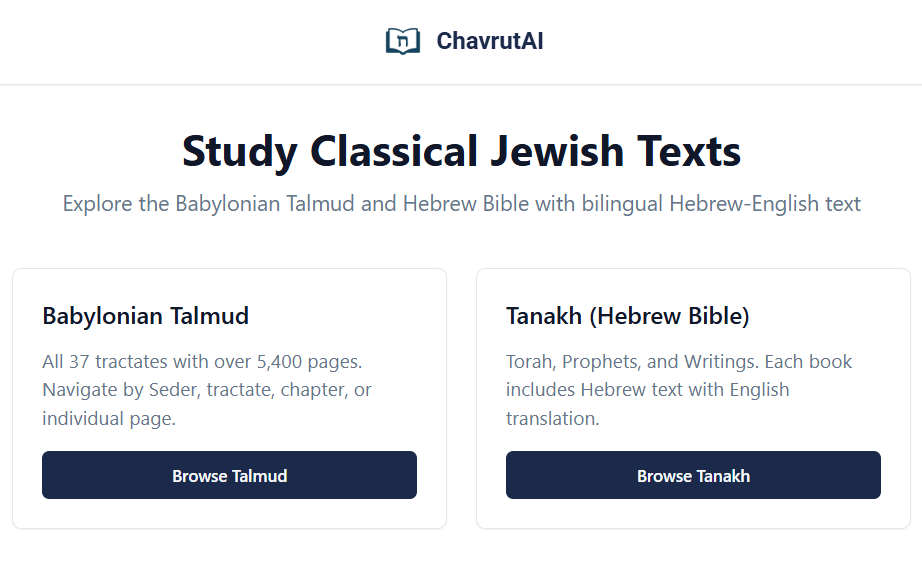
This change reflects the fact that ChavrutAI is not just a Talmud reader anymore; it’s now a broader platform for studying classical Jewish texts, and the homepage should reflect that.
Quick Access Row
Below the text collections, three features sit in a horizontal row:
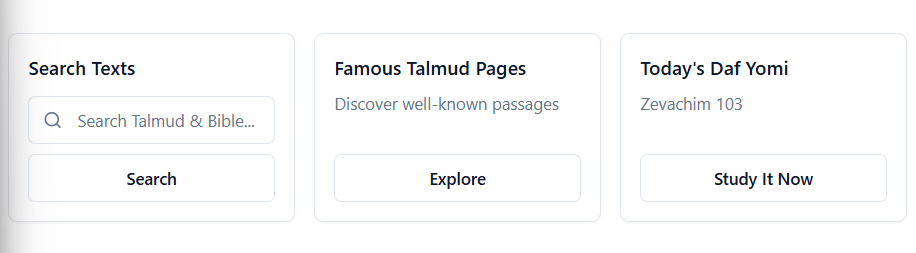
Search: A compact search bar lets you search across both Talmud and Bible texts without leaving the homepage. Type a term, hit enter, and you’re taken to the full search results page with your query already filled in.2
Famous Talmud Pages: A link to the Suggested Pages section, which highlights well-known passages like the opening of Berakhot or significant halachic discussions. Useful for newcomers or anyone looking for starting points.
Today’s Daf Yomi: Shows the current day’s Daf Yomi page (the daily Talmud study cycle followed by thousands of people worldwide) with a button to study it directly. The widget fetches live data (from Sefaria, via their API’s calendar endpoint), so it’s always current.
Screenshot:
Study Tools
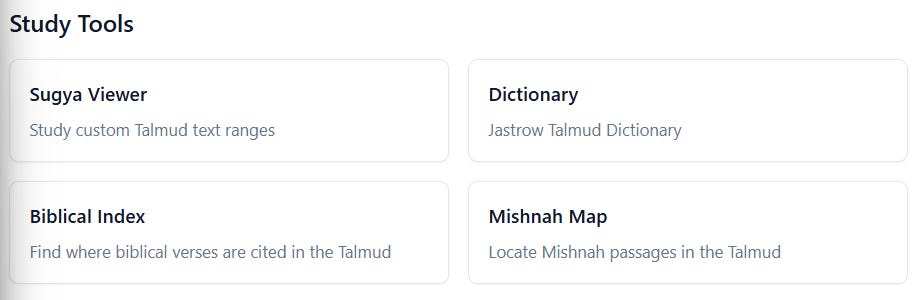
A grid of four cards provides access to specialized features:
Sugya Viewer — Study custom ranges of Talmud text. Enter a starting and ending reference, and view just that passage.
Dictionary — The Jastrow Dictionary, a modernization of this standard reference for Aramaic and Hebrew terms in rabbinic literature.3
Biblical Index — Find where biblical verses are cited throughout the Talmud. A comprehensive cross-reference tool.
Mishnah Map — Locate where Mishnah passages appear in the traditional Talmud pagination.
Each card links directly to its respective tool.
Screenshot:
About Link
At the bottom, a simple link to the About page provides context for new visitors who want to understand what ChavrutAI is and how it works.
Design Principles
I approached this redesign with a few principles in mind:
Minimalism over decoration. Earlier drafts included icons next to every section header. I removed them. They added visual noise without adding clarity. The current design uses typography and spacing to create hierarchy.
Equal treatment of texts. The Talmud and Tanakh are both central to traditional Jewish learning. The homepage reflects this parity rather than privileging one over the other.
Discoverability. Every major feature of the platform is now one click away from the homepage. New users can understand what’s available without hunting through menus.
Utility over marketing. This isn’t a landing page designed to convert visitors. It’s a directory designed to help people study. The language is direct, the descriptions are factual, and there are no promotional flourishes.
Looking Ahead
This homepage redesign is part of a broader effort to make ChavrutAI more useful and more accessible. The platform continues to evolve.
If you have feedback or suggestions, please email me!4
As an aside, I also recently fixed a number of bugs/made improvements to existing features, you can see a summary at the changelog page. The major ones (rephrasing from there):
External Links on Bible Pages:
(On External Links on Talmud Pages, see my “ChavrutAI Updates, and Talmud Manuscripts on ‘Al HaTorah’ Website“ [Dec 07, 2025], section “External Links and Cross-Platform Study“.)
Added verse-level external links (Sefaria, Al-HaTorah, Wikisource) next to each verse header
Added chapter-level external links footer to each Bible chapter page
Verified Al-HaTorah transliterations for all 39 Tanakh books
URL Update:
Changed Talmud contents URL from
/contentsto/talmudJastrow Dictionary Fix:
Fixed entries being cut off for words with multiple verb forms (e.g., Hiphil/Hif.)
Nested grammatical forms now display with proper labels showing verb stem and conjugation
Improved Name Recognition:
Fixed text splitting to keep genealogical phrases like “R’ Elazar, son of R’ Shimon” on one line
Compound names with “son of” now highlight as single entries (for the name labeling, via gazetteer) instead of separate name fragments
Navigation Fixes
Fixed empty page issue: tractates ending on ‘a’ side no longer show invalid ‘b’ pages
On this new search feature and its development, see my recent piece: “Introducing ChavrutAI’s Search: Full-Text Search of Bible and Talmud” (Dec 23, 2025).
I’ve made a number of small changes since then to improve it.
See my previous piece on this feature: “Jastrow’s Talmud Dictionary: A Modernized and Enhanced Digital Presentation at ChavrutAI”.
My email is at the “About me” page on this Substack.