

I’ve been continually working on developing ChavrutAI, my website for studying the Babylonian Talmud. The site serves all 37 tractates with bilingual Hebrew-English text, and these recent changes focus on three areas: connecting ChavrutAI with other digital Talmud resources, improving the reading experience through customization options, and optimizing performance for faster page loads.
This post documents the main changes from November and December 2025.1 I’ve also included a technical appendix at the end for those interested in implementation details.
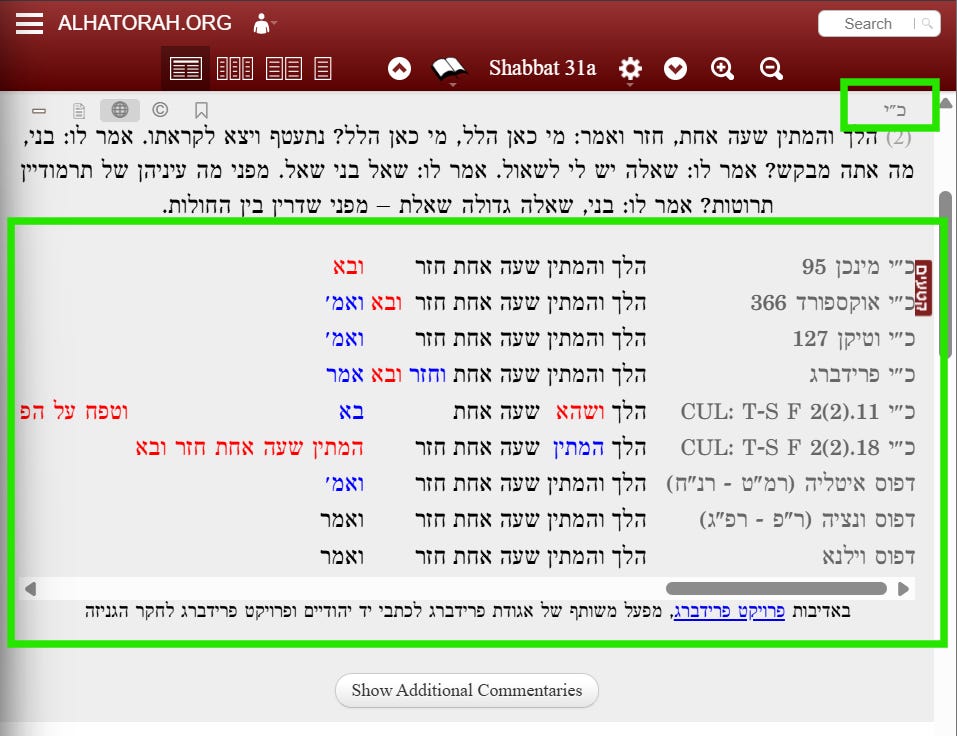
Unrelated, the Talmud reader at the ‘Al HaTorah’ website2 now shows Talmud manuscripts, from the Friedberg project.3 This is a huge development.
Screenshot, for example, from Shabbat 31a, section 2:4
Outline
Intro
External Links and Cross-Platform Study
Connecting to Other Talmud Resources
Customization and Reading Experience
Theme Options
Typography Choices
Simplified Navigation
New Study Features
Sugya Viewer
Text Processing Improvements
Conclusion
Appendix - Technical
External Links Implementation
Text Processing Pipeline
External Links and Cross-Platform Study
Connecting to Other Talmud Resources
One important new feature implemented is the ability to easily cross-reference content with other digital Talmud platforms. Each of these platforms has its own strengths: Sefaria offers extensive commentaries and translations, Al HaTorah provides detailed analysis tools, Hebrew Wikisource has the raw Hebrew text,5 and Daf Yomi shows the traditional page layout (tzurat ha-daf).6
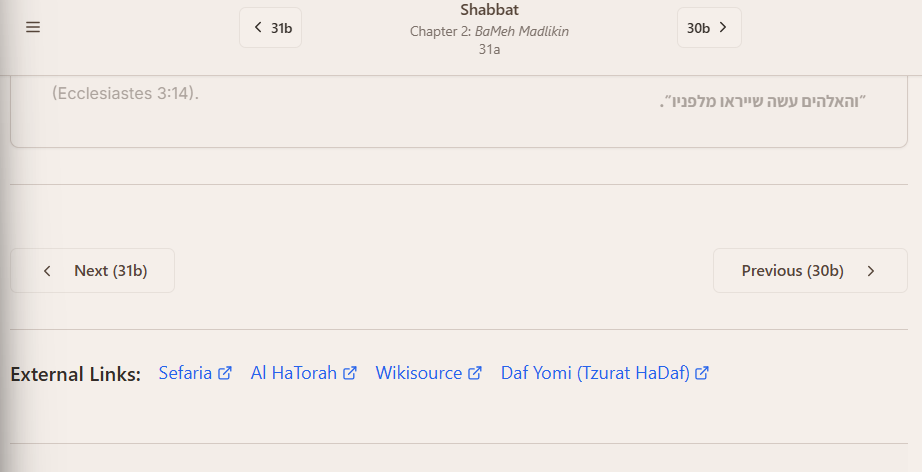
I’ve now added external links directly on each Talmud page. At the bottom of every page, there’s an “External Links” section with direct links to that page on Sefaria, Al HaTorah, Wikisource, and Daf Yomi.
Screenshot, from Shabbat 31a:
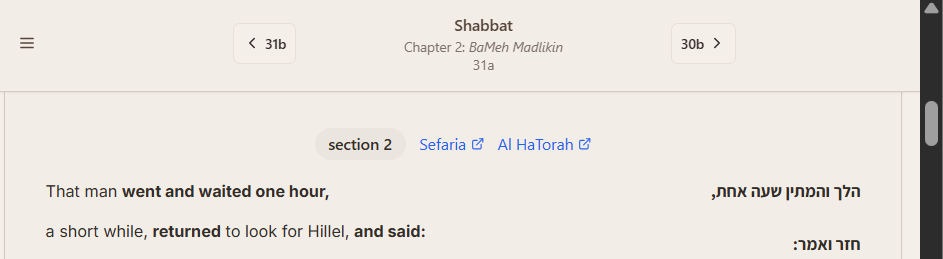
I’ve also added section-level links. Next to each section header within a page, there are now direct links to that specific section on Sefaria and Al HaTorah. This is particularly helpful when you want to look up a commentary on a specific passage rather than scrolling through an entire page on another site.
Screenshot, from that same page, ibid., section 2:
Customization and Reading Experience
Theme Options
ChavrutAI now offers three visual themes:
Sepia (called “Paper” in the theme picker):7 A warm, parchment-like appearance. This was the default since launch; the default is now “White”, see next).
White: A clean, standard appearance with white backgrounds.
Dark: A moderate dark theme.
This theme picker is now in the footer:

Typography Choices
I’ve expanded the font options for both Hebrew and English text.
For Hebrew, there are now five font choices: Assistant (the new default), Noto Sans Hebrew, Noto Serif Hebrew, Frank Ruhl Libre, and David Libre. I changed the default to Assistant after testing showed it was more readable.
For English, I added four options: Inter (the default), Roboto, Source Sans 3, and Open Sans.8
Text size controls remain available, allowing you to adjust the reading size to your preference.
Simplified Navigation
I’ve simplified the navigation throughout the site. All secondary pages (Dictionary, About, Sitemap, Contact, Privacy, Changelog, etc.) now have a consistent header with a centered logo that links directly to the homepage. I removed redundant “Home” buttons and “Quick Navigation” sections that were adding clutter without providing much value.
New Study Features
Sugya Viewer
In November, I launched the Sugya Viewer, which allows you to study custom text ranges.9 Rather than being limited to viewing one folio page at a time, you can specify a starting and ending point to view a complete sugya (Talmudic discussion) that might span multiple pages. This is useful since sugyot almost never align neatly with page boundaries.
In that same page, I added an AI chatbot to assist with text study. This feature is available for asking questions about the text you’re currently viewing.10
Text Processing Improvements
Working with bilingual Hebrew-English text presents various formatting challenges. In November, I fixed several issues with how the text is split and displayed.11
Conclusion
The external links feature should make it easier to use ChavrutAI alongside other digital Talmud resources. The customization options let you adjust the reading experience to your preferences. And the performance improvements mean faster page loads, particularly on mobile devices.
As always, the changelog page on the site has the complete list of changes, and the About page has been rewritten with a clearer overview for new visitors.
Appendix - Technical
External Links Implementation
The external link generation is handled by a TypeScript module (external-links.ts) that constructs URLs for each platform based on a Talmud reference object containing tractate, folio, side, and optional section number.
Each platform has different URL conventions:
Sefaria: Uses the format
sefaria.org.il/{tractate}.{folio}{side}.{section}Al HaTorah: Uses
shas.alhatorah.org/Full/{tractate}/{folio}{side}.{section}Wikisource: Uses Hebrew tractate names and Hebrew numerals12 for folio numbers
Daf Yomi: Uses numeric IDs for tractates and a calculated amud (page-side) number
Text Processing Pipeline
Text from the Sefaria API goes through several processing steps:
HTML entities and tags are parsed
Hebrew text has nikud (vowel points) removed for cleaner display
Text is split into paragraphs using intelligent rules that respect punctuation clusters
Hebrew text is marked with RTL (right-to-left) direction attributes
The processing handles edge cases like quoted text with trailing punctuation, numbers with commas, and mixed Hebrew-English content.
See also my recent pieces on specific major new pages; I don’t discuss those here:
Introducing ChavrutAI’s Mishnah-Talmud Mapping Table (Nov 23, 2025)
Introducing the ChavrutAI Bible Reader (Nov 09, 2025)
Jastrow’s Talmud Dictionary: A Modernized and Enhanced Digital Presentation at ChavrutAI (Sep 28, 2025)
As an aside, unrelated, I recently updated two new pieces to my Academia page:
Based on my continuing development of these gazetteers, for the ChavrutAI labeling:
For a general review of the website, see my discussion two years ago, “Evaluating Al HaTorah’s Digital Repository” (Jun 09, 2023).
Note that the manuscripts view is accessed by clicking on the Hebrew acronym for “manuscripts” (כ”י) at the top right.
I highlight that--and the manuscript text itself--with green boxes in my screenshot.
As well as links to the full-text major traditional commentaries, and links to the same page at a number of external platforms.
For more on the tzurat ha-daf, see my “Beyond the Mystique: Correcting Common Misconceptions About the Talmud, and Pathways to Accessibility“, section “Myth #2: The Talmud Has a Complex “Nested Structure”“.
Compare also my other pieces on other Talmud reading platforms (in addition to my review of Al HaTorah, cited in a previous footnote):
ChavrutAI Talmud Web App Launch: Review and Comparison with Similar Platforms
From Print to Pixel: Digital Editions of the Talmud Bavli (Seforim Blog)
Guide to Online Resources for Scholarly Jewish Study and Research - 2023 (Academia.edu)
Helpful Formatting of the Talmud: Ohr Somayach’s ‘Talmud Navigator’
Inspired by this name used at the Chabad Talmud reader; on the Display Preferences at that reader, see my “ChavrutAI Talmud Web App Launch: Review and Comparison with Similar Platforms” (cited in previous footnote), section “Display Preferences”, sub-section “Chabad (“Torah Texts”)”.
Previously there was no option for English font selection.
I previously noted this new page in a footnote here (Nov 26, 2025). See there for further details, and a screenshot illustrating.
Note that this chatbot is completely new, and is unrelated to the separate one that I discuss in my other recent piece “Some Tech Updates: The Newly Launched Gemini 3 for Hebrew OCR; Updates to ChavrutAI Chatbot; and on a General AI Browser Assistant as a Talmud Study Partner” (Nov 19, 2025).
More about the specifics can be found at the changelog page.
See there also for specifics relating to all the work I did relating to Performance, leading to significantly faster page loads.
Compare “gematria”.
The Wikisource URL generation includes a Hebrew numerals conversion function that handles the special cases for 15 (יו instead of יה) and 16 (טז instead of יו) according to traditional conventions.