

Over the last few years, I’ve written a large number of Talmud-related blogposts. Some are short notes on one sugya; some are longer thematic essays; many are multi-part series. I keep an index page so readers can find posts by tractate and page range. That works, but it has its limitations: now that the list is quite long, it’s relatively difficult to scan and search. In addition, I wanted to connect each post to the current Daf Yomi cycle.
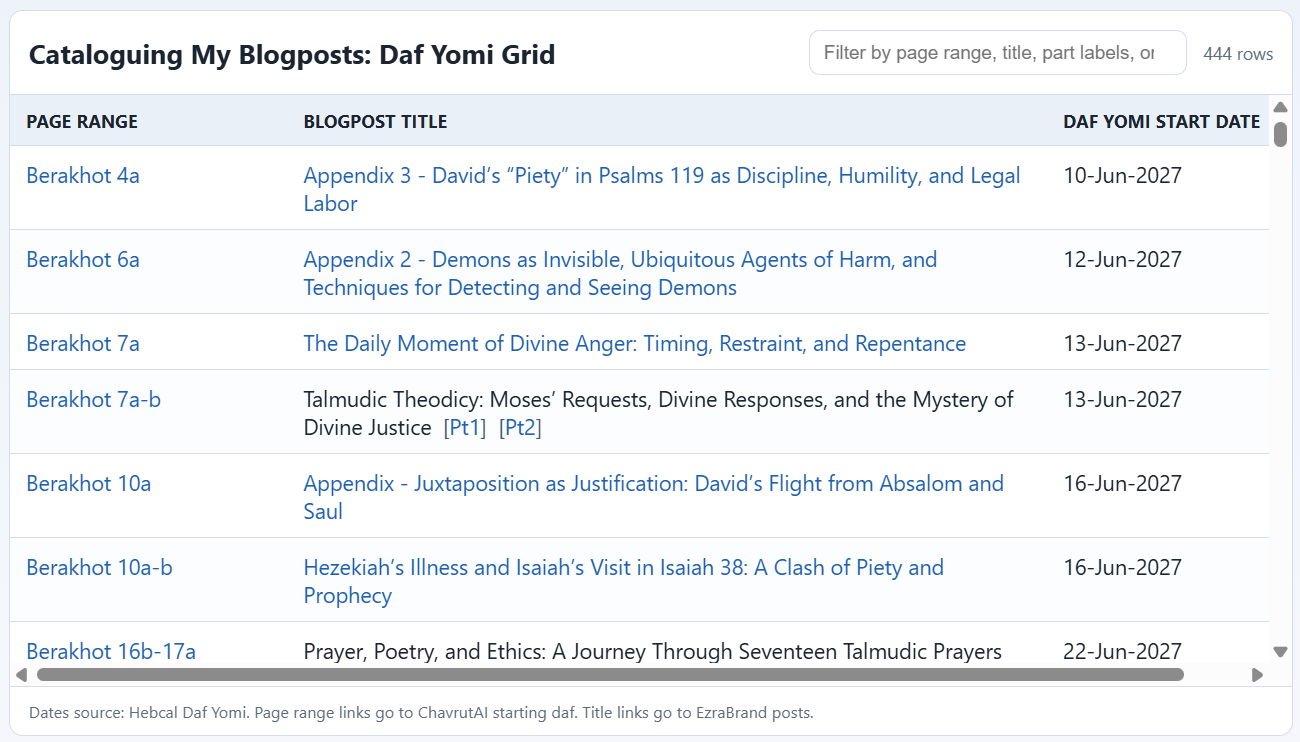
I wanted something simple and practical. So I built a lightweight public page that maps my indexed blogposts to Talmud pages and Daf Yomi start dates, and lets readers browse that data as a searchable table. The page is here:1
https://ezrabrand.github.io/talmud-blogpost-dafyomi-grid/
Screenshot:
This post explains what I built, why I built it, and how to use it.
Outline
Intro
What the page does
The iCal file: practical use
Appendix - Technical
Data sources
Row extraction logic
Date mapping
Output artifacts
Deployment
What the page does
The page is a grid with three columns:
Page range
Blogpost title
Daf Yomi start date
Each row is one indexed entry from my index page.
I preserved the order as it appears in the index, so it still follows the familiar Talmud sequence. But now each row is also linked:
The page range links to ChavrutAI at the starting daf.
The blogpost title links to the original post URL from my index.
If a row is a multi-part series, I append links like
[Pt1] [Pt2] [Pt3]directly in that row.
The result is a table you can scroll, filter, and sort.
This includes the ability to scan by date and quickly see what is relevant for Daf Yomi now or coming soon.
Additionally, you can filter by words in the title (for example, “dream,” “names,” “prayer,” “Abaye”) and immediately see the page range context.
The iCal file: practical use
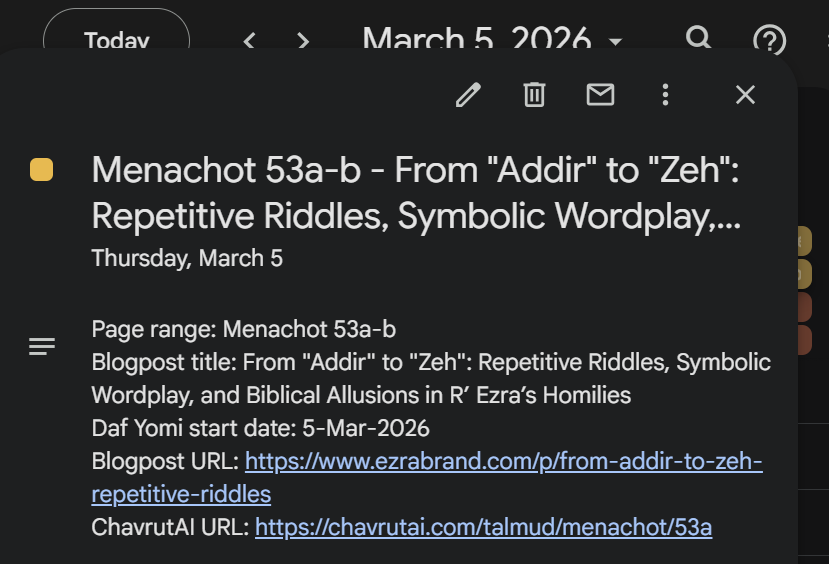
In addition, for myself, I also generated an iCalendar (.ics) file based on the same grid data.
Each calendar event includes:
the page range
the blogpost title
the Daf Yomi start date
the corresponding URLs
This means I can import the file into Google Calendar (or any standard calendar app).
Screenshot, showing an added event from 5-Mar-26:2
Appendix - Technical
I built this as a lightweight static-data pipeline. If I update the underlying index, I can rebuild and republish quickly.
Data sources
My archived index HTML (local backup of the post).
Row extraction logic
The script scans <p> blocks in the archived index and identifies rows with page references in parentheses (for example Berakhot 7a-b).
For each row:
It extracts page range.
It extracts blogpost title.
It picks the first relevant hyperlink from the source paragraph as the title URL.
It detects follow-up ordered-list blocks (
<ol>) containing Pt1, Pt2, etc., and attaches those links.
Date mapping
From each page range, I parse the starting daf (for example 7a from 7a-b) and tractate name.
I normalize tractate names to match Hebcal naming conventions, then lookup the first matching date in the downloaded Daf Yomi JSON data.
Display format is D-Mon-YYYY (for example: “10-Jun-2027”).
Output artifacts
The build script writes:
blogpost_dafyomi_db.csvblogpost_dafyomi_grid.htmlblogpost_dafyomi_calendar.ics
The HTML grid is fully client-side. The ICS file creates one all-day event per row on the mapped start date.
Deployment
I publish with GitHub Pages (branch gh-pages) as a static site.
The underlying Github repo, with the relevant scripts, is here:
https://github.com/EzraBrand/talmud-blogpost-dafyomi-grid
Unrelated: I extensively revamped the design of this blog (e.g., changing the theme to blue, and making the background color lighter), and re-did the homepage, navbar, and other parts of it.
I also extensively updated this table: “Index of Personal Names, Place Names, and Key Terms in the Talmud“, added a large number of Wikipedia entry links, and making other fixes. (See my discussion of that table here: “Introducing a New Talmudic Glossary“ [Feb 22, 2026].)
I also made a number of updates to ChavrutAI, including in the main footer. I also launched a new X/Twitter account for it, and updated the Github “Readme” page.
I’ve also been continuing to work on LLM Talmud segmentation, in a separate branch on the Github.
I in fact re-posted this blogpost that day.