

This is the second and final part of a two-part series. Part 1 is here; the outline of the series can be found at Part 1.
Rav Ḥinnana bar Pappa - God delays punishment of a nation/king until its “sending away” (banishment)
אמר רב חיננא בר פפא:
אין הקדוש ברוך הוא נפרע מן האומה עד שעת שילוחה,
Rav Ḥinnana bar Pappa says:
God does not punish a nation deserving of punishment until its time to be banished (שילוחה),
i.e., until the time of its final eradication from the world,
Prooftext - Isa 27:8
שנאמר:
״בסאסאה
בשלחה וגו׳״.
[...]
as it is stated:
“In full measure,
when you send her away,
you contend with her” (Isaiah 27:8).1
[...]
Rava - 3 cups of Egypt correspond with the multiple punishments across eras (Moses, Pharaoh Neco, future) - Gen 40:11–13
(See footnote.)2
אמר רבא:
שלש(ה) כוסות האמורות במצרים --
למה?
Rava said:
three cups of misfortune that are stated with regard to Egypt in the dream of its chief butler (see Genesis 40:11–13) --
Why are there specifically three?
אחת ששתת בימי משה,
ואחת ששתת בימי פרעה נכה,
ואחת שעתידה לשתות עם חברותיה
[...]
They are an allusion to three cups of misfortune that would later befall Egypt:
One that it drank in the days of Moses during the ten plagues and the Exodus;
one that it drank in the days of Pharaoh Neco, the king of Egypt who was defeated by Nebuchadnezzar;
and one that it will drink in the (messianic) future with its companions, i.e., the other nations, when they are punished during the days of the Messiah.
[...]
R’ Yehuda’s anecdote about Minyamin the Egyptian convert - Counters the “those Egyptians are gone” move: in R’ Akiva’s circle Egypt still treated as biblical Egypt (re: 3rd-generation rule) - Deut 23:8–9 (Egyptian convert, 3rd generation)
תניא,
אמר רבי יהודה:
מנימין גר המצרי היה לי חבר מתלמידי רבי עקיבא.
אמר מנימין גר המצרי:
אני
מצרי ראשון,
ונשאתי
מצרית ראשונה,
אשיא לבני
מצרית שניה
כדי שיהא בן בני
מותר לבא בקהל
[...]
taught in a baraita in the Tosefta (Kiddushin 4:3):
R’ Yehuda said:
Minyamin, an Egyptian convert,3 was a friend of mine from among the students of R’ Akiva,
and Minyamin the Egyptian convert said:
After I converted I was
a 1st-generation Egyptian convert,
and so I married
another 1st-generation Egyptian convert.
I will marry off my son, who is a 2nd-generation Egyptian convert,
to another 2nd-generation Egyptian convert,
in order that my grandson
will be permitted to enter into the congregation.4
[...]
Ameimar’s version of Rav Ḥinnana bar Pappa’s statement - Reads “I, YHWH, have not changed” as “I do not strike a nation twice”; contrasts Israel: struck repeatedly yet not consumed - Mal 3:6; Deut 32:23
אמימר מתני להא דרב חיננא בר פפא אהא,
מאי דכתיב:
״כי אני ה׳ לא שניתי
ואתם בני יעקב לא כליתם״?
Ameimar teaches that statement of Rav Ḥinnana bar Pappa with regard to this:
What is the meaning of that which is written:
“For I YHWH change not;
and you, sons of Jacob, are not consumed” (Malachi 3:6)?
״אני ה׳ לא שניתי״ —
לא הכיתי לאומה ושניתי לה.
“For I YHWH change [shaniti] not”
is interpreted to mean: I did not strike a nation and repeat [shaniti] striking it,
as a stricken nation never recovers from the initial strike.
״ואתם בני יעקב לא כליתם״ —
היינו דכתיב:
״חצי אכלה בם״.
חצי
כלין,
והן
אינן כלין.
“And you, sons of Jacob, are not consumed,”
is interpreted to mean: Despite the fact that I strike you many times for your sins, I do not let you perish.
This is the same as that which is written:
“I will heap evils upon them; I will consume My arrows (חצי) upon them” (Deuteronomy 32:23),
which is interpreted to mean:
My arrows
are consumed and used up,
and they, the Jewish people,
are not consumed
but will continue to endure despite the many calamities that will befall them.
Rav Hamnuna - God does not punish a person until his “se’a” is filled (punishment waits for a threshold) - Job 20:22
אמר רב המנונא:
אין הקדוש ברוך הוא נפרע מן האדם עד שתתמלא סאתו,
שנאמר:
״במלאות שפקו יצר לו וגו׳״.
Rav Hamnuna says:
God does not punish a person until his se’a, the measure that is suitable for him, is filled,
as it is stated:
“In the fullness of his sufficiency he shall be in straits;
the hand of every one that is in misery shall come upon him” (Job 20:22).
In other words, when the sufficient measure of sin has been reached, then the trouble will overtake him.
Rav Ḥinnana bar Pappa - Moses and David’s achievements (sanctuary/city gates) were not ruled over by enemies - Ps 33:1
דרש רב חיננא בר פפא,
מאי דכתיב:
״רננו צדיקים בה׳
לישרים נאוה תהלה״?
Having mentioned Rav Ḥinnana bar Pappa, the Talmud quotes another of his interpretations.
Rav Ḥinnana bar Pappa interpreted a verse homiletically:
What is the meaning of that which is written:
“Rejoice in YHWH, you righteous,
praise is comely for the upright [nava tehilla]” (Psalms 33:1)?
אל תקרי ״נאוה תהלה״,
אלא ״נוה תהלה״,
זה משה ודוד,
שלא שלטו שונאיהם במעשיהם.
Do not read the conclusion of the verse as: “Praise is comely [nava]”;
Rather, read it as: “A house [naveh] of praise.”5
This is referring to Moses and David,
whose enemies did not rule over their achievements,
as they each built a naveh, a house for YHWH, and this house remained in existence.
Prooftext for David: “her gates sunk into the ground” (ie, not destroyed)
דוד —
דכתיב: ״טבעו בארץ שעריה״.
With regard to David,
the citadel that housed his home and city, was not destroyed, as it is written:
“Her gates are sunk into the ground” (Lamentations 2:9),
as the gates of Jerusalem built by David were not destroyed by enemies, but sunk into the ground and were buried there.
Moses: Mishkan equipment hidden
משה —
דאמר מר:
משנבנה מקדש ראשון --
נגנז אהל מועד,
קרשיו
קרסיו
ובריחיו
ועמודיו
ואדניו.
This is also so with regard to Moses,
as the Master said:
When the First Temple was built (c. 10th century BCE)--
the Tent of Meeting was sequestered,6
including
its boards,
its clasps,
and its bars,
and its pillars,
and its sockets.7
Rav Ḥisda citing Avimi - Mishkan equipment was hidden under the Sanctuary tunnels
היכא?
אמר רב חסדא, אמר אבימי:
תחת מחילות של היכל.
The Talmud asks: Where is it sequestered?
Rav Ḥisda says that Avimi says:
Beneath the tunnels (מחילות) of the Sanctuary (היכל)
Baraita - Sota set her eyes on one unfit → she loses both what she sought and what she had; generalizes: one who covets what is not his loses both
תנו רבנן:
סוטה נתנה עיניה במי שאינו ראוי לה,
מה שביקשה —
לא ניתן לה,
ומה שבידה —
נטלוהו ממנה.
שכל הנותן עיניו במה שאינו שלו —
מה שמבקש --
אין נותנין לו,
ומה שבידו —
נוטלין הימנו.
§ A baraita states in the Tosefta (4:16–19):
The sota placed her eyes, fixed her gaze, on one who is unfit for her, i.e., another man, so this is her punishment:
That which she desired, i.e., to be with her paramour,
is not given to her,
as she becomes forbidden to him forever.
And that which she had, i.e., her husband,
was taken away from her,
as she is now forbidden to him as well.
This teaches that anyone who places his eyes on that which is not his
what he desires,
is not given to him
and that which he had
is taken from him.
Primeval snake desired Eve → didn’t get her
(See footnote.)8
וכן מצינו בנחש הקדמוני,
שנתן עיניו במה שאינו ראוי לו —
מה שביקש
לא נתנו לו,
ומה שבידו
נטלוהו ממנו.
And, so too, we found with regard to the primeval snake who seduced Eve,
for he placed his eyes on that which was unfit for him, as he wanted to marry Eve.
Consequently,
that which he desired
was not given to him,
and that which was in his possession
was taken from him.
Primeval snake lost former status; curse details (belly, dust, enmity) - Gen 3:14–15
Table summarizing:9
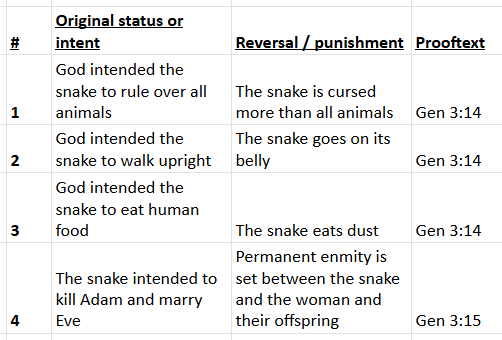
אמר הקדוש ברוך הוא:
אני אמרתי
יהא מלך על כל בהמה וחיה,
ועכשיו
״ארור הוא מכל הבהמה ומכל חית השדה״.
אני אמרתי
יהלך בקומה זקופה,
עכשיו —
״על גחונו ילך״.
אני אמרתי
יהא מאכלו מאכל אדם,
עכשיו —
״עפר יאכל״.
הוא אמר
אהרוג את אדם ואשא את חוה,
עכשיו —
״איבה אשית בינך ובין האשה ובין זרעך ובין זרעה״.
God said:
I initially said that
the snake will be king over every domesticated animal (בהמה) and wild animal (חיה),
but now
he is cursed more than all the domesticated animals and all the non-domesticated animals of the field, as it is stated: “And YHWH God said unto the serpent: Because you have done this, you are cursed from among all cattle, and from among all beasts of the field; upon your belly shall you go, and dust shall you eat all the days of your life” (Genesis 3:14).
I said that
the snake will walk upright,
but now
he shall go on his belly;
I said that
his food will be the same as the food eaten by a person,
but now
he shall eat dust.
The snake said:
I will kill Adam and marry Eve,
but now:
“I will put enmity between you and the woman and between your seed and her seed” (Genesis 3:15).
Catalogue of major wicked Biblical figures who desired the unfit--they lose sought goal and existing holdings: A list of 10 figures (Cain, Korah, Balaam, Doeg, Ahithophel, Gehazi, Absalom, Adonijah, Uzziah, Haman)
(See footnote.)10
וכן מצינו ב
קין
וקרח
ובלעם
ודואג
ואחיתופל
וגחזי
ואבשלום
ואדוניהו
ועוזיהו
והמן —
שנתנו עיניהם במה שאינו ראוי להם.
מה שביקשו —
לא ניתן להם,
ומה שבידם —
נטלוהו מהם.
The baraita continues:
And so we found with regard to
Cain,
who desired to inherit the whole world alone (see Genesis 4);
and Korah,
who desired the priesthood (see Numbers 16);11
and Balaam,
who desired Balak’s money (see Numbers 22);12
and Doeg,
who was jealous of David (see I Samuel 21–22);13
and Ahithophel,
who was also jealous of David (see II Samuel 16);14
and Gehazi,
who took Naaman’s money (see II Kings 5);15
and Absalom,
who wanted the kingdom (see II Samuel 15);16
and Adonijah,
(David’s 4th son,) who also wanted the kingdom (see I Kings 1);
and Uzziah,
(the 10th king of Judah,) who wanted to be the High Priest (see II Chronicles 26);
and Haman,
who wanted to kill all the Jews (see Esther 3:13).17
All of these were people who placed their eyes on that which is unfit for them,
and consequently
what they desired
was not given to them,
and what they had
was taken from them.
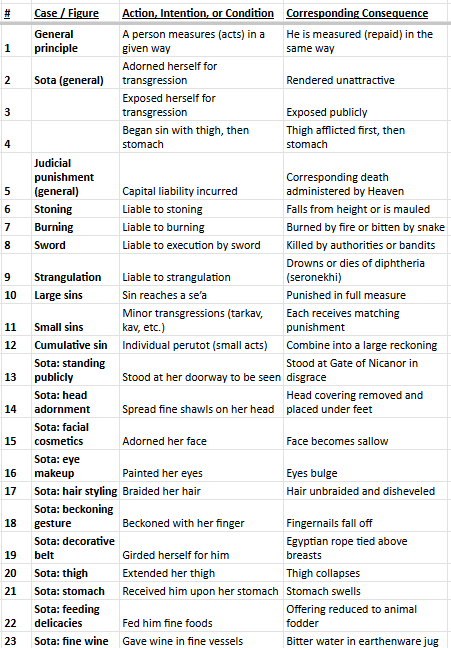
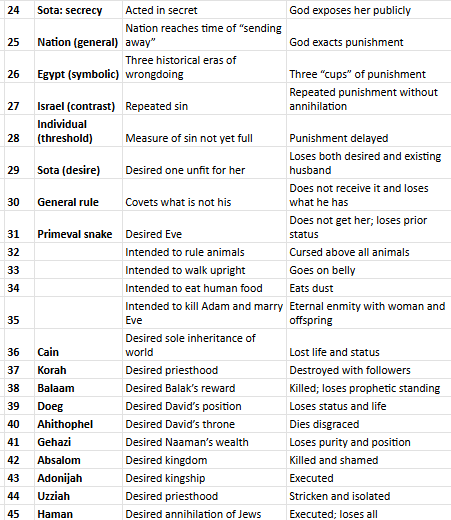
Appendix - Summary table of all instances in the sugya of action / condition, and corresponding consequential outcome
Each row shows case, action / condition, and corresponding outcome
The same prooftext as in earlier in the sugya, in Part 1, section “R’ Yehuda HaNasi - Derives middah keneged middah (“with the measure one measures…”) from Isaiah’s “in full measure” - Isa 27:8“.
This statement of Rava is also cited elsewhere, see my “Pt2 Talmudic Typological Interpretations: Egyptian Butler’s Dream in Genesis 40, Hosea’s Wife in Hosea 3, and Zechariah 11 (Chullin 92a)“, section “Rava (on Egypt’s “3 cups”) - The 3 cups signify Egypt’s 3 punishments: in Moses’ time, under Pharaoh Necho, and in the (messianic) future with all non-Jewish nations - Gen 40:11“.
לבא בקהל - i.e. marry a regular Jewish woman, as his grandson will be a 3rd-generation Egyptian convert, who is permitted to marry in the Jewish community.
Steinsaltz explains:
The Torah prohibits Egyptian converts before the 3rd generation to enter into the congregation (see Deuteronomy 23:8–9).
On this prohibition, see Hebrew Wikipedia, “לא תתעב אדומי ולא תתעב מצרי“.
Playing on the similarity between the verse’s unusual word for “fitting, good” - נאוה (in Talmudic Hebrew: נאה) and one of the literary biblical words for “house, dwelling” - נָוֶה.
נגנז.
Compare the related idea elsewhere in the Talmud in my “Appendix 3 - The Concealing of the Ark and Other Temple Items (Yoma 52b)“, especially section “List of Temple Items concealed (I Samuel 6:8)“.
And see also the next section - that they’re buried under the Sanctuary - and compare my “Pt2 Anecdotes in Pesachim and Yoma: A Selected Anthology“, section “Yoma 54a (= Mishnah Shekalim 6:2) - A priest discovers Ark’s hidden location, dies“, that “[the] Ark [of the Covenant] was buried (גנוז) in the Chamber of the Woodshed ( דיר העצים)”, with a related anecdote.
These Mishkan / Tabernacle elements are described mainly in Exodus 26 in the command section, then again in Exodus 36 in the construction section.
For the idea that the primeval serpent sexually desired - or actually had sex with - Eve, see my note in “Pt2 Dealing with Dangerous Snakes: Swallowing, Bites, Pursuits, and Attacks (Shabbat 109b-110a)“, on section “A Woman Being Sexually Pursued by a Snake“.
The literary structure of this passage is as follows:
Each row follows a fixed promise–reversal formula:
Initial divine intention or agentic desire → explicit negation through curse
The literary pattern is:
“I (=God) said / he (=snake) said X — now Y”
Each unit consists of:
A stated prior condition (divine plan or the snake’s intent)
A sharp adversative pivot (now / עכשיו)
A scripturalized outcome that inverts the original status
Across the list, the reversals move from status (rule → curse), to posture (upright → prone), to sustenance (human food → dust), to sexual ambition (marriage → perpetual hostility).
As in the sota catalogue, the repetition enforces a mechanical logic: punishment is a systematic undoing of an earlier position or claim.
For another discussion of these curses at the beginning of Genesis, see my “Bread in the Basket, Eyes on the Plate: Talmudic Psychology (Yoma 74b-75a)“, section “God’s Attribute of Mercy Even in Curse: Contrast Between Divine and Human Nature“, sub-sections “The Serpent’s curse (Genesis 3:14-15), and its sustenance from dust”, “The Woman’s Curse (Genesis 3:16) and Men’s Desire“, and “The Ground’s Curse (Genesis 3:17-19) and Universal Sustenance“, and see my notes there (especially on the concept of a snake eating dirt mentioned here as well).
It is worth noting that five of the wicked biblical figures listed here (namely, list items #2–6), are also included in the Mishnah’s list in tractate Sanhedrin as having “no share in the World-to-Come”, see my “Barred from the Afterlife: Heretics, Biblical Sinners, and Groups Denied a Share in the World-to-Come (Mishnah Sanhedrin 10:1-4)“, sections “Three Biblical Kings and Four Biblical Commoners Who Have No Share in the World-to-Come (Mishnah section #2)“ and “Eight biblical historical groups who have no share in the World-to-Come (Mishnah sections # 3-4)“.
Thus, these figures are discussed at length in the Talmud there, as noted in my following footnotes.
For an elaboration of the story of Korah in the Talmud, see my “Wealth, Wives, and Punishment: The Story of Korah’s Rebellion Against Moses in Numbers 16 (Sanhedrin 109b-110a)”, final part: Pt2.
For an elaboration of the story of Balaam in the Talmud, see my “The Prophet, the Prostitutes, and the Curses Reversed: The Biblical Story of Balaam in Numbers 23-25 (Sanhedrin 105b-106b)“, final part: Pt2.
For an elaboration of the story of Doeg in the Talmud, see my “The Wicked Doeg and His Relationship With David in 1 Samuel 21-22 and in Psalms (Sanhedrin 106b)”.
For an elaboration of Ahithophel in the Talmud, see the sugya on Doeg (cited in previous footnote), especially sections “R’ Yehuda HaNasi - Doeg and Ahithophel raised 400 halachic dilemmas regarding “floating cupboards” “, “R’ Yoḥanan - Doeg and Ahithophel lived in different eras and never met“, and “R’ Yoḥanan - David reclassified Ahithophel over time: teacher → colleague → student - Psalms 55:14–15; 41:10“.
For an elaboration of the story of Gehazi in the Talmud, see my “Elisha Narratives in II Kings 2-8, From Failure to Accompany to Failure to Reprove Gently: Jericho’s Youths, Bethel’s Bears, Gehazi, and the Principle of Measured Rejection (Sotah 46b-47a)”, final part: Pt2.
For an elaboration of the story of Absalom in the Talmud, see earlier in this macro-sugya, in my “ ‘My Son Absalom!’: The Pride, Punishment, and Aftermath of Absalom in II Samuel 14-19 (Sotah 10b-11a)”.