

The sugya begins with a baraita describing the 24 priestly divisions (mishmarot). Each division, or “watch,” served in the Temple for one week at a time. Of each division, half were stationed in Jerusalem, and half in Jericho — the latter providing logistical support, such as water and food, for their counterparts engaged in Temple service.
The sugya then outlines the historical development of these watches. Moses first established eight divisions — four descended from Eleazar and four from Ithamar, Aaron’s sons. Samuel expanded them to sixteen, and David finalized the permanent structure of twenty-four, a system grounded in biblical verses from I Chronicles (9:22; 24:4; 26:31).
Later, after the Babylonian exile, only four divisions returned: Jedaiah, Harim, Pashhur, and Immer.1 The prophets of that generation reestablished the full complement of 24 by dividing these four into six subgroups each, using a lottery (kalfei). They decreed that even if the descendants of the former first division, Jehoiarib, were to return, Jedaiah would retain precedence.
The amoraic discussions that follow deepen the understanding of the Temple’s human network. Rav Yehuda in the name of Shmuel asserts that priests, Levites, and Israelites are all indispensable (me’akvin) to the offering; without representation from each, a sacrifice cannot be complete. R. Shimon ben Elazar, in turn, emphasizes priests, Levites, and musical instruments as essential — expanding the definition of service to include sacred sound itself.
From there, the text shifts to the non-priestly watches (ma’amadot) — the Israelite representatives who, though not serving in the Temple, sustained its spiritual parallel across the land. In their towns, these lay members gathered to read Ma’aseh Bereishit (the account of Creation in Genesis), affirming that the world’s very existence depends upon ongoing divine service. As R. Ya’akov bar Aḥa quoting R. Asi teaches: “Were it not for the ma’amadot, heaven and earth would not continue.” The Talmud roots this idea in Abraham’s dialogue with God (Genesis 15), interpreting God’s covenantal command to offer sacrifices as a promise: even when the Temple no longer stands, the recitation of the order of offerings counts as if they had been brought, ensuring divine forgiveness and the endurance of creation itself.
Finally, the baraita details the weekly discipline of the ma’amadot. While the priests prayed for the Temple offerings’ acceptance, the Israelites fasted four days — Monday through Thursday — each corresponding to an act of Creation and a sector of human need: sailors (sea), travelers (land), children’s health (heavenly lights), and mothers (living beings). They refrained from fasting on Friday and Shabbat out of honor for the day, and not on Sunday either — for reasons that range from Christian distinction (R. Yoḥanan), to human frailty after creation (R. Shmuel bar Naḥmani), to mystical loss of the neshamah yetera, the “additional soul” of Shabbat (Reish Lakish).
I Chronicles 24:1-19
I Chronicles 24:1-19:2
ולבני אהרן מחלקותם
בני אהרן
נדב ואביהוא
אלעזר ואיתמר
The divisions of the Aaronites were:
The sons of Aaron:
Nadab and Abihu,
Eleazar and Ithamar.
וימת נדב ואביהוא לפני אביהם
ובנים לא היו להם
ויכהנו אלעזר ואיתמר
Nadab and Abihu died in the lifetime of their father,
and they had no children,
so Eleazar and Ithamar served as priests.
ויחלקם
דויד
וצדוק מן בני אלעזר
ואחימלך מן בני איתמר
לפקדתם בעבדתם
and divided them
David,
and Zadok of the sons of Eleazar,
and Ahimelech of the sons of Ithamar
into offices (פקדתם) by their tasks.
וימצאו בני אלעזר רבים לראשי הגברים מן בני איתמר
ויחלקום
לבני אלעזר ראשים לבית אבות ששה עשר
ולבני איתמר לבית אבותם שמונה
The sons of Eleazar turned out to be more numerous by male heads than the sons of Ithamar,
so they divided
the sons of Eleazar into 16 chiefs of clans (בית אבות)
and the sons of Ithamar into 8 clans.
ויחלקום בגורלות
אלה עם אלה
כי היו שרי קדש ושרי האלהים
מבני אלעזר
ובבני איתמר
They divided them by lot (גורלות),
both on an equal footing,
since they were all sanctuary officers and officers of God—
the sons of Eleazar
and the sons of Ithamar.
ויכתבם שמעיה בן נתנאל הסופר מן הלוי
לפני
המלך
והשרים
וצדוק הכהן
ואחימלך בן אביתר
וראשי האבות לכהנים וללוים
בית אב אחד אחז לאלעזר
ואחז אחז לאיתמר
Shemaiah son of Nathanel, the scribe, who was of the Levites,
registered them under the eye of
the king,
the officers,
and Zadok the priest,
and Ahimelech son of Abiathar,
and the chiefs of clans of the priests and Levites—
one clan more taken for Eleazar
for each one taken of Ithamar.
ויצא הגורל
הראשון ליהויריב
לידעיה השני
לחרם השלישי
לשערים הרבעי
למלכיה החמישי
למימן הששי
להקוץ השבעי
לאביה השמיני
לישוע התשעי
לשכניהו העשרי
לאלישיב עשתי עשר
ליקים שנים עשר
לחפה שלשה עשר
לישבאב ארבעה עשר
לבלגה חמשה עשר
לאמר ששה עשר
לחזיר שבעה עשר
להפצץ שמונה עשר
לפתחיה תשעה עשר
ליחזקאל העשרים
ליכין אחד ועשרים
לגמול שנים ועשרים
לדליהו שלשה ועשרים
למעזיהו ארבעה ועשרים
The lot fell
the 1st on Jehoiarib;
the 2nd on Jedaiah;
the 3rd on Harim;
the 4th on Seorim;
the 5th on Malchijah;
the 6th on Mijamin;
the 7th on Hakkoz;
the 8th on Abijah;
the 9th on Jeshua;
the 10th on Shecaniah;
the 11th on Eliashib;
the 12th on Jakim;
the 13th on Huppah;
the 14th on Jeshebeab;
the 15th on Bilgah;
the 16th on Immer;
the 17th on Hezir;
the 18th on Happizzez;
the 19th on Pethahiah;
the 20th on Jehezkel;
the 21st on Jachin;
the 22nd on Gamul;
the 23rd on Delaiah;
the 24th on Maaziah.
אלה פקדתם לעבדתם
לבוא לבית יהוה
כמשפטם ביד אהרן אביהם
כאשר צוהו יהוה אלהי ישראל
According to this allocation of offices by tasks,
they were to enter the House of YHWH
as was laid down for them by Aaron their father,
as YHWH God of Israel had commanded him.
Outline
Intro
I Chronicles 24:1-19
The Passage - The Temple’s Priestly and Non-Priestly Divisions: Their Formation, Function, and Revival From Moses to the Second Temple (Taanit 27a-b)
Baraita - There were 24 priestly watches (משמרות) total; 12 of that watch stationed in Jericho to supply water/food while the other 12 were elsewhere; half a watch ascended from throughout Israel and half from Jericho
Rav Yehuda citing Shmuel - Priests, Levites, and Israelites are indispensable for Temple sacrifice
R’ Shimon ben Elazar - Priests, Levites, and instruments are indispensable for Temple sacrifice
The Chronological Development of the Priestly Divisions: From Moses, to David and Samuel, to the Early Second Temple
Rav Ḥama bar Gurya citing Rav - Moses instituted 8 watches (4 Eleazar, 4 Itamar); Samuel raised them to 16; David to 24 - 1 Chronicles 26:31
Baraita - Moses instituted 8 (4 Elazar, 4 Itamar); David and Samuel established 24 - 1 Chronicles 9:22
Baraita - Moses instituted 16 (8 Elazar, 8 Itamar); later, with Eleazar more numerous, division set at 24
Prooftexts - 1 Chronicles 24:4-6
Baraita - Only 4 watches returned from Babylonian exile (at the beginning of Second Temple period)--Jedaiah, Harim, Pashhur, Immer
... prophets divided them by lot into 24
Prophets among the returnees - Even if Jehoiarib (former first) returns, Jedaiah retains precedence; Jehoiarib is subordinate
Non-priestly watches
R’ Ya’akov bar Aḥa citing Rav Asi - Non-priestly watches and service sustain “heaven and earth”
Prooftext - Dialogue between Abraham and God - Offerings ensure endurance; when no Temple, reciting the order of offerings counts as if offered - Genesis 15:8-9
Baraita - Members of the priestly watch pray for acceptance of the offering; members of the non-priestly watch fast Mon–Thu with themes mapped to Creation days - Genesis 1
Why No fast on Sunday? R’ Yoḥanan - Due to Christians; R’ Shmuel bar Naḥmani - because it is “day 3” from man’s creation (post-creation weakness); Reish Lakish - due to the Shabbat “additional soul”
Reish Lakish - ‘Va-Yinafash’: The Extra Soul of Shabbat - Exodus 31:17
Appendix - Torah Study as a Substitute for Temple Offerings (Menachot 110a)
R’ Shmuel b. Naḥmani citing R’ Yonatan - Torah Study in Place of Temple Offerings - Malachi 1:11
“Pure Meal Offering”: one who marries first and then studies Torah - Malachi 1:11
R’ Yoḥanan - Nocturnal Torah Study as Equivalent to Temple Service - Psalms 134:1
Rav Giddel citing Rav - Eternal Service After the Temple - II Chronicles 2:3
R’ Yoḥanan - Studying Temple Law as Rebuilding the Temple - II Chronicles 2:3
Reish Lakish - Torah Study Equivalent to Temple Sacrifice - Leviticus 7:37
Rava - Torah Study Eliminates the Need for Sacrifice
R’ Yitzḥak - Studying Specific Sacrificial Laws counts as offering a that specific offering - Leviticus 6:18; 7:1
The Passage
Baraita - There were 24 priestly watches (משמרות) total; 12 of that watch stationed in Jericho to supply water/food while the other 12 were elsewhere; half a watch ascended from throughout Israel and half from Jericho
תנו רבנן:
עשרים וארבעה משמרות בארץ ישראל,
ושתים עשרה ביריחו.
[...]
הגיע זמן המשמר לעלות --
חצי המשמר
היה עולה מארץ ישראל לירושלים,
וחצי המשמר
היה עולה מיריחו,
כדי שיספקו מים ומזון לאחיהם שבירושלים.
A baraita states:
There were 24 priestly watches in Eretz Yisrael,
and 12 in Jericho.
[...]
When the time arrived for the members of a certain priestly watch to ascend --
half the priestly watch
would ascend from all over Eretz Yisrael to Jerusalem,
and half the priestly watch
would ascend from Jericho,
in order to provide water and food to their brothers in Jerusalem from Jericho.
Rav Yehuda citing Shmuel - Priests, Levites, and Israelites are indispensable for Temple sacrifice
אמר רב יהודה אמר שמואל:
כהנים
ולוים
וישראלים
מעכבין את הקרבן.
Rav Yehuda said that Shmuel said:
Priests,
Levites,
and Israelites
are all indispensable3 for the offering,
and consequently, they all must be present when the daily offering is sacrificed.
R’ Shimon ben Elazar - Priests, Levites, and instruments are indispensable for Temple sacrifice
במתניתא תנא רבי שמעון בן אלעזר:
כהנים
ולוים
וכלי שיר
מעכבין את הקרבן.
[...]
It is taught in a baraita that R’ Shimon ben Elazar says:
Priests,
Levites,
and musical instruments
are indispensable for the offering.
[...]
The Chronological Development of the Priestly Divisions: From Moses, to David and Samuel, to the Early Second Temple
Summary table, of the ensuing Talmud discussion:
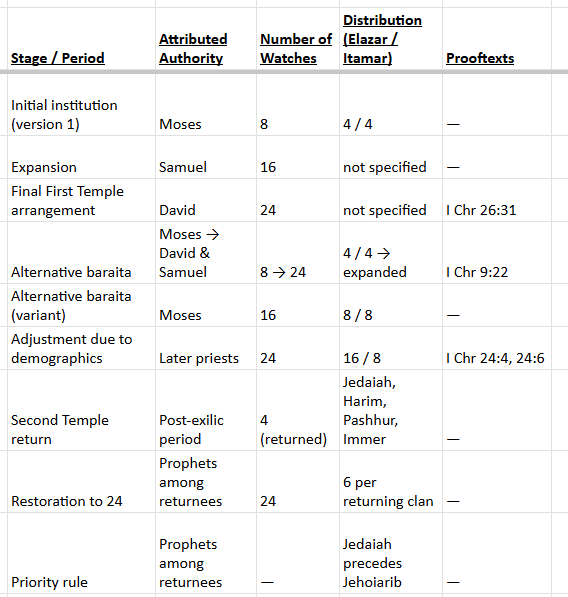
Key Structural Observations:
Mosaic origin: Moses is credited with either 8 or 16 watches.
Davidic institutionalization: David (with or without Samuel) consistently functions as the authority who fixes the system at 24.
Early Second Temple reconstitution: Seen as an attempt to reconstitute the Davidic system, limited by the fact that members of only 4 of the original 24 priestly clans had returned to Jerusalem from Babylonia. (The rest either longer existed—their bloodline ended or no one still identified as part of those clans—or their members didn't return to Jerusalem.)
Rav Ḥama bar Gurya citing Rav - Moses instituted 8 watches (4 Eleazar, 4 Itamar); Samuel raised them to 16; David to 24 - 1 Chronicles 26:31
אמר רב חמא בר גוריא, אמר רב:
משה תיקן להם לישראל שמונה משמרות --
ארבעה מאלעזר
וארבעה מאיתמר.
בא שמואל והעמידן על שש עשרה,
בא דוד והעמידן על עשרים וארבעה,
שנאמר:
״בשנת הארבעים למלכות דויד נדרשו
וימצא בהם גבורי חיל ביעזיר גלעד״.
[...]
Rav Ḥama bar Gurya said that Rav said:
Moses initially instituted (תיקן) for the Jews 8 priestly watches --
4 from the descendants of Elazar
and 4 from the descendants of Itamar.
Samuel came and established4 them as 16,
and David came and established them as 24,
as it is stated, after the watches are listed:
“In the 40th year of the reign of David they were sought for,
and there were found among them mighty men of valor at Jazer of Gilead” (I Chronicles 26:31).
[...]
Baraita - Moses instituted 8 (4 Elazar, 4 Itamar); David and Samuel established 24 - 1 Chronicles 9:22
משה תיקן להם לישראל שמונה משמרות --
ארבעה מאלעזר
וארבעה מאיתמר,
ובא דוד ושמואל והעמידן על עשרים וארבע,
שנאמר: ״המה יסד דויד ושמואל הראה באמונתם״
[...]
a baraita:
Moses instituted for the Jews 8 priestly watches --
4 from Elazar
and 4 from Itamar.
And David and Samuel came and established them as 24,
as it is stated: “Whom David and Samuel the seer ordained in their set office” (I Chronicles 9:22).
[...]
Baraita - Moses instituted 16 (8 Elazar, 8 Itamar); later, with Eleazar more numerous, division set at 24
תניא אידך:
משה תיקן להם לישראל שש עשרה משמרות --
שמונה מאלעזר ושמונה מאיתמר.
וכשרבו בני אלעזר על בני איתמר --
חלקום והעמידום על עשרים וארבע,
It is taught in another baraita:
Moses instituted for the Jews 16 priestly watches --
8 from Elazar
and 8 from Itamar.
And when the descendants of Elazar grew more numerous than the descendants of Itamar --
he divided the descendants of Elazar and established them together with the descendants of Itamar as 24 watches,
Prooftexts - 1 Chronicles 24:4-6
שנאמר:
״וימצאו בני אלעזר רבים לראשי הגברים מן בני איתמר
ויחלקום:
לבני אלעזר --
ראשים לבית אבות ששה עשר
ולבני איתמר --
לבית אבותם שמונה״,
ואומר:
״בית אב אחד אחז לאלעזר
ואחז אחז לאיתמר״.
[...]
as it is stated:
“And there were more chief men found of the sons of Elazar than of the sons of Itamar,
and they were divided thus:
Of the sons of Elazar --
there were 16 heads of fathers’ houses,5
and of the sons of Itamar --
according to their fathers’ houses, 8” (I Chronicles 24:4).
And it says:
“One father’s house taken (אחז) for Elazar,
and proportionately for Itamar” (I Chronicles 24:6).
[...]
Baraita - Only 4 watches returned from Babylonian exile (at the beginning of Second Temple period)--Jedaiah, Harim, Pashhur, Immer
תנו רבנן:
ארבעה משמרות עלו מן הגולה,
ואלו הן:
ידעיה,
חרים,
פשחור,
ואימר.
A baraita states:
Only 4 priestly watches ascended from the Babylonian exile, while the other twenty stayed in Babylonia.
And these are the watches who returned:
The descendants of
Jedaiah,
Harim,
Pashhur,
and Immer.
... prophets divided them by lot into 24
עמדו נביאים שביניהם, וחלקום והעמידום על עשרים וארבעה,
בללום ונתנום בקלפי.
בא ידעיה ונטל חלקו וחלק חבריו שש,
בא חרים ונטל חלקו וחלק חבריו שש,
וכן פשחור,
וכן אימר.
The prophets among those who returned arose and divided them and established them as 24 watches.
They achieved this by writing the names of these new 24 watches on pieces of paper, mixing them up, and putting them in a receptacle6 from which lots were drawn.
A representative from the family of Jedaiah came and drew his portion and the lot of 5 other watches, for a total of 6.
Harim came and also drew his portion and the lot of 5 other watches, a total of 6.
And likewise Pashhur,
and likewise Immer.
Prophets among the returnees - Even if Jehoiarib (former first) returns, Jedaiah retains precedence; Jehoiarib is subordinate
וכן התנו נביאים שביניהם:
שאפילו יהויריב ראש משמרת עולה —
לא ידחה ידעיה ממקומו.
אלא ידעיה עיקר, ויהויריב טפל לו.
And likewise the prophets among them stipulated that
even if the descendants of Jehoiarib, who originally headed the priestly watches, ascended to Eretz Yisrael,
Jedaiah would not be demoted from its place as the first of the watches.
Rather, the watch of Jedaiah would retain precedence, and Jehoiarib would be subordinate to it.
Non-priestly watches
R’ Ya’akov bar Aḥa citing Rav Asi - Non-priestly watches and service sustain “heaven and earth”
וישראל שבאותו משמר מתכנסין בעריהן
וקורין במעשה בראשית.
מנהני מילי?
אמר רבי יעקב בר אחא, אמר רב אסי:
אלמלא מעמדות --
לא נתקיימו שמים וארץ,
§ The Mishnah taught: And the Israelites of that priestly watch assembled in their towns
and read the act of Creation.
The Talmud asks: From where is this matter, that they must read this specific portion, derived?
R’ Ya’akov bar Aḥa said that Rav Asi said:
Were it not for the non-priestly watches and the Temple service --
heaven and earth would not continue to exist,
Prooftext - Dialogue between Abraham and God - Offerings ensure endurance; when no Temple, reciting the order of offerings counts as if offered - Genesis 15:8-9
(See footnote.)7
שנאמר:
״ויאמר:
ה׳ אלהים!
במה אדע כי אירשנה?״,
אמר אברהם:
רבונו של עולם!
שמא ישראל חוטאין לפניך,
אתה עושה להם כדור המבול וכדור הפלגה?
אמר ליה: לאו.
אמר לפניו:
רבונו של עולם!
הודיעני במה אירשנה?
אמר ליה: ״קחה לי עגלה משלשת ועז משלשת וגו׳״.
אמר לפניו:
רבונו של עולם!
תינח בזמן שבית המקדש קיים.
בזמן שאין בית המקדש קיים מה תהא עליהם?
אמר לו:
כבר תקנתי להם סדר קרבנות,
בזמן שקוראין בהן לפני —
מעלה אני עליהם כאילו הקריבום לפני
ואני מוחל להם על כל עונותיהם.
as it is stated:
“And he [=Abraham] said:
YHWH God!
by what shall I know that I shall inherit it?” (Genesis 15:8).
The Talmud explains this verse.
Abraham said:
God!
perhaps the Jews will sin before You.
Will You treat them as You did the generation of the flood and the generation of the dispersion, and destroy them?
God said to him: No.
Abraham said before God:
God!
Tell me, with what shall I inherit it? How can my descendants ensure that You will maintain the world?
God said to Abraham:
“Take for Me a three-year-old heifer, and a three-year-old goat, and a three-year-old ram, and a turtledove, and a young pigeon” (Genesis 15:9).
God was alluding to the offerings, in whose merit the Jewish people, and through them the entire world, will be spared divine punishment.
Abraham said before God:
God!
this works out well when the Temple is standing,
but when the Temple is not standing, what will become of them?
God said to him:
I have already enacted for them the order of offerings.
When they read them before Me --
I will ascribe them credit as though they had sacrificed them before Me
and I will pardon them for all their transgressions.
Since the offerings ensure the continued existence of the Jewish people and the rest of the world, the act of Creation is read in their honor.
Baraita - Members of the priestly watch pray for acceptance of the offering; members of the non-priestly watch fast Mon–Thu with themes mapped to Creation days - Genesis 1
תנו רבנן:
אנשי משמר היו מתפללין על קרבן אחיהם שיתקבל ברצון.
ואנשי מעמד מתכנסין לבית הכנסת, ויושבין ארבע תעניות:
בשני בשבת,
בשלישי,
ברביעי,
ובחמישי.
§ A baraita states:
The members of the priestly watch (משמר) would pray for the offerings of their brothers, the daily offering, that it should be accepted with favor.
And meanwhile, the members of the non-priestly watch (מעמד) remained in their towns and would assemble in the synagogue and observe four fasts:
On Monday of that week,
on Tuesday,
on Wednesday,
and on Thursday.
בשני —
על יורדי הים.
בשלישי —
על הולכי מדברות.
ברביעי —
על אסכרא שלא תיפול על התינוקות.
בחמישי —
על עוברות ומיניקות.
עוברות —
שלא יפילו,
מיניקות —
שיניקו את בניהם.
ובערב שבת לא היו מתענין מפני כבוד השבת,
קל וחומר בשבת עצמה.
On Monday
they would fast for seafarers (יורדי הים), that they should be rescued from danger, as the sea was created on Monday.
On Tuesday
they would fast for those who walk in the desert,8 as the dry land was created on Tuesday.
On Wednesday
they would fast over croup,9 that it should not befall the children, as on the fourth day the bodies of light [me’orot] were created, a textual allusion to curses [me’erot].
On Thursday
they would fast for pregnant women and nursing women, as living beings were first created on this day.
For pregnant women
they would fast that they should not miscarry,
while for nursing women
they would fast that they should be able to nurse their children properly.
And on Friday they would not fast, in deference to Shabbat,
and a fortiori they would not fast on Shabbat itself.
Why No fast on Sunday? R’ Yoḥanan - Due to Christians; R’ Shmuel bar Naḥmani - because it is “day 3” from man’s creation (post-creation weakness); Reish Lakish - due to the Shabbat “additional soul”
באחד בשבת מאי טעמא לא?
אמר רבי יוחנן: מפני הנוצרים.
רבי שמואל בר נחמני אמר: מפני שהוא שלישי ליצירה.
ריש לקיש אמר: מפני נשמה יתירה,
The Talmud asks: What is the reason that they would not fast on Sunday?
R’ Yoḥanan said: Due to the Christians, as Sunday is their day of rest, and they would claim that even the Jews ascribe significance to their special day.
R’ Shmuel bar Naḥmani said: Because it is the third day after the Creation of man, who was created on Friday, and the third day of recovery from a wound or sickness, in this case one’s very creation, is considered the most painful.
Reish Lakish said: They would not fast on Sunday due to the added soul,
Reish Lakish - ‘Va-Yinafash’: The Extra Soul of Shabbat - Exodus 31:17
דאמר ריש לקיש:
נשמה יתירה ניתנה בו באדם בערב שבת,
במוצאי שבת נוטלין אותה ממנו,
שנאמר: ״שבת וינפש״.
כיון ששבת —
וי אבדה נפש.
as Reish Lakish said:
An added soul is given to man on Friday (ערב שבת),
and at the conclusion of Shabbat (מוצאי שבת) it is removed it from him,
as it is stated: “He ceased from work and rested [va-yinafash]” (Exodus 31:17),
which he expounds as follows: Since one has rested and Shabbat has passed —
woe for the soul [vai nefesh]10 that is lost, the added soul that each individual relinquishes.
Consequently, one is still weak from this loss on Sunday.
Appendix - Torah Study as a Substitute for Temple Offerings (Menachot 110a)
Menachot.110a.6-13
Across these passages, the Talmud systematically relocates sacrificial value into Torah study. The moves range from metaphorical substitution, to heavenly continuation, to outright replacement. The tension between equivalence (“as though he sacrificed”) and obviation (“he does not need to sacrifice”) is left unresolved.
R’ Shmuel b. Naḥmani citing R’ Yonatan - Torah Study in Place of Temple Offerings - Malachi 1:11
The Talmud rereads “in every place offerings are presented to My name” as a metaphor. R’ Shmuel bar Naḥmani, citing R’ Yonatan, asserts that Torah scholars who study anywhere are credited as though they offer sacrifices.
״בכל מקום מקטר מגש לשמי״ –
בכל מקום סלקא דעתך?!
אמר רבי שמואל בר נחמני, אמר רבי יונתן:
אלו תלמידי חכמים העוסקים בתורה בכל מקום,
מעלה אני עליהן כאילו מקטירין ומגישין לשמי
§ The verse states: “And in every place offerings are presented to My name, and a pure meal offering; for My name is great among the nations, says YHWH of hosts.”
Does it enter your mind to say that it is permitted to sacrifice offerings in every place?!
Rather, R’ Shmuel bar Naḥmani says that R’ Yonatan says:
These are Torah scholars, who engage in Torah study in every place.
God says: I ascribe them credit as though they burn and present offerings to My name.
“Pure Meal Offering”: one who marries first and then studies Torah - Malachi 1:11
“Pure meal offering” is interpreted as Torah study conducted “in purity.” This purity is defined concretely: one marries first and then studies Torah, thereby avoiding sexual distraction.
״ומנחה טהורה״ –
זה הלומד תורה בטהרה,
נושא אשה ואחר כך לומד תורה.
Furthermore, when the verse states: “And a pure meal offering,”
this is referring to one who studies Torah in purity,
i.e., one who first marries a woman and afterward studies Torah.
Since he is married, he is not disturbed by sinful thoughts.
R’ Yoḥanan - Nocturnal Torah Study as Equivalent to Temple Service - Psalms 134:1
R’ Yoḥanan explains “those who stand in the House of YHWH at night” as scholars who study Torah at night. Since sacrificial service does not occur at night, the verse is reread metaphorically. Nighttime study is equated with Temple labor.
״שיר המעלות
הנה ברכו את ה׳
כל עבדי ה׳
העמדים בבית ה׳ בלילות״,
מאי ״בלילות״?
אמר רבי יוחנן:
אלו תלמידי חכמים העוסקים בתורה בלילה,
מעלה עליהן הכתוב כאילו עסוקים בעבודה.
The Talmud cites another verse that praises Torah scholars.
“A Song of Ascents,
Behold, bless YHWH,
all you servants of YHWH,
who stand in the House of YHWH at night” (Psalms 134:1).
What is the meaning of “at night,” given that the Temple service is not performed at night and all the offerings must be sacrificed during the daytime?
R’ Yoḥanan says:
These are Torah scholars, who engage in Torah study at night.
The verse ascribes them credit as though they engage in the Temple service.
Rav Giddel citing Rav - Eternal Service After the Temple - II Chronicles 2:3
Rav Giddel, citing Rav, resolves the phrase “an ordinance forever” by positing a heavenly altar. Michael, the archangel, continues to sacrifice there after the physical Temple’s destruction.
״לעולם זאת על ישראל״,
אמר רב גידל, אמר רב:
זה מזבח בנוי,
ומיכאל שר הגדול עומד ומקריב עליו קרבן.
§ The Talmud cites another verse that is interpreted in a similar vein.
King Solomon said to Hiram of Tyre: “Behold, I am about to build a house for the name of YHWH my God, to dedicate it to Him, and to burn before Him incense of sweet spices, and for the continual shewbread, and for the burnt offerings morning and evening, on the Shabbatot, and on the New Moons, and on the Festivals of YHWH our God.
This is an ordinance forever for Israel” (II Chronicles 2:3).
Since the Temple was eventually destroyed, what did Solomon mean when he said that it is “an ordinance forever”?
Rav Giddel says that Rav says:
This is referring to the altar that remains built in Heaven even after the earthly Temple was destroyed, and the angel Michael, the great minister,
stands and sacrifices an offering upon it.
R’ Yoḥanan - Studying Temple Law as Rebuilding the Temple - II Chronicles 2:3
R’ Yoḥanan offers an alternative: the verse refers to scholars who study the halakhot of Temple service. Their study is credited as though the Temple were rebuilt in their time.
ורבי יוחנן אמר:
אלו תלמידי חכמים העסוקין בהלכות עבודה,
מעלה עליהם הכתוב כאילו נבנה מקדש בימיהם.
And R’ Yoḥanan says that there is an alternative explanation of the verse:
These are Torah scholars, who engage in studying the halakhot of the Temple service.
The verse ascribes them credit as though the Temple was built in their days and they are serving in it.
Reish Lakish - Torah Study Equivalent to Temple Sacrifice - Leviticus 7:37
Reish Lakish derives from “this is the law of the burnt offering…” that engaging in Torah counts as offering all major sacrifices. (“Torah” is homiletically read expansively.)
אמר ריש לקיש:
מאי דכתיב
״זאת התורה
לעלה
למנחה
ולחטאת
ולאשם״?
כל העוסק בתורה כאילו הקריב
עולה,
מנחה,
חטאת,
ואשם.
§ The Talmud cites similar interpretations of verses: Reish Lakish said:
What is the meaning of that which is written:
“This is the law [torah]
of the burnt offering,
of the meal offering,
and of the sin offering,
and of the guilt offering,
and of the consecration offering, and of the sacrifice of peace offerings” (Leviticus 7:37)?
This teaches that anyone who engages in Torah study is considered as though he sacrificed
a burnt offering,
a meal offering,
a sin offering,
and a guilt offering.
Rava - Torah Study Eliminates the Need for Sacrifice
Rava objects on grammatical grounds and reframes the claim. One who studies Torah does not need to bring offerings at all. (Torah here functions not as symbolic equivalence but as replacement.)
אמר רבא:
האי ״לעלה למנחה״ –
״עלה ומנחה״ מיבעי ליה!
אלא אמר רבא:
כל העוסק בתורה אינו צריך
לא עולה
(ולא חטאת)
ולא מנחה
ולא אשם.
Rava said an objection to this interpretation:
This verse states: “Of the burnt offering, of the meal offering.”
If the interpretation of Reish Lakish is correct, the verse should have written: “Burnt offering and meal offering.”
Rather, Rava says that the correct interpretation of this verse is:
Anyone who engages in Torah study
need not bring a burnt offering,
nor a sin offering,
nor a meal offering,
nor a guilt offering.
R’ Yitzḥak - Studying Specific Sacrificial Laws counts as offering a that specific offering - Leviticus 6:18; 7:1
R’ Yitzḥak narrows the principle: studying the law of a sin offering counts as offering a sin offering; likewise for a guilt offering (i.e. the equivalence is precise and topic-specific rather than global).
אמר רבי יצחק:
מאי דכתיב
״זאת תורת החטאת״
ו״זאת תורת האשם״?
כל העוסק בתורת חטאת –
כאילו הקריב חטאת,
וכל העוסק בתורת אשם –
כאילו הקריב אשם.
R’ Yitzḥak said:
What is the meaning of that which is written:
“This is the law of the sin offering” (Leviticus 6:18),
and: “This is the law of the guilt offering” (Leviticus 7:1)?
These verses teach that anyone who engages in studying the law of the sin offering
is ascribed credit as though he sacrificed a sin offering,
and anyone who engages in studying the law of a guilt offering
is ascribed credit as though he sacrificed a guilt offering.
My hyperlinks point to the Wikipedia entries for priests bearing this name. These figures are the purported ancestors of the eponymous priestly “watches” (משמרות), i.e., clans.
On Second Temple clans named after Biblical figures, see my “The Eight Second Temple Clans in the Schedule of the Wood Offering, Purported Descendants of Families mentioned in Late Biblical Books (Mishnah, Ta’anit 4:5)“.
And compare also my recent “Biblical Figures in the Talmud: Counts, Contexts, and Index“, section “Notes re eponymous ancestors, epithets, and etymologies“.
See Wikipedia, “1 Chronicles 24“:
This chapter records the organization and departments of priests (verses 1–19) and a list of non-priestly Levites (verses 20–31).
The whole chapter belongs to the section focusing on the kingship of David (1 Chronicles 9:35 to 29:30), which from chapter 22 to the end does not have any parallel in 2 Samuel […]
And ibid., section “David organizes the priests (24:1–19)“:
This section details the organization of the priests, the highest branch of the Levites, in a more advanced and systematic manner than anywhere else in the Hebrew Bible […]
Lists of the priestly families also found partially in 1 Chronicles 9:10–13; Nehemiah 10:2–8; Nehemiah 12:1–7; Nehemiah 12:12–21.
And ibid., section “Verse 3“:
Of the two priestly families (1 Chronicles 15:11; 18:16–17; 25:1; cf. 2 Samuel 8:16–18), Zadok represented the family of Eleazar, and Ahimelech represented the family of Ithamar, to help David organizing the priests.
The Chronicler emphasizes the equal treatment of the two groups in the passage (cf 24:31; 26:13) using a procedure of drawing lots (verse 5), also in 1 Chronicles (24:31; 25:8; 26:13) and elsewhere (for examples. Nehemiah 10:35), to indicate God’s hand in the distribution of the personnel.
And see the breakdown of the 24 priestly divisions in a table, ibid., section “List of the priestly divisions“.
מעכבין - literally: “prevents”.
See Jastrow:
to detain, prevent [….]
Esp[ecially] to invalidate an act by an omission; to be indispensable […]
to detain, prevent, delay; to hesitate; to withhold.
העמידן - literally: “stood them up”.
Compare the usage of this idiomatic phrase and literary formula (“[X biblical figure] stood them on [number Y]”) in a very different context, in my “Pt2 Religious Initiative, Prophetic Distillation of Commandments, and the Endurance of Faith in Exile (Makkot 23b-24a)“, section “Distilling the 613 commandments to a few fundamental principles: David - 11, Isaiah - 6, Micah - 3, Isaiah - 2, Amos and/or Ḥabakkuk - 1“.
And see the note there on the literary formula.
בית אב - i.e. clan.
קלפי - kalfei.
The Bible and Talmud frequently attributes the use of lotteries (cleromancy) to the biblical past, likely as a way of assuming impartiality.
Compare these pieces of mine:
“Pt1 The Confession, Punishment, and Atonement of Achan in Joshua 7 (Sanhedrin 43b-44b)“, sections “Joshua’s Supplication and the Refusal of Divine Informing (Joshua 7:11): Supplicatory Language Explained; God’s Refusal to Name the Sinner“ and “Achan Challenges the Validity of Cleromancy (Joshua 7:16–18): Achan is Chosen by Cleromancy; Achan Questions the Evidence; Critique of Cleromancy’s Reliability“ and “Joshua Defends Cleromancy (Numbers 26:55): Joshua Pleads with Achan; Future Implications for undermining apportioning by lot in Eretz Yisrael“, and my notes there.
“Moses’ Wilderness Lotteries and the Prophecy of Eldad and Medad in Numbers 3 and 11 (Sanhedrin 17a)“
On the ritual “reciting the order of offerings (סדר קרבנות)”, compare the Talmud’s statements elsewhere that the daily prayers correspond to the daily Temple animal sacrifices (=tamid). And see the related idea in the appendix at the end of this piece: “Appendix - Torah Study as a Substitute for Temple Offerings (Menachot 110a)“.
And see Hebrew Wikipedia, “פרשת הקורבנות“; and the discussion in Melamed, “סדר קרבנות“.
On the danger of sea and desert travel in rituals, compare my “Gratitude After Adversity: The Obligation of Thanksgiving for Seafarers, Desert Travelers, the Recovered, and the Freed, Rooted in Psalm 107 (Berakhot 54b)“.
אסכרא .
On this disease, see my “Pt2 Bodily Afflictions and Illnesses as Signs of Sin: Wounds, Edema (Hidrokan), and Diphtheria (Askara) (Shabbat 33a-b)“, section “Diphtheria (Askara) is divine punishment for neglecting to separate tithes (ma’aser) or due to speaking Lashon Hara (Psalms 63:12)“, and the extended note there.
וי אבדה נפש.
Compare the similar homiletic wordplay on this biblical prefix construct, in my “ ‘And it Came to Pass’: The Ominous Implication of “Va-Yehi” in Biblical Narratives (Megillah 10b)“.
And see the initial note there, breaking it down.