

What are the longest chapters and sections in the Jerusalem Talmud and Maimonides’ Mishneh Torah? I ran every chapter of both works through ChavrutAI’s API from Sefaria, and counted the Hebrew words. Here’s what I found.1
Outline
The Jerusalem Talmud (Yerushalmi)
Longest Chapter: Kiddushin, Chapter 1
The Runners-Up
Longest Individual Section: Chagigah 2:10
Maimonides’ Mishneh Torah (Rambam)
Longest Chapter: Tefillin, Mezuzah and the Torah Scroll, Chapter 8
The Runners-Up
Longest Individual Halakhah: Tefillin 8:4
Appendix 1 - Yerushalmi
Top 20 Longest Chapters — Yerushalmi
Appendix 2 - Mishneh Torah
Top 10 Longest Chapters — Mishneh Torah
Top 10 Longest Sections (Halakhot) — Mishneh Torah
Bottom 10 Shortest Sections (Halakhot) — Mishneh Torah
Appendix 3 - Technical: Methodology and Full Results
Data Collection
Word Counting
Appendix 4 - Excerpt of Maimonides’ List of ‘Petuchot’ and ‘Setumot’ in the Pentateuch - Formatted As Numbered Lists (Mishneh Torah, Laws of Tefillin Mezuzah and Torah Scroll 8:4a)
Genesis
Parashat Bereshit (Genesis 1:1–6:8)
Parashat Noach (Genesis 6:9–11:32)
Parashat Chayyei Sarah (Genesis 23:1–25:18)
Parashat Vayishlach (Genesis 32:4–36:43)
Exodus
Parashat Vezot Haberakhah (Deuteronomy 33:1–34:12)
Song of Haazinu
The Jerusalem Talmud (Yerushalmi)
The Yerushalmi contains roughly 812,000 Hebrew words across 297 chapters and 39 tractates. The average chapter runs about 2,735 words, but the range is enormous.2
Longest Chapter: Kiddushin, Chapter 1
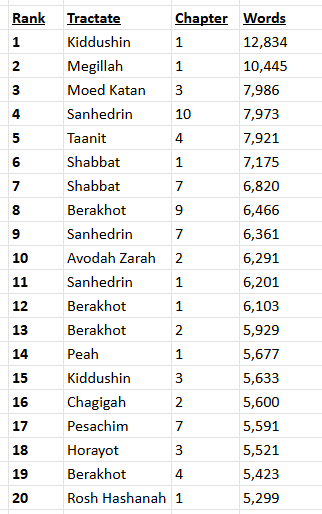
At 12,834 words, the first chapter of Kiddushin towers over everything else in the Yerushalmi. That’s nearly double the next-longest chapter. Kiddushin 1 covers the foundational methods of betrothal and acquisition, topics that branch into long legal discussions touching property law, personal status, and the mechanics of kinyan (formal acquisition).3
The Runners-Up
Megillah Chapter 1 (10,445 words) and Moed Katan Chapter 3 (7,986 words) round out the top three. Several tractates place multiple chapters in the top 20: Berakhot contributes four chapters (1, 2, 4, and 9), Sanhedrin three (1, 7, and 10), and Shabbat two (1 and 7).
Longest Individual Section: Chagigah 2:10
When we zoom in from chapters to individual segments, the picture shifts. The longest single section in the Yerushalmi is Chagigah Chapter 2, segment 10, at 817 words. Chagigah 2 is famous for its esoteric content (Maaseh Bereishit and Ma’aseh Merkavah) as well the story of Aher; this particular segment contains anecdotes of Aher and R’ Meir.4
The next-longest segments come from Taanit Chapter 4 (540 words, on the history of fast days) and another passage from Chagigah 2 (535 words).
Maimonides’ Mishneh Torah (Rambam)
The Mishneh Torah is a very different kind of text. Maimonides wrote it as a systematic legal code: organized, precise, and deliberately concise.5 The entire work spans roughly 764,500 Hebrew words across 1,001 chapters and 83 sections of Hilchot (legal topics), grouped into 14 books.
The average chapter is just 764 words, less than a third of the Yerushalmi average. That brevity is by design; Maimonides prized clarity and economy of language.
Longest Chapter: Tefillin, Mezuzah and the Torah Scroll, Chapter 8
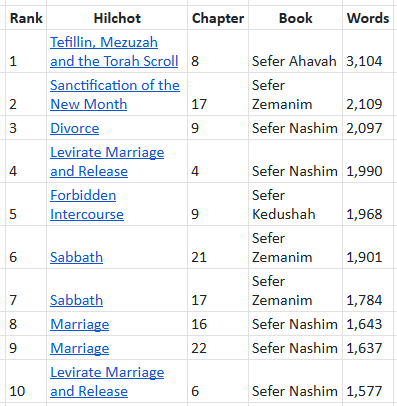
The longest chapter in the entire Mishneh Torah is Hilchot Tefillin, Mezuzah and the Torah Scroll, Chapter 8, at 3,104 words. This chapter is dominated by a single extraordinary halakhah: halakhah 4, which alone contains 2,911 words.6
The Runners-Up
After that outlier, the next-longest chapters are more modest. Sanctification of the New Month Chapter 17 (2,109 words) deals with the complex astronomical calculations for the Jewish calendar. Divorce Chapter 9 (2,097 words) covers the detailed formulations and procedures for writing a get. These are chapters where Maimonides had to work through intricate procedural or technical material that resisted compression.
Sabbath law places three chapters in the top 20 (17, 21, and 22), reflecting the density of Shabbat regulations. Marriage and Forbidden Intercourse also appear repeatedly.
Longest Individual Halakhah: Tefillin 8:4
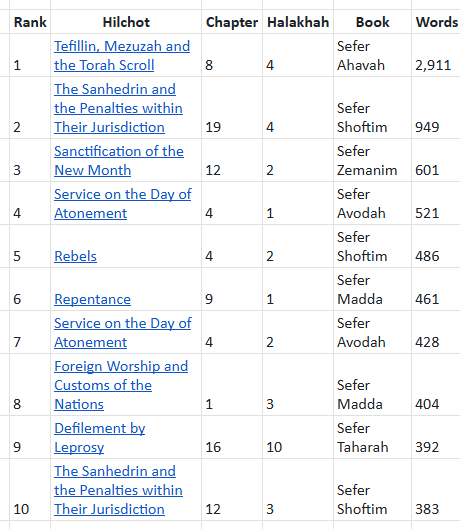
The longest individual halakhah is, unsurprisingly, the same passage that makes Chapter 8 the longest chapter: Tefillin 8:4 at 2,911 words. The next-longest halakhah — Sanhedrin 19:4 at 949 words7 — is less than a third its size. After that, values drop quickly: Sanctification of the New Month 12:2 (601 words), Service on the Day of Atonement 4:1 (521 words), and so on. The overwhelming majority of Rambam’s halakhot are under 200 words.
Appendix 1 - Yerushalmi
Top 20 Longest Chapters — Yerushalmi
Appendix 2 - Mishneh Torah
Top 10 Longest Chapters — Mishneh Torah
Top 10 Longest Sections (Halakhot) — Mishneh Torah
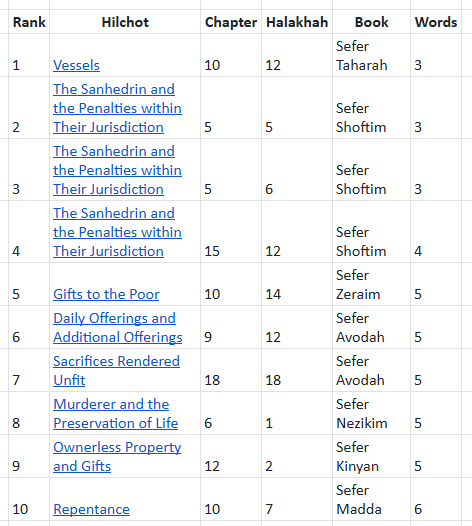
Bottom 10 Shortest Sections (Halakhot) — Mishneh Torah
Appendix 3 - Technical: Methodology and Full Results
Data Collection
Two TypeScript scripts queried every chapter of both works through ChavrutAI’s REST API:
Yerushalmi: GET
/api/yerushalmi/:tractate/:chapter— 297 chapters across 39 tractates. Each API call proxies to Sefaria’s API, fetching all halakhot within a chapter in parallel, then returning processedhebrewSections[].Rambam: GET
/api/rambam/:hilchot/:chapter— 1,001 chapters across 83 Hilchot sections. Each API call fetches a single bilingual chapter from Sefaria, returning processedhebrewSections[].
Word Counting
Hebrew word count was computed by:
Stripping all HTML tags from each section string
Replacing HTML entities with spaces
Matching all sequences of Hebrew Unicode characters (ranges U+0590–U+05FF, U+FB1D–U+FB4F)
Counting matches
This counts actual Hebrew words, excluding punctuation, numerals, and any embedded Latin-script text.
Appendix 4 - Excerpt of Maimonides’ List of ‘Petuchot’ and ‘Setumot’ in the Pentateuch - Formatted As Numbered Lists (Mishneh Torah, Laws of Tefillin Mezuzah and Torah Scroll 8:4a)
See Wikipedia, “Parashah”:
The division of parashot found in the modern-day Torah scrolls of all Jewish communities is based upon the systematic list provided by Maimonides in Mishneh Torah, Laws of Tefillin, Mezuzah and Torah Scrolls, chapter 8.
Maimonides based his division of the parashot for the Torah on the Aleppo Codex.
The Passage
In Sefaria: Mishneh_Torah%2C_Tefillin%2C_Mezuzah_and_the_Torah_Scroll.8.4
In ChavrutAI: Tefillin_Mezuzah_and_the_Torah_Scroll/8#4
ולפי שראיתי שבוש גדול בכל הספרים שראיתי בדברים אלו.
וכן בעלי המסרת
שכותבין ומחברין להודיע הפתוחות והסתומות
נחלקים בדברים אלו במחלקת הספרים שסומכין עליהם
ראיתי לכתב הנה כל פרשיות התורה הסתומות והפתוחות
וצורת השירות
כדי לתקן עליהם כל הספרים ולהגיה מהם.
Since I have seen great confusion8 about these matters in all the [Torah] scrolls (ספרים) I have seen,
and similarly, the masters of the tradition9
who have written down and composed [texts] to make it known [which passages are] p’tuchot and [which are] s’tumot10
are divided with regard to the [Torah] scrolls on which to rely,
I saw fit to write down the entire list of all the passages in the Torah (=Pentateuch) that are s’tumot and p’tuchot,
and [also] the form of (צורת) the songs (שירות).
In this manner, all the scrolls can be corrected and checked (להגיה) against these [principles].
וספר שסמכנו עליו בדברים אלו הוא הספר הידוע במצרים
שהוא כולל ארבעה ועשרים ספרים
שהיה בירושלים מכמה שנים להגיה ממנו הספרים
ועליו היו הכל סומכין לפי שהגיהו בן אשר
ודקדק בו שנים הרבה והגיהו פעמים רבות כמו שהעתיקו
ועליו סמכתי בספר התורה שכתבתי כהלכתו
The sefer11 on which I relied on for [clarification of] these matters was a book12 renowned in Egypt,
which includes all the 24 books [of the Bible].
It was kept in Jerusalem for many years so that scrolls could be checked from it.
Everyone relies upon it because it was corrected (הגיהו) by ben Asher,
who spent many years writing it precisely (דקדק), and checked13 it many times.
I relied [on this book] when I wrote a Torah scroll according to law.
Genesis
(See footnote).14
Parashat Bereshit (Genesis 1:1–6:8)
ספר בראשית -
יהי רקיע.
יקוו המים.
יהי מארת.
ישרצו המים.
תוצא הארץ.
ויכלו.
אלה תולדות השמים.
כלן פתוחות.
והן שבע פרשיות.
אל האשה אמר.
ולאדם אמר.
שתיהן סתומות.
ויאמר יי׳ אלהים
פתוחה.
והאדם ידע.
זה ספר.
ויחי שת.
ויחי אנוש.
ויחי קינן.
ויחי מהללאל.
ויחי ירד.
ויחי חנוך.
ויחי מתושלח.
ויחי למך.
ויהי נח.
אחת עשרה פרשיות אלו כלן סתומות
וירא יי׳.
אלה תולדת נח.
שתיהן פתוחות.
Parashat Noach (Genesis 6:9–11:32)
ויאמר אלהים לנח.
וידבר אלהים אל נח.
ויאמר אלהים אל נח.
שלשתן סתומות.
ויהיו בני נח.
ואלה תולדת בני נח.
שתיהן פתוחות.
וכנען ילד.
ולשם ילד.
שתיהן סתומות.
ויהי כל הארץ שפה אחת.
אלה תולדת שם.
שתיהן פתוחות.
וארפכשד חי.
ושלח חי.
ויחי עבר.
ויחי פלג.
ויחי רעו.
ויחי שרוג.
ויחי נחור.
ויחי תרח.
כלן סתומות השמונה פרשיות.
ויאמר יי׳ אל אברם.
ויהי רעב.
ויהי בימי אמרפל.
שלשתן פתוחות.
אחר הדברים.
ושרי אשת אברם.
ויהי אברם.
ויאמר אלהים אל אברהם.
ארבעתן סתומות.
וירא אליו
פתוחה.
ויסע משם.
ויי׳ פקד את שרה.
שתיהן סתומות.
ויהי בעת ההוא.
ויהי אחר.
ויהי אחרי הדברים.
ויהיו חיי שרה.
ארבעתן פתוחות.
Parashat Chayyei Sarah (Genesis 23:1–25:18)
ואברהם זקן
סתומה.
ויסף אברהם.
ואלה תלדת ישמעאל.
ואלה תולדת יצחק.
ויהי רעב.
ארבעתן פתוחות.
ויהי עשו.
ויהי כי זקן יצחק.
ויצא יעקב.
שלשתן סתומות.
Parashat Vayishlach (Genesis 32:4–36:43)
וישלח יעקב
פתוחה.
ויבא יעקב.
ותצא דינה.
שתיהן סתומות.
ויאמר אלהים.
וירא אלהים.
ויהיו בני יעקב.
ואלה תלדות עשו.
ארבעתן פתוחות.
אלה בני שעיר
סתומה.
ואלה המלכים.
וישב יעקב.
ויהי בעת.
שלשתן פתוחות.
ויוסף הורד מצרימה
סתומה.
ויהי אחר הדברים.
ויהי מקץ.
שתיהן פתוחות.
ויגש אליו.
ואלה שמות.
ואת יהודה.
שלשתן סתומות.
ויהי אחרי הדברים.
ויקרא יעקב.
שמעון ולוי.
יהודה.
זבולן.
יששכר.
כלן פתוחות.
והן שש.
דן.
גד.
מאשר.
נפתלי.
בן פרת יוסף.
חמשתן סתומות.
בנימין
פתוחה.
מנין הפתוחות: שלש וארבעים.
והסתומות: שמונה וארבעים.
הכל: תשעים ואחת
Exodus
ספר ואלה שמות -
[...]
Parashat Ve-zot Ha-berakhah (Deuteronomy 33:1–34:12)
לבנימן.
וליוסף.
ולזבולן.
ולגד.
ולדן.
ולאשר.
ויעל משה.
כלן סתומות, והן שבע.
מנין הפתוחות של ספר זה: שלשים וארבע.
והסתומות: מאה ועשרים וארבע.
הכל: מאה וחמשים ושמונה.
מנין הפתוחות של כל התורה: מאתים ותשעים.
ומנין הסתומות: שלש מאות ושבעים ותשע.
הכל: שש מאות וששים ותשע
Song of Haazinu
צורת שירת האזינו -
כל שיטה ושיטה יש באמצע רוח אחד כצורת הפרשה הסתומה.
ונמצא כל שיטה חלוקה לשתים.
וכותבין אותה בשבעים שיטות.
ואלו הן התבות שבראש כל שיטה ושיטה:
האזינו.
יערף.
כשעירם.
כי.
הצור.
אל.
שחת.
הליי׳.
הלוא.
זכר.
שאל.
בהנחל.
יצב.
כי.
ימצאהו.
יסבבנהו.
כנשר.
יפרש.
יי׳.
ירכבהו.
וינקהו.
חמאת.
בני.
ודם.
שמנת.
וינבל.
בתועבת.
אלהים.
לא.
ותשכח.
מכעס.
אראה.
בנים.
כעסוני.
בגוי.
ותיקד.
ותלהט.
חצי.
וקטב.
עם.
ומחדרים.
יונק.
אשביתה.
פן.
ולא.
ואין.
יבינו.
ושנים.
ויי׳.
ואיבינו.
ומשדמת.
אשכלת.
וראש.
חתום.
לעת.
וחש.
ועל.
ואפס.
צור.
ישתו.
יהי.
ואין.
מחצתי.
כי.
אם.
אשיב.
אשכיר.
מדם.
הרנינו.
ונקם.
כל אלו התבות שבראש
ואלו הן התבות שבראש כל חצי שיטה אחרונה שהן באמצע הדף:
ותשמע.
תזל.
וכרביבים.
הבו.
כי.
צדיק.
דור.
עם.
הוא.
בינו.
זקניך.
בהפרידו.
למספר.
יעקב.
ובתהו.
יצרנהו.
על.
ישאהו.
ואין.
ויאכל.
ושמן.
עם.
עם.
וישמן.
ויטש.
יקנאהו.
יזבחו.
חדשים.
צור.
וירא.
ויאמר.
כי.
הם.
ואני.
כי.
ותאכל.
אספה.
מזי.
ושן.
מחוץ.
גם.
אמרתי.
לולי.
פן.
כי.
לו.
איכה.
אם.
כי.
כי.
ענבמו.
חמת.
הלא.
לי.
כי.
כי.
כי.
ואמר.
אשר.
יקומו.
ראו.
אני.
ואין.
ואמרתי.
ותאחז.
ולמשנאי.
וחרבי.
מראש.
כי.
וכפר
Data collected via ChavrutAI’s Yerushalmi and Rambam APIs, which source Hebrew text from the Sefaria database. Word counts are based on Hebrew word tokens after stripping HTML markup.
See my recent similar analysis and writeup for “halachot” in Talmud Yerushalmi: “What Are the Longest and Shortest ‘Halachot’ in the Talmud Yerushalmi?” (Apr 19, 2026). (as there, in general, this is part of my ongoing work on improving ChavrutAI’s Mishneh Torah reader, which recently went live: https://chavrutai.com/rambam.)
The same qualification that noted there in a footnote re “halachot” applies to Mishneh Torah “halachot” (sections) as well: the sections in the printed editions are often not original to Maimonides himself, but are rather later printers. (For Maimonides’ own splittings, see the Frankel ed. of Mishneh Torah.)
Therefore, this analysis is primarily for the later transmission of the work, as well as a rough heuristic for finding unusual passages. (See especially my piece on using high word count of a Talmud page, to identify aggadic passages: “A Computational Approach to Identifying and Mapping Aggadic Content in the Talmud: Word Count as a Robust Proxy Indicator“. )
The same is even more true of “sections” in Talmud Yerushalmi, which as far as I know, are quite a recent innovation. Section in Talmud Bavli stem from the Steinsaltz edition; presumably, sections in Talmud Yerushalmi stem from the Guggenheimer edition.
Note also: I’m analyzing Yerushalmi and Mishneh Torah together in this piece simply for convenience, since I recently added both of them to ChavrutAI, and I haven’t yet analyzed their word counts. They aren’t inherently especially structurally similar. If anything, Mishnah and Mishneh Torah are the more structurally similar.
The relevant scripts and outputs are at the ChavrutAI Github repo: /talmud-data/wordcount-analysis
Compare my chapter word counts for Talmud Bavli, as well as my merged Mishnah and Bavli word counts, at my Academia page:
“Bavli By the Numbers: Word Counts of All Chapters in Talmud Bavli“
“Merged Mishnah and Bavli Chapter Wordcounts” (see my extended abstract there, with analysis)
I may do a merged Bavli and Yerushalmi chapter words counts, to see if they correlate, as opposed to Bavli and Mishnah; it seems that they do.
See my discussion of the Mishnah passages here: “‘Tractate Kinyanim’: Modes of Acquiring People, Livestock, Land and More (Mishnah Kiddushin 1:1-6)“.
I plan to discuss this Yerushalmi passage soon.
In this regard, it’s structurally closer to the Mishnah than to the Talmud, as I mentioned in the earlier footnote.
I present extended excerpts of this halakha in an appendix at the end of this piece.
This halakha consists of a long list of 168 items of negative commandments punished by the court with flagellation.
Note that in the printed editions, these and other lists are explicitly numbered, with Maimonides providing a mnemonic (”sign”) at the end.
שבוש - or: “mistake”.
בעלי המסרת - “masters of the massoret”, i.e. the Masoretes.
See Wikipedia, “Masoretes“:
The Masoretes (Hebrew: בַּעֲלֵי הַמָּסוֹרָה, romanized: Baʿălēy Hammāsōrā, lit. ‘Masters of the Tradition’) were groups of Jewish scribe-scholars who worked from around the end of the 5th through 10th centuries CE, based primarily in the Jewish centers of the Levant (e.g., Tiberias and Jerusalem) and Mesopotamia (e.g., Sura and Nehardea).
Each group compiled a system of pronunciation and grammatical guides in the form of diacritical notes (niqqud) on the external form of the text of the Hebrew Bible (the Tanakh) in an attempt to standardize its pronunciation, paragraph and verse divisions, and cantillation for the worldwide Jewish community.
הפתוחות והסתומות - literally: “the open and the closed”.
See next note.
ספר - sefer. This is the same general word used before to refer to a Torah scroll; but assuming that this is referring to the Aleppo codex, in this case, the translation should be “book, codex”.
הגיהו - this word has the semantic range of “checked, corrected”, as in the previous line.
On this word in the Talmudic literature, see Jastrow (modernized), entry “נָגַהּ”, section “Hif’il”:
to look over; to revise a manuscript, to correct, restore (when faded).
Berakhot 13a:24 - בקורא להַגִּיהַּ when he reads for the sake of revising.
Yerushalmi Shabbat 7, 10b bottom of page (in a misplaced passage) -אם להגיה כדי להגיה וכ׳ (not להגות) if (he carries ink) for the purpose of correcting, (he is guilty when carrying) enough to correct one letter.
Ketubot 106a:9 - מַגִּיהֵי ספרים וכ׳ the official revisers of Biblical manuscripts;
Yerushalmi Shekalim 4, 48a top - מַגִּיהֵי ספר העזרה (Bavli printed edition variant: עזרא, see Rabbinowicz, ‘Dikdukei Sofrim’ there, note) the revisers of the Temple manuscript.
Mishnah Moed Katan 3:4 (=Moed Katan 18b:24) - אין מַגִּיהִין אות אחת אפי׳ בספרי העזרה Manuscript Munich: (ed. בספר עזרא, see Rabbinowicz, ‘Dikdukei Sofrim’ there, note) we dare not (during the festive week) correct (restore) one letter even in the Temple books (printed edition: “in the manuscript named after Ezra”).
Mishnah Megillah 2:2 - היה … ומַגִּיהָהּ if he recited the Book of Esther while he was writing or teaching or correcting it; and frequently.
Part. pass. מוּגָּהּ revised, correct.
Pesachim 112a - כשאתה … למדהו בספר מוגה - when you teach your son, teach him from a corrected book.
Ketubot 19b:4 - ספר שאינו מוגה - an unrevised Bible manuscript.
See Wikipedia, ibid., section “Torah”, sub-section “Genesis”.
My sub-section headers are based on those in that entry. Note that sometimes the header isn’t precise, as it would split Maimonides’ list. Eg, “Parashat Noach (Genesis 6:9–11:32)”, which really starts at Maimonides’ second list item “אלה תולדת נח”.
Note that Maimonides’ lists are all incipits; meaning, the initial word(s) of the section. Maimonides’ literary formula is listing series of incipits, as follows:
incipit list
collective petuchah/setumah label
numerical total
So, for example:
אל האשה אמר.
ולאדם אמר.
שתיהן סתומות.
This means: the sections beginning with those two incipits are both setumot.
When there are longer runs, the formula becomes: series of incipits → collective summary → count.
For example:
ויחי שת.
ויחי אנוש. ...
ויהי נח.
אחת עשרה פרשיות אלו כלן סתומות.
Or:
“ארפכשד חי. ושלח חי. ... ויחי תרח. כלן סתומות השמונה פרשיות.
At the end of each book, as well as the end of the Torah, Maimonides provides totals of petuchot, setumot, and their combined total (petuchot + setumot).